President Lee Jae Myung's Statement on "No Realistic Possibility for Additional Nuclear Power Plants" Sparks Controversy
Minister Kim Sung Hwan Calls for "Public Discussion on New Nuclear Power Plants"
Korea Hydro & Nuclear Power Expected to Effecti
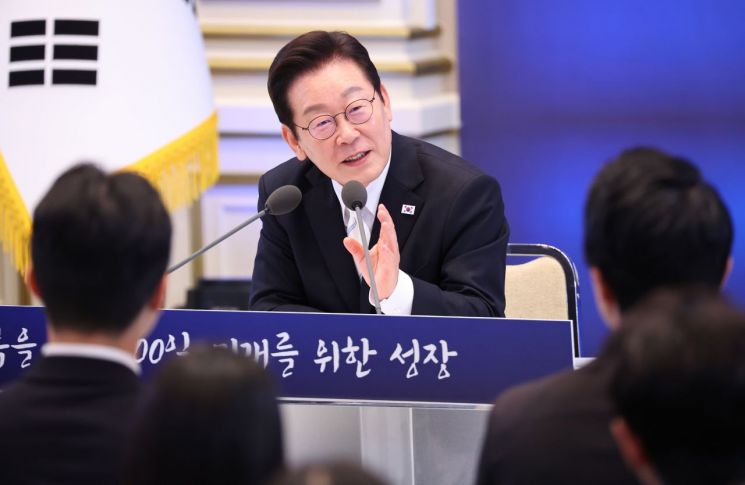 President Lee Jae Myung is speaking at the 100-day inauguration press conference titled "100 Days for Recovery, Growth for the Future" held at the Blue House State Guesthouse on the 11th. 2025.9.11 Yonhap News Agency
Following Kim Sung Hwan, the current Minister of Environment and a strong candidate for the newly established Ministry of Climate, Energy, and Environment, President Lee Jae Myung has expressed a negative stance on new nuclear power plant construction, leaving the nuclear industry visibly unsettled. Some are voicing concerns that this could signal a second phase of nuclear phase-out. The process of selecting sites for new nuclear plants, which was scheduled to begin in the second half of this year, is effectively being put on hold.
At the 100-day inauguration press conference held at the Blue House State Guesthouse on September 11, President Lee stated, "It takes 15 years to build a nuclear power plant, so we need to significantly scale up renewable energy," adding, "There is no practical feasibility for starting additional nuclear power plant construction."
President Lee further explained, "We need a massive amount of electricity right now, and the fastest way to supply it is through renewable energy sources like solar and wind," emphasizing, "We must lay the infrastructure and power grid to significantly expand the renewable energy industry." He added, "Additional nuclear power plant construction is only possible if there are available sites and safety is guaranteed, but in my view, it is not realistic."
President Lee's remarks came after Minister Kim Sung Hwan stated on September 9 that "a national debate is needed on new nuclear power plants."
At that time, Minister Kim commented on the construction of two large nuclear power plants and one small modular reactor (SMR) included in the 11th Basic Plan for Long-term Electricity Supply and Demand, saying, "The 11th Basic Plan is the current government policy and should be respected," but also noted, "Even if we continue to extend the lifespan of existing nuclear plants with safety as a priority, there is an opinion that whether to build new nuclear plants should be decided after hearing public opinion." He further stated, "The final decision on new nuclear power plants will be included in the 12th Basic Plan."
The nuclear industry interpreted these remarks as an intention to reconsider the construction of two new nuclear plants after a process of public debate. In a phone call with our publication, Minister Kim said, "This was a general statement, and the policy direction on nuclear power will be decided after discussions between the relevant ministries and the Presidential Office following the establishment of the Ministry of Climate, Energy, and Environment," declining to elaborate further.
An energy industry official commented, "It seems that Minister Kim and the Presidential Office have already reached a consensus on new nuclear power plants."
In fact, during the press conference, President Lee stated, "It would take at least 10 years to operate new nuclear plants, so how can that be considered a policy? Minister Kim's point is that we should move toward large-scale construction of renewable energy, not nuclear plants," adding, "We must use the existing nuclear plants, and the energy mix policy remains unchanged," thus supporting Minister Kim's remarks.
Korea Hydro & Nuclear Power, the main entity responsible for new nuclear plant construction, appeared visibly unsettled. The company has closely monitored changes in nuclear policy since the new administration took office, but was particularly taken aback by the President's remarks on this day.
A senior executive at Korea Hydro & Nuclear Power said, "We had completed all preparations for the site selection process for new nuclear plants," adding, "We plan to discuss our next steps internally."
After the 11th Basic Plan was finalized in February this year, Korea Hydro & Nuclear Power began the process of selecting sites for new nuclear plants. The original plan was to start accepting applications in the second half of the year and select candidate sites by the end of the year. However, the application process is now indefinitely postponed. The 12th Basic Plan is expected to be finalized only at the end of next year, and if a public debate is held, the outcome is unpredictable.
Before officially launching the site application process, Korea Hydro & Nuclear Power had been sounding out potential local governments. Within the nuclear industry, the Yeonggwang region, where the Cheonji nuclear project was previously canceled due to the nuclear phase-out policy of the Moon Jae In administration, has been mentioned as a candidate site.
Employees at Korea Hydro & Nuclear Power are also feeling uneasy. Shim Min Seop, Director of External Cooperation at the labor union, said, "Minister Kim Sung Hwan stated during his confirmation hearing that he is not a proponent of nuclear phase-out, but the current situation seems to reveal his hidden intentions," adding, "Saying that the two large nuclear plants in the 11th Basic Plan will be reconsidered through public debate and reflected in the 12th Basic Plan can only be interpreted as effectively scrapping them."
Academics in the energy sector point out that alternatives must be prepared if new nuclear plants are to be reconsidered.
Jung Dong Wook, professor at the Department of Energy Systems Engineering at Chung Ang University and chair of the 11th Basic Plan committee, said, "Nuclear plant construction is a long-term project, so in the short term, focusing on expanding renewable energy is appropriate," adding, "It is important to design an energy mix suitable for short-, medium-, and long-term periods."
Yoo Seung Hoon, professor at the Department of Future Energy Convergence at Seoul National University of Science and Technology, said, "Given that our country is electrically isolated from external grids, relying solely on highly variable renewables like solar and wind requires alternatives," adding, "It is true that nuclear plant construction takes a long time, but we must also prepare for future generations."
© The Asia Business Daily(www.asiae.co.kr). All rights reserved.

















