Yeongdeok, North Gyeongsang Province on the East Coast
Holds Policy Research Report Meeting for the Green Energy Project
On September 11, Yeongdeok County in North Gyeongsang Province announced its top 10 future visions for the renewable energy sector at the policy research report meeting for the Yeongdeok Green Energy Project.
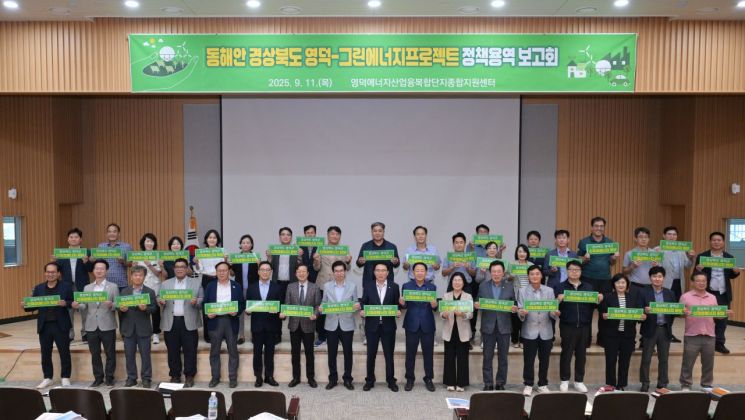 Gyeongbuk Yeongdeok-gun Announces Top 10 Future Visions for Renewable Energy. Provided by Yeongdeok-gun
This project, launched in March, aims to rebuild the livelihoods of areas in Yeongdeok County affected by massive wildfires, establish a future vision for the county's renewable energy sector, and institutionalize, through local ordinances, both resident participation and profit-sharing in wind and solar power projects, which are referred to as "wind and sunlight pensions."
The report meeting was held at the Gyeongbuk Energy Industry Convergence Complex Support Center, which was completed in the first half of this year. The event was attended by the Yeongdeok County Council, which represents local residents, the Gyeongbuk Provincial Energy Policy Division, and all senior officials of Yeongdeok County.
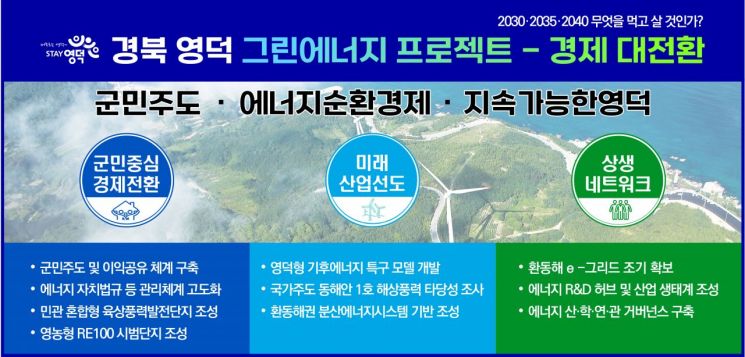
The main agenda focused on the goals of "resident-led initiatives, an energy circular economy, and sustainable development for Yeongdeok." Key topics included the formation of a resident-led public-private council, the development of a climate energy special zone model, the construction of onshore and offshore wind farms, the creation of a pilot agrivoltaic RE100 site, the establishment of a distributed energy system based on hydrogen and carbon, and the founding of the Yeongdeok Climate Energy Center, along with the announcement of the top 10 future visions for the renewable energy sector and active discussions among participants.
The scale of the development projects includes the construction of a 200MW mixed public-private wind power complex in Jipum-myeon, an area affected by wildfires; a feasibility study for a 1.5GW fixed and floating offshore wind power complex; the creation of a megawatt-scale agrivoltaic pilot site; and the establishment of a wind resource measurement verification center and an offshore wind demonstration complex. The total project cost exceeds 10 trillion won.
If the construction of onshore and offshore wind farms and the establishment of a renewable energy R&D industrial ecosystem, including a wind resource measurement verification center, are realized, it is expected that over 2 trillion won in government funds-such as special support grants, basic support grants, and REC multipliers known as wind and sunlight pensions-will flow into the region. Additionally, attracting businesses, creating jobs, and expanding construction are anticipated to have significant positive effects on the local economy.
The atmosphere at the event was optimistic, with participants agreeing that the project is generally feasible, provided the plans are clarified and resident opinions are well integrated. This consensus was based on factors such as the global RE100 trend, the government's policy direction, Yeongdeok's strong wind resources, the location of the Gyeongbuk Energy Industry Convergence Complex in Yeongdeok, and the overall conditions of the East Sea Rim region. The confidence of Yeongdeok County officials was also evident.
The subsequent report on the design of the Yeongdeok-type ordinance for resident profit-sharing in development projects explained the Yeongdeok model of wind and sunlight pensions, in which residents living near power plants participate in projects and share in the profits in accordance with the Renewable Energy Act. Various opinions were presented regarding specific methods and ratios for investment and dividends, as well as strategies for investment protection and risk management.
On the same day, Yeongdeok County announced plans to enhance the expertise of its green energy project by signing a win-win partnership MOU this year with Pohang Technopark and Root Energy, the organizations responsible for the research report meeting.
Pohang Technopark, the only technopark operated by a basic local government in Korea, has made significant contributions to R&D development, including the hydrogen economy in the East Sea Rim region, since its establishment in 2000. Root Energy, in particular, has been recognized as a specialized company for resident participation and profit-sharing, having successfully implemented wind and sunlight funds in multiple municipalities nationwide, including the Taebaek Gadeoksan Wind Power and Jeju Hallim Offshore Wind Power projects, which serve as public-led wind power models in Korea.
Alongside the report and presentations, Professor Jeong Jae-hak of Yeungnam University delivered a special lecture on agrivoltaics. According to Yeongdeok County officials, the county will accelerate the creation of a pilot agrivoltaic site as part of efforts to increase resident income and transform the local industry, in line with the government's policy to expand solar power and recent legislative changes.
Kim Seong-ho, chairman of the Yeongdeok County Council, who attended the report and presentation, stated, "After the massive wildfire in Yeongdeok last March, there were serious concerns about the region's future. However, I commend Yeongdeok County for its dedication to establishing a renewable energy vision as a new growth engine and income source through communication with residents and the county council. We will actively cooperate in enacting the necessary ordinances to implement the project."
Currently, Yeongdeok County faces multiple challenges, including not only the reconstruction of areas damaged by massive wildfires, but also aging demographics, population decline, and the risk of regional extinction. Due to the characteristics of rural counties, there are still insufficient jobs, medical issues such as limited access to obstetrics and pediatrics, and the problem of families having to leave their hometowns for their children's education. These challenges are why there are high expectations for the results of this new renewable energy project, which takes a different approach from previous regional development policies.
On the same day, County Governor Kim Gwang-yeol stated, "Above all, our residents must be able to live well and prosper. We will communicate extensively with residents to develop a systematic project plan. Through the success of the Green Energy Project, we will address local issues such as improving living conditions, rebuild areas damaged by the massive Yeongdeok wildfire, and do our utmost to create new sources of income for Yeongdeok in the global RE100 era for the next 50 and 100 years."
Since the massive wildfire in Changpo-ri in the 2000s, Yeongdeok County has built the nation's first commercial wind power plant, transforming the devastated area into one of Korea's top sunrise and wind power tourism destinations. Currently, the county operates five privately funded wind power plants in Yeongdeok-eup and Changsu-myeon, was designated as a Clean Energy Special Zone in 2007, was selected as the Gyeongbuk Energy Industry Convergence Complex by the Ministry of Trade, Industry and Energy in 2021, completed the Gyeongbuk Energy Comprehensive Support Center in 2025, was chosen for a 6.4 billion won government project for a wind power field technical workforce training center, and has signed MOUs for cooperation with related energy organizations such as Gyeongbuk Technopark, making it a focal point for the renewable energy industry in the East Sea Rim region of Gyeongbuk Province.
© The Asia Business Daily(www.asiae.co.kr). All rights reserved.
![Clutching a Stolen Dior Bag, Saying "I Hate Being Poor but Real"... The Grotesque Con of a "Human Knockoff" [Slate]](https://cwcontent.asiae.co.kr/asiaresize/183/2026021902243444107_1771435474.jpg)
















