President Lee Jae-myung's 100-Day Inauguration Press Conference
On the Commercial Act Amendment: "Not Meant to Tighten Regulations on Companies"
Business Community Responds: "Negative Side Effects Already Evident"
"Skewed Toward One Side, U
At the "100-Day Inauguration Press Conference" on the 11th, President Lee Jae-myung explained the intent and objectives behind the amendments to the Commercial Act, which have already been revised twice and are now approaching a third revision. However, the business community continues to voice opposition.
There are repeated outcries that the amendments are "bad laws" that disrupt the balance between majority shareholders, who are typically represented by corporate management, and minority shareholders. Calls for the implementation of supplementary legislation to correct these issues have also resurfaced.
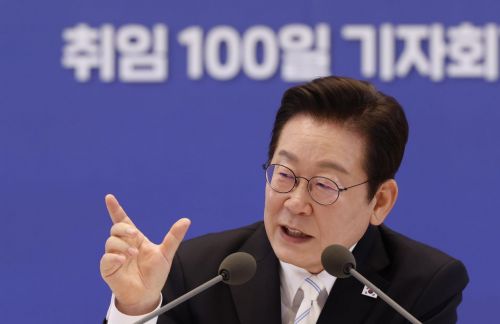 President Lee Jae-myung is speaking at the 100-day inauguration press conference titled "100 Days for Recovery, Growth for the Future" held at the Blue House State Guest House on the 11th. Photo by Presidential Office Press Photographers Group. Yonhap News Agency
Most business community representatives watched President Lee's press conference at the Blue House State Guest House on TV or through news articles that day. While they were reluctant to publicly state their positions on the president’s remarks, the majority expressed some opposition to President Lee's claim that the amendments to the Commercial Act do not "strangle" businesses.
An official from one company pointed out, "The tightening effects are already evident, as some companies are threatened by 'action platforms' formed by minority shareholders, and some directors are facing imminent litigation risks."
An official from another company emphasized, "(Contrary to the president's perception,) the amendments to the Commercial Act are heavily skewed in favor of one side-minority shareholders." This was in response to President Lee's remark that "even if controlling shareholders only own 20-30%, their power and influence are overwhelming." The official argued that, in seeking to strengthen the rights of minority shareholders and enable them to counterbalance majority shareholders, the amendments have backfired by undermining the principles of power, checks, and balance.
The main provisions of the Commercial Act that have been revised in the first and second rounds are mostly aimed at enabling minority shareholders to exert influence on the board of directors and to put the brakes on major corporate decisions. Notably, the scope of directors' fiduciary duties has been expanded from the company alone to include shareholders, allowing shareholders to hold directors accountable. The "3% rule" and "cumulative voting system" are representative measures that enable minority shareholders to secure seats on the board.
Since the board of directors holds the authority to determine key management issues, companies' concerns are growing. Another business community representative said, "Efforts to pursue new growth opportunities such as investments and mergers and acquisitions (M&A) are being hampered, and it is difficult to respond quickly in global management, where speed is crucial." This stands in contrast to President Lee's assertion that the amendments are "truly aimed at protecting the company's shareholders, contributing more strongly to the national economy, and fostering corporate management that helps companies grow themselves."
The business community also expressed disappointment that President Lee did not mention the "supplementary legislation" promised by the ruling party as the Commercial Act amendments are set to pass the National Assembly plenary session. Although the Democratic Party is pushing for a third amendment to the Commercial Act, which would mandate the cancellation of treasury shares, and is moving to establish minimum safeguards for corporate management rights through measures such as the KOSPI 5000 Special Committee and the Task Force for Rationalizing Economic Criminal and Civil Liability, they believe that if President Lee had addressed the need for these measures, it would have ensured more reliable implementation. Economic organizations in Korea have been demanding rational improvements to the crime of breach of trust and the codification of the business judgment rule to address the side effects of the Commercial Act amendments.
In this regard, at a meeting held at the Korea Chamber of Commerce and Industry in Jung-gu, Seoul on the 9th, it was stated, "We will improve the system to support bold management decisions that underpin investment and innovation, and to ensure that substantive measures follow when compensation and accountability are needed." It was added, "This is the path to enhancing our companies' long-term global competitiveness and the balance the Democratic Party aims for."
© The Asia Business Daily(www.asiae.co.kr). All rights reserved.
![Clutching a Stolen Dior Bag, Saying "I Hate Being Poor but Real"... The Grotesque Con of a "Human Knockoff" [Slate]](https://cwcontent.asiae.co.kr/asiaresize/183/2026021902243444107_1771435474.jpg)















