Dismisses Unconstitutionality Controversy at 100th Day Press Conference
Judicial Independence Also Subject to the Sovereign Will of the People
Stresses the Need to Respect the Will of the People Through Legislative Authority
On September 11, President Lee Jaemyung stated regarding the Democratic Party's push to establish a Special Tribunal for Insurrection, "We must respect the will of the people as expressed through legislative authority." Addressing concerns raised by the political sphere and the judiciary about potential unconstitutionality, he expressed his disagreement, asking, "In what way is this unconstitutional?"
President Lee made these remarks in response to a question about reports suggesting his support for the Special Tribunal for Insurrection during a press conference marking his 100th day in office, held at the State Guest House of the Blue House in Jongno-gu, Seoul.
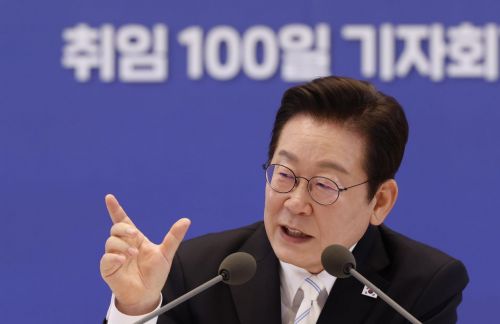
President Lee began by saying, "There seems to be some misunderstanding about the separation of powers; it does not mean doing as one pleases. The core values are oversight, checks, and balance. Judicial independence is also subject to the sovereign will of the people."
He continued, "Because the Republic of Korea is a democratic republic, no legislation, administration, or judiciary that goes against the sovereign will of the people is permitted. I believe everything depends on the will of the people, and those who best represent that will are the directly elected authorities." President Lee added, "Appointed authorities derive their powers secondarily from the elected authorities. The highest power lies with the people and their sovereignty, and there is a hierarchy of power: direct electoral authority, indirect electoral authority, and so on."
He further stated, "Since the National Assembly is the body most directly entrusted with sovereignty, it is the legislature's authority to design the national system. The judiciary makes judgments according to the constitution and conscience within the structure set by the legislature; the judiciary does not have the authority to determine its own structure at will." Emphasizing that "this is the general principle," President Lee said, "The Republic of Korea is a democratic republic, and isn't politics the mechanism through which the sovereign will of the people is expressed? The judiciary, in fact, derives its authority indirectly from politics, but at some point, this has become reversed. Korea is becoming a judiciary state."
Regarding the constitutional controversy over the establishment of the Special Tribunal for Insurrection, he said, "How is this unconstitutional? We should not debate in such a manner. Judges are appointed by the Chief Justice of the Supreme Court. Unless the Supreme Court is prevented from conducting the final review, the will of the people expressed through the legislature must be respected."
The Special Act on Insurrection, proposed by Democratic Party lawmaker Park Chan-dae and others, includes provisions for a Special Tribunal for Insurrection with judges dedicated to handling cases related to former President Yoon Sukyeol's emergency martial law. The law stipulates that the Special Tribunal, established within the Seoul Central District Court and the Seoul High Court, will be exclusively responsible for the first and second trials of insurrection charges, and that warrants will be issued by judges specifically assigned to this task.
© The Asia Business Daily(www.asiae.co.kr). All rights reserved.