Golf Monthly Reveals Facts Using Shot Scope Data
Only 1-2% Difference in Accuracy Between Woods and Drivers
Reaching the Green from 100 Yards, Two Putts from 3 Meters Is Realistic
Golf is complex and challenging. Achieving a good score is rarely easy. There are many different golf theories, and some common beliefs are actually misconceptions. The American golf media outlet Golf Monthly recently published an article addressing misunderstandings in the game of golf, focusing on golf strategy, course management, and club selection. To help golfers understand easily, the article utilized data from Shot Scope.
Amateur golfers often reach for a fairway wood when the fairway narrows, believing they can hit more accurately than with a driver. It is true that a fairway wood has more loft and a shorter shaft than a driver, making it easier to control.
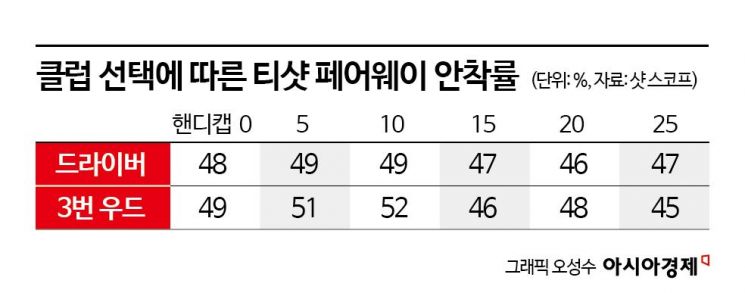
However, the results show little difference. According to Shot Scope data, the difference in fairway hit rates between woods and drivers is minimal-just about 1 to 2 percent. This is a negligible margin. Looking at the averages across all handicap levels, there is no significant advantage in using a fairway wood. In fact, the advice is that it is better to use a driver to hit farther, then approach the green with a shorter club.
There is also a belief that skilled golfers always keep the ball on the fairway. However, Shot Scope data shows that players with lower handicaps actually missed more fairways than those with higher handicaps. Last year, the average driver accuracy on the PGA Tour was 61 percent, with the top player at 72 percent. The biggest difference between high and low handicap golfers is actually driving distance. A golfer with a 0 handicap hit their tee shot an average of 80 yards farther than a golfer with a 25 handicap-an enormous advantage.
While par-3 holes are often seen as birdie opportunities, it is not easy to reduce your score. For players with a handicap of 10 or higher, the average score on par-3 holes ranges from 3.9 to 4.2 strokes. Simply making par is considered a success. Many golfers believe they can stick the ball close to the hole from 100 yards out, but for amateurs, just reaching the green is a good result. A golfer with a 15 handicap missed the green 6 times out of 10 attempts from this distance. For a 20 handicap golfer, the green-in-regulation rate was only 33 percent. Targeting the center of the green is a wise strategy.
The advice that golfers should always leave their favorite distance when attacking a par-5 hole is not 100 percent accurate. Even when laying up, it is best to get as close to the green as possible. For a 20 handicap golfer, there was a one-stroke difference between playing from 60 yards and from 20 yards. Even a 0 handicap golfer scored more than 0.5 strokes higher from the longer distance. On par-5 holes, it is always better to get as close to the green as possible.
The belief that you can always hole a 3-meter putt also needs to be reconsidered. Data shows that golfers with a 0 or 5 handicap make a 3-meter putt only once in three attempts. A 10 handicap golfer makes it once in four tries, while golfers with handicaps between 15 and 25 succeed just once in five attempts. The probability of missing is very high. Expectations for 3-meter putts should be adjusted. Rather than putting pressure on yourself, aim to finish with two putts.
© The Asia Business Daily(www.asiae.co.kr). All rights reserved.
![Clutching a Stolen Dior Bag, Saying "I Hate Being Poor but Real"... The Grotesque Con of a "Human Knockoff" [Slate]](https://cwcontent.asiae.co.kr/asiaresize/183/2026021902243444107_1771435474.jpg)
















