Artificial Kidney Synthesized with Improved Plumbing Structure and Cellular Maturation by Mimicking Low-Oxygen Environment
Higher Accuracy in Drug Efficacy and Toxicity Testing
Accelerating Replacement of Animal Experiments, Published in Adv. Sci.
An artificial mini kidney has been developed that more closely resembles the plumbing structure and function of the human kidney.
On September 11, a team led by Professor Taeun Park from the Department of Biomedical Engineering at UNIST and Professor Dongsung Kim from the Department of Mechanical Engineering at POSTECH announced the development of an artificial mini kidney (kidney organoid) that replicates the connection structure and cellular function of the human kidney.
 Researchers, (from left) Hyunji Lim, UNIST Researcher (First Author), Taeun Park, UNIST Professor, Dongsung Kim, POSTECH Professor. Courtesy of UNIST
The human kidney consists of approximately 1 million nephrons, which act as purification units. The tubules inside the nephrons are connected to collecting ducts, through which waste products are excreted.
However, until now, organoids created in laboratories lacked the structure that connects to these collecting ducts. Additionally, the cells inside the nephrons were less mature, making it difficult for them to perform real kidney functions.
The research team addressed this issue by creating a low-oxygen environment during the cultivation process.
In reality, embryos develop in an environment that is not rich in oxygen. By mimicking this, the induced pluripotent stem cells produced not only nephron cells but also cells that connect to the collecting ducts. As these two types of cells exchanged signals and grew together, a network was formed in which multiple nephrons were connected to a collecting duct-like structure, closely resembling an actual kidney.
Single-cell genome analysis showed that both the cellular composition and the degree of maturation exhibited a high similarity to those of the actual human kidney.
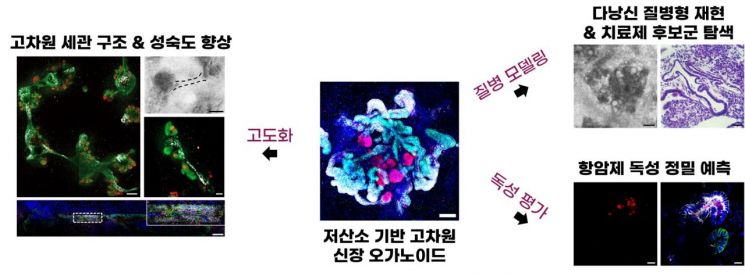
This artificial mini kidney also proved effective in disease modeling and drug toxicity assessment, which involve recreating the state of diseased organs. The team succeeded in producing organoids with polycystic kidney disease, where cysts spread throughout the renal tubules, and found that when exposed to nephrotoxic anticancer drugs, the new organoids detected toxicity much more sensitively than previous versions.
Professor Taeun Park stated, "By recreating the developmental environment, we have produced a mini artificial kidney with improved structure and function. This provides a foundation for screening potential therapeutics and accurately predicting toxicity, thereby increasing the potential for organoids to replace animal testing."
This research was led by Hyunji Lim, a researcher at UNIST, as the first author.
The study was supported by the Mid-career Researcher Program and Excellent Young Researcher Program of the Ministry of Science and ICT and the National Research Foundation of Korea, the Korea ARPA-H project of the Ministry of Health and Welfare, the Industrial Technology Alchemist Project of the Ministry of Trade, Industry and Energy, and by UNIST. The results were published online in the international journal Advanced Science on August 21.
© The Asia Business Daily(www.asiae.co.kr). All rights reserved.
![Clutching a Stolen Dior Bag, Saying "I Hate Being Poor but Real"... The Grotesque Con of a "Human Knockoff" [Slate]](https://cwcontent.asiae.co.kr/asiaresize/183/2026021902243444107_1771435474.jpg)
















