LG Energy Solution Halts All U.S. Business Trips
Hyundai Motor Issues Guidelines to Postpone New Trips
No Fundamental Countermeasures Even for Companies Not Targeted
"Temporary Measures No Longer Work
Entire Industry Could Be Shaken at Once"
Calls for Pre-Departure Visa Verification
and Manuals Including Partner Companies
The situation has come to a close as approximately 300 Korean workers, who had been detained on charges of illegal stay at the Hyundai Motor-LG Energy Solution joint battery factory construction site in Georgia, United States, are now returning to Korea. Across industry and academia, there is growing consensus that both corporations and the government must use this incident as an opportunity to establish systematic visa response manuals.
A senior official at Hyundai Motor Group stated on September 12, "It has not been easy for the company to dispatch employees on business trips," adding, "We have had no choice but to respond to each situation as it arose." He emphasized, "This time, we need to establish a proper system," and insisted that "visa issues must be addressed through government-to-government negotiations." The official repeatedly stressed that fundamental solutions are difficult to achieve with only short-term measures, highlighting the need for an institutionalized negotiation structure. He also warned that without comprehensive compliance management-including not just large corporations but also their partners-similar incidents could recur.
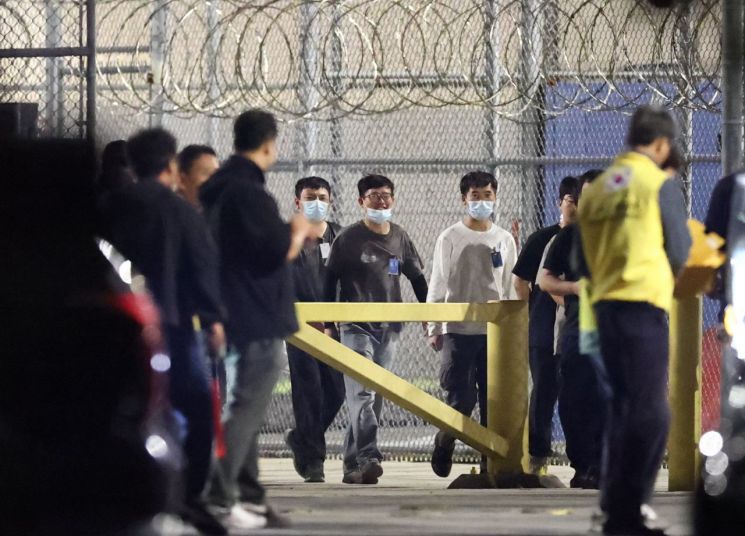 Employees at the Hyundai Motor-LG Energy Solution battery factory construction site, who were arrested during immigration raids, are leaving the Immigration and Customs Enforcement (ICE) detention facility in Folkston, Georgia, on the 11th (local time) to head to Atlanta Airport. Photo by Yonhap News
Within the business community, there are also calls to obtain visas through proper procedures and to create response manuals for similar situations in the future. An executive at a major conglomerate affiliate said, "We have requested that not only the primary companies but also their partners comply equally with the law during the visa issuance and acquisition process," adding, "There is now a shared understanding that we must not engage in activities that violate the law and that visas must be obtained through proper channels." He emphasized that if some partners are lax in the hiring process, the risk could be transferred even to the primary company, and that this incident should be seen as a compliance management issue for the entire corporate network, not just for large companies.
LG Energy Solution has announced a complete suspension of business trips to the United States and has instructed employees already there to either return immediately or remain at their accommodations. All business trips have been banned except for unavoidable cases such as pre-existing client meetings. Hyundai Motor has also recommended prompt returns and issued guidelines to postpone new business trips unless absolutely necessary.
Other companies that were not targeted by the recent U.S. immigration enforcement are in a similar position. The prevailing view is that they avoided trouble not because of fundamental countermeasures, but rather because the timing of the raids coincided with certain construction phases. For example, Samsung Electronics is currently building a semiconductor plant in Taylor, Texas, but as the work is being carried out primarily by construction firms at this stage, they avoided impact. An industry insider commented, "If this had happened during equipment installation or when engineers were being dispatched, Samsung would also have inevitably been affected," adding, "The LG Energy Solution case has set a precedent, effectively buying time for other companies to prepare their responses."
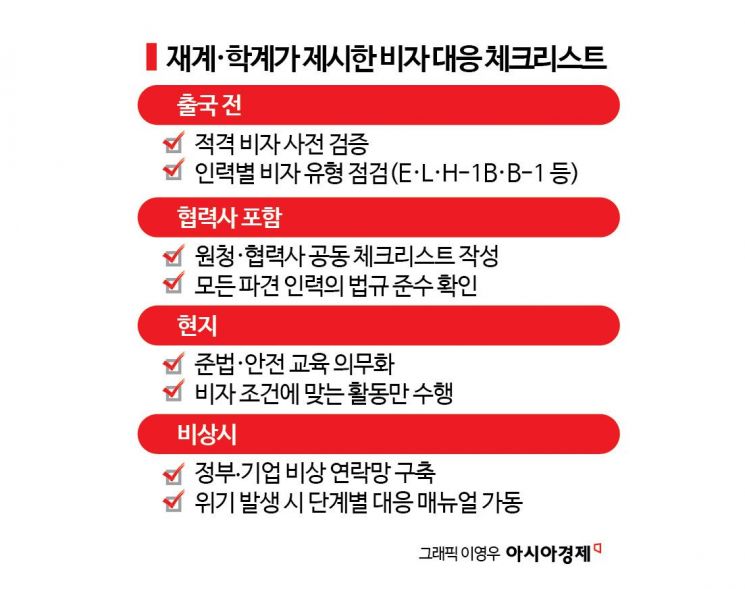
Industry insiders are saying, "It is no longer viable to respond with temporary measures each time an incident occurs." Until now, visa issues have been treated as individual company matters, but this incident has demonstrated that the entire industry can be shaken simultaneously. This is why there are calls for step-by-step manuals, including pre-departure visa eligibility verification, checklists that cover partner companies, local compliance training, and emergency contact networks between the government and companies in case of a crisis.
An official from the Korea International Trade Association said, "Companies with large investment volumes need tailored strategies, such as utilizing E, L, or H-1B visas for long-term stays and employment, while smaller companies can use B-1 visas for short-term business trips." The E visa is typically used by companies with a certain level of investment or trade activity, the L visa is mainly for multinational companies dispatching employees to overseas subsidiaries, the H-1B is a representative employment visa for professionals, and the B-1 is used for short-term business trips or attending meetings.
Nam Jiyeong, a U.S. attorney, said, "Companies should hire headquarters employees and dispatch them legally with L visas, or design various routes in advance such as E-2 visas according to the scale of investment."
Some in the business community are also insisting that major diplomatic events, such as the Asia-Pacific Economic Cooperation (APEC) summit scheduled for October, should be used as an opportunity to formally address visa issues. A senior industry official said, "This incident should prompt us to assess risks not only in the United States but also in other countries where we operate."
© The Asia Business Daily(www.asiae.co.kr). All rights reserved.
![Clutching a Stolen Dior Bag, Saying "I Hate Being Poor but Real"... The Grotesque Con of a "Human Knockoff" [Slate]](https://cwcontent.asiae.co.kr/asiaresize/183/2026021902243444107_1771435474.jpg)
















