Cracks Emerge in the Traditional Pathway from Senior Ministry Officials to Heads of Affiliated Agencies
Major Policy Bank Leadership Appointments to Begin Soon
Most Positions Likely to Be Filled by Internal Candidates
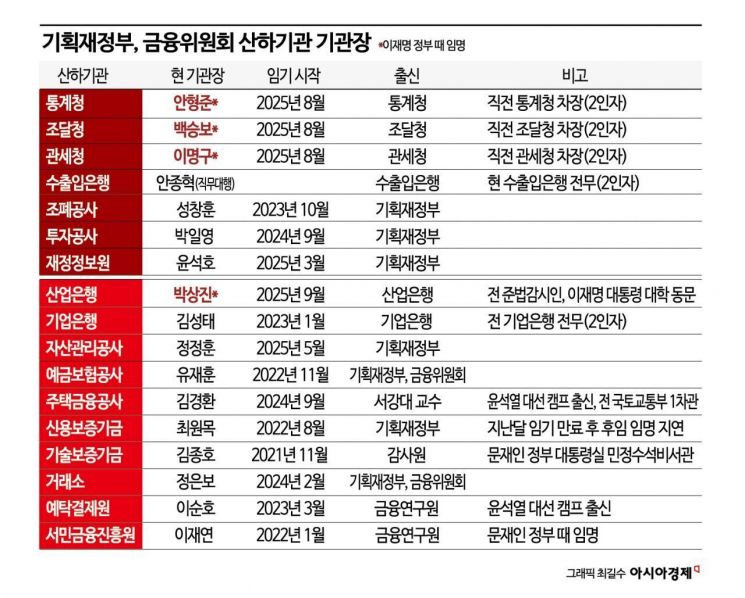
The government's personnel policy is clearly shifting toward reducing the influence of the so-called "Mofia"-a term referring to former officials from the Ministry of Economy and Finance and the Financial Services Commission. Recently, key positions at major affiliated agencies, which were previously held by former officials from these ministries, have been filled by internal candidates. Even the president of the Korea Development Bank has now been appointed from within the organization. There is growing speculation that internal candidates are also likely to be appointed to other institutions, such as the Export-Import Bank of Korea and the Korea Credit Guarantee Fund, whose heads are soon to be named due to the expiration of their terms.
On September 9, the Financial Services Commission nominated Park Sangjin, former Chief Compliance Officer of the Korea Development Bank and a fellow alumnus of Chung-Ang University Law School with President Lee Jaemyung, as the new president of the Korea Development Bank. This is the first time since the bank's establishment in 1971 that an internal candidate, rather than a former financial bureaucrat, has been selected for the role. Previously, the heads of three vice-ministerial-level agencies-the National Statistical Office, the Public Procurement Service, and the Korea Customs Service-were also filled by internal candidates who had served as the second-in-command (deputy heads) of their respective organizations. Now, even the heads of affiliated institutions are being chosen from within. This marks a break in the traditional personnel route of first-grade officials at the Ministry of Economy and Finance moving on to head affiliated agencies and then becoming vice ministers. Even the ministerial-level post of Chief of the Office for Government Policy Coordination has been filled by an internal candidate, with former First Deputy Chief Yoon Changryeol appointed to the position. Historically, most Chiefs of the Office for Government Policy Coordination (including those of the Prime Minister's Office) have come from the Ministry of Economy and Finance (including its predecessors such as the Ministry of Planning and Budget, and the Ministry of Strategy and Finance). Yoon is the first internal candidate to be appointed to this role.
This trend is expected to continue in future appointments of heads of affiliated institutions. With the selection of top financial regulators now complete, the process of appointing heads of major state-run banks and other affiliated institutions is set to begin soon. Most of these positions are likely to be filled by internal candidates.
High Likelihood of Internal Candidates Being Appointed as Future Heads of Affiliated Institutions
As an affiliated institution of the Ministry of Economy and Finance, the Export-Import Bank of Korea is also expected to appoint an internal candidate as its new president. The bank is currently led by Acting President Ahn Jonghyuk (current Executive Director), following the expiration of the term of former President Yoon Heeseong, who was close to former President Yoon Sukyeol during their university years. There is a strong possibility that Ahn, an internal candidate, will be formally appointed as president.
Other heads of affiliated institutions-such as Seong Changhoon of Korea Minting and Security Printing Corporation, Park Ilyoung of Korea Investment Corporation, and Yoon Seokho of the Korea Fiscal Information Service-are also former officials from the Ministry of Economy and Finance, so when their terms end, internal candidates may be selected. However, their terms expire in 2026 for Seong, 2027 for Park, and 2028 for Yoon, so there is still considerable time remaining.
Among institutions under the Financial Services Commission, the Korea Development Bank has already seen an internal candidate appointed, and the Industrial Bank of Korea, Korea Credit Guarantee Fund, and Korea Deposit Insurance Corporation are also set to appoint new heads soon. The president of the Industrial Bank of Korea, appointed in January 2023, will reach the end of his term later this year, requiring a new appointment. Since 2010, except for former president Yoon Jongwon, all four presidents have been internal candidates, so there is a strong possibility that the next president will also be promoted from within.
The heads of the Korea Credit Guarantee Fund and Korea Deposit Insurance Corporation were appointed during the Yoon Sukyeol administration, so replacements are likely. The term of Choi Wonmok, chairman of the Korea Credit Guarantee Fund and a former head of policy at the Ministry of Economy and Finance, expired last month, so a new head must be appointed. Most chairmen of the Korea Credit Guarantee Fund have come from the Ministry of Economy and Finance or similar bureaucratic backgrounds. The term of Yoo Jaehun, president of the Korea Deposit Insurance Corporation, who took office in November 2022, will expire this November. Yoo is a representative bureaucrat, having served as Director-General of the Treasury Bureau at the Ministry of Economy and Finance and as a standing commissioner at the Financial Services Commission. The process for selecting his successor is expected to begin in earnest in October.
Even the Korea Housing Finance Corporation, whose head still has a significant amount of time left in his term, is within the scope of possible leadership change. Since Kim Kyunghwan, the current president, was appointed during the previous Yoon Sukyeol administration in September last year, there is expected to be strong pressure for replacement. Kim, a former professor at Sogang University, served as the first vice minister of the Ministry of Land, Infrastructure and Transport during the Park Geunhye administration and played a key role in real estate policy and campaign pledges for Yoon Sukyeol's presidential campaign.
In the case of Korea Asset Management Corporation, President Jeong Junghoon, who was appointed in May this year just before the launch of the new administration, is a former Ministry of Economy and Finance official (most recently Director-General of the Tax Policy Bureau). However, since he only recently began his term and has little association with the previous administration, he is expected to remain in his position.
At the Korea Securities Depository, President Lee Soonho, who came from the Korea Institute of Finance, began his term in March 2023 and will serve until March 2026. Therefore, discussions about his successor are expected to begin early next year. At the Korea Inclusive Finance Agency, President Lee Jaeyeon, also from the Korea Institute of Finance, has been in office since January 2022. Although his term expired in January of this year, he remains in the position as a successor has not yet been appointed.
Meanwhile, at the Korea Technology Finance Corporation, Chairman Kim Jongho, who was appointed during the Moon Jaein administration, remains in office even after his term expired in November last year, so there is a possibility he will be reappointed. At the Korea Exchange, former Financial Supervisory Service Governor Jeong Eunbo, a bureaucrat with experience at the Ministry of Strategy and Finance and the Financial Services Commission, took office in February last year and is expected to serve until 2027.
Pros and Cons of Bureaucratic Versus Internal Candidates
In the past, the appointment of bureaucrats as heads of institutions under the Ministry of Economy and Finance and the Financial Services Commission was regarded as a form of privilege. The predecessors of these ministries-the Economic Planning Board, Ministry of Finance, Ministry of Strategy and Finance, and the Ministry of Planning and Budget-were considered the gathering places of elite economic bureaucrats and were the most sought-after ministries for those who passed the higher civil service exam in economic administration. Officials from these ministries were often promoted more slowly than those in other ministries, so being appointed as the head of an affiliated institution served as compensation for their service in a core ministry.
Especially in the case of public financial institutions, these positions were considered particularly desirable due to their higher salaries and significant roles compared to general public institutions. The term "Mofia" is a portmanteau of "MOF" (Ministry of Finance) and "mafia," referring to those who handled financial affairs in the old Ministry of Finance. In a narrow sense, "Mofia" refers to financial departments of the former Ministry of Finance and Ministry of Strategy and Finance, but more broadly, it refers to the entire ministry.
Until the early 2000s, most heads of affiliated institutions were bureaucrats, but as these positions became known as "very good jobs," political figures and former members of presidential campaign teams began to be parachuted into these roles. Sometimes, internal candidates with political connections or ties to the administration were appointed as heads. Until the early 2010s, bureaucrats sometimes served as heads of affiliated institutions two or three times, but as more political appointees took these positions, bureaucrats have had to settle for just one term as head. Recently, private financial companies have also recognized the capabilities of former Mofia officials and have appointed them as chief executive officers. Notable examples include former Korea Exchange Bank President Yoon Yongro, current Woori Financial Group Chairman Lim Jongryong, and Dongyang Life Insurance President Sung Daegyu (formerly president of Shinhan Life Insurance).
There are both advantages and disadvantages to appointing either bureaucratic or internal candidates as heads of affiliated institutions. When a highly capable bureaucrat is appointed, communication with the supervising ministry is smooth and there is momentum for internal reform. However, there is criticism that, due to unfamiliarity with the work, the first six months after appointment and the last six months before the end of the term are often wasted. When an internal candidate is appointed, they are usually well-versed in all aspects of the organization and can boost unity and morale. On the other hand, there is a risk of forming a "let's all get along" atmosphere, where compromises with labor unions and adherence to existing practices can lead to a culture of sharing positions for mutual benefit.
© The Asia Business Daily(www.asiae.co.kr). All rights reserved.


















