Ministry of Climate, Energy, and Environment to Take Over Nuclear Power Affairs
"Nuclear Power as Baseload... Inevitable to Use Alongside Rapid Expansion of Renewables"
Considering Independence of Electricity Commission and Restructuring of Stat
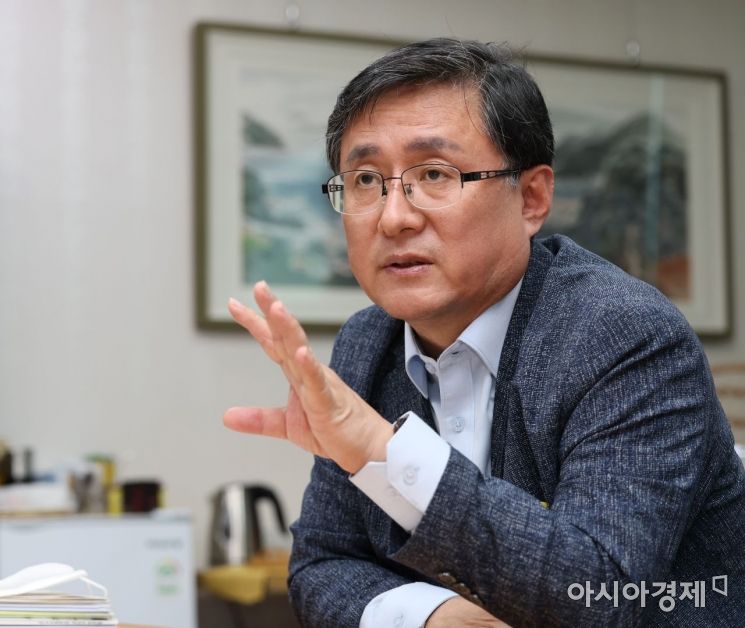
Kim Sung-hwan, who is considered the leading candidate to become the inaugural Minister of Climate, Energy, and Environment, has outlined the new ministry's core directions as utilizing nuclear power and ensuring the independence of the Electricity Commission. While recognizing nuclear power as a baseload energy source, he made it clear that the expansion of renewable energy must be accelerated. He also stated that he would consider making the Electricity Commission independent in order to enhance the objectivity of the electricity pricing structure.
At a press briefing held on September 9 at the Han River Flood Control Office in Seoul, Minister Kim said, "Nuclear power requires risk management, but right now, reducing carbon emissions is the top priority. It is inevitable to use nuclear power as a baseload source while rapidly increasing the share of renewables. Please do not interpret this as 'Nuclear Phase-Out Season 2.'"
He also explained the short-term and mid-to-long-term directions of nuclear policy. Minister Kim said, "The two new nuclear reactors and one small modular reactor (SMR) included in the 11th Basic Plan for Electricity Supply and Demand are part of the current administration's plan and should be respected. However, whether to build additional reactors will be decided after a public consensus is reached in the 12th Basic Plan next year." Regarding nuclear power exports, he added, "Since Korea Hydro & Nuclear Power has the expertise, it should take the lead in export strategies, and the Ministry of Climate, Energy, and Environment will cooperate."
He also expressed his position on the independence of the Electricity Commission. There has been considerable criticism that the current structure, where the Electricity Commission operates under the Ministry of Trade, Industry, and Energy, lacks objectivity in determining the pricing system and grid investment directions. Minister Kim said, "There has been ongoing criticism that the current structure under the Ministry lacks objectivity and independence. After the government reorganization, we will discuss independence measures in consultation with the Office of the President. This is not just about changing the nameplate, but about depoliticizing electricity pricing and rationalizing grid investment decisions."
However, the social impact is expected to be significant. The independence of the Electricity Commission would change the 'rules' of electricity policy, intertwining sensitive issues such as upward pressure on rates, increased burdens on industry, and protection for vulnerable groups. Therefore, substantial conflict is anticipated during the institutional design process following independence.
Minister Kim identified grid transition, restructuring of state-owned energy enterprises, implementation of the Nationally Determined Contribution (NDC), and establishment of a Climate Science Institute as tasks for the new ministry. He said, "In the era of renewable energy, electricity demand will increase by 2 to 2.3 times compared to now. We will build an intelligent grid, the so-called 'energy superhighway,' to create a stable system without blackouts." He also proposed measures for managing distributed power sources, such as relocating data centers in the Seoul metropolitan area to regional areas, piloting distributed energy zones, and expanding energy storage systems (ESS).
He also addressed the restructuring of state-owned energy enterprises. Minister Kim said, "Since the five power generation subsidiaries responsible for coal-fired power must cease all coal operations by 2040, restructuring is inevitable. We must promptly consider options such as downsizing, integration, or transitioning to renewable energy businesses like offshore wind." He emphasized that a sophisticated transition roadmap is necessary, as this is not simply a matter of changing power sources but also involves labor transitions, mitigating regional economic shocks, and investment recovery issues.
He also expressed his intention to strengthen the scientific foundation supporting policy needs in the field, such as designing the emissions trading scheme and analyzing reduction costs by sector. Minister Kim said, "We need a dedicated organization, such as a 'Climate Science Institute' (tentative name), to consolidate dispersed research functions like the Greenhouse Gas Information Center and the National Institute of Environmental Research. We will enhance expertise by reallocating functions without increasing personnel."
Regarding the NDC, he emphasized, "Achieving a 40% reduction by 2030 is a very challenging goal, but since it is a promise to the international community, we will accomplish it without fail." In particular, concerning the interim target for 2035, he explained, "If we apply a simple linear calculation from 2018 emissions to carbon neutrality in 2050, we would need to reduce emissions by about 53% in 2035. This is the so-called 'linear path.'"
The international community's recommended standard is a 61% reduction, and if recent statistical revisions are reflected, it rises to about 65%. Furthermore, some experts believe that a 67% reduction is necessary to limit the rise in global average temperature to within 1.5 degrees Celsius. Minister Kim said, "These figures are not subjects for a vote for or against, but rather starting points for public discussion. We will achieve social consensus by comprehensively considering the pace of industrial transition, the scale of fiscal input, and international standards."
Regarding water resource policy, he stated, "The principle is that rivers must flow. Since the situation for each weir is different, we will restore basin councils and make decisions through public discussions with residents and experts." After directly inspecting the 14 new dams announced by the Yoon Suk-yeol administration, he said, "About half are necessary and half are not. We will correct overlapping investments and unreasonable scales."
On the controversy over electricity rates due to the expansion of paid allocation in the emissions trading scheme, he said, "The key is to drive coal-fired power out of the market through price signals. We will accelerate the transition by expanding renewables and lowering unit costs."
Minister Kim emphasized, "We cannot afford to focus only on carbon neutrality by 2050. There is a high possibility of a 2-degree Celsius rise in the early 2030s. The fate of the planet depends on how quickly we transition to a decarbonized society during the five years of the Lee Jaemyung administration." He added, "Although Korea is a manufacturing powerhouse, if the pace of green industry conversion is slow, we could lose competitiveness in electric vehicles, ESS, solar power, wind power, and heat pumps. We will simultaneously address the climate crisis and foster green industry growth to propel Korea to 'King Korea' status."
© The Asia Business Daily(www.asiae.co.kr). All rights reserved.

















