Aftermath of Korean Detentions in Georgia
"Many Companies Worried They Could Be Targeted"
"Foreign Business Operations in the U.S. Expected to Shrink"
Following the detention of Korean workers at the Hyundai Motor Group-LG Energy Solution joint battery plant construction site in Georgia, United States, foreign media have reported that multinational companies across the U.S. are now on edge. According to Yonhap News Agency on September 9 (local time), citing the UK’s Financial Times (FT), “Immigration and visa law firms have been flooded with inquiries from multinational companies worried that their own employees could also be targeted in similar raids.”
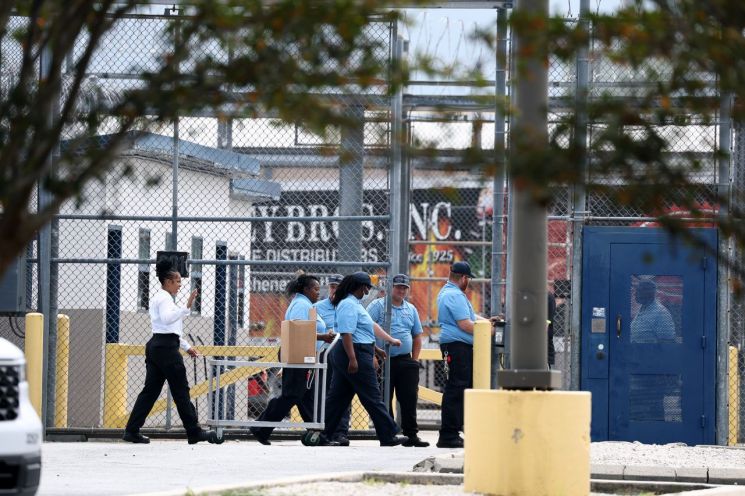 The Immigration and Customs Enforcement (ICE) detention facility in Folkston, Georgia, where employees at the Hyundai Motor-LG Energy Solution battery factory construction site, arrested by U.S. immigration authorities, are being held. Photo by Yonhap News Agency
Matthew Dunn, head of U.S. business immigration at the law firm HSF Cramer, told the FT, “Our inbox is overflowing with emails from clients concerned about whether they could be exposed to Immigration and Customs Enforcement (ICE) raids. Clients are asking whether their headquarters should be concerned about this issue, whether their managers in the U.S. are at risk, and whether foreign workers with employment visas are now being targeted by the U.S. government.”
Charles Kuck, founding partner of the immigration law firm Kuck Baxter, is currently representing some of those detained at the ICE facility in Folkston, Georgia. While working on legal defense, he is also fielding inquiries from other companies. Kuck said, “On September 7, two overseas companies with large-scale facilities in the U.S. called to ask how they should respond if ICE shows up at their plants.”
Tami Overby, former vice president for Asia at the U.S. Chamber of Commerce, said, “Some foreign companies have suspended business trips to the U.S. as they assess the potential legal fallout from this incident.” Overby added, “The footage of Koreans being arrested was not only shown in Korea, but also in Japan, Taiwan, and other countries that are major trade partners with significant investments in the U.S. The impact is expected to be significant going forward.”
There are concerns that this crackdown, which has starkly demonstrated the unpredictability characteristic of the Donald Trump administration, will severely restrict the activities of foreign companies in the U.S. An executive at a Taiwanese company told the FT, “President Trump may have done this to send a political message to the Korean government. The U.S. government is now very different and unpredictable.”
Robert Loughran, an immigration attorney in Texas, said, “Since the Trump administration took office, ICE’s enforcement practices have changed dramatically. Similar incidents could continue to occur.” Loughran explained, “Except for responding to specific complaints, ICE had largely remained at their desks for the past four years. Now, the situation is the complete opposite.” He added, “ICE agents now receive incentives for going into the field to uncover immigration violations. Frankly, it’s an environment with an abundance of potential targets.”
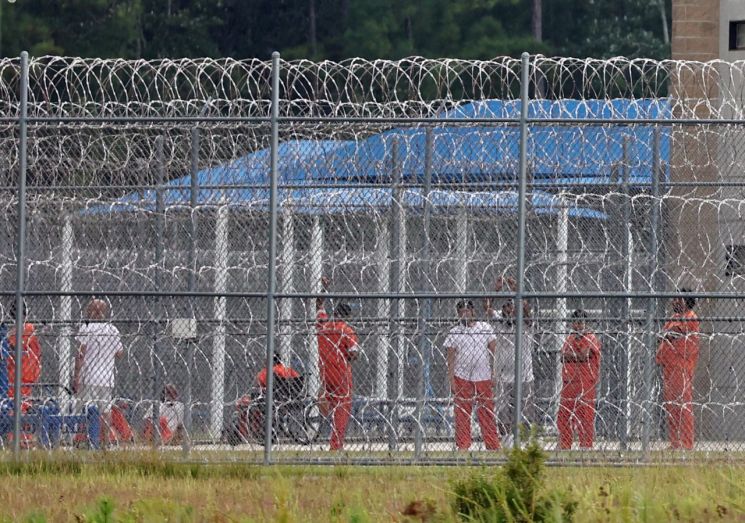 Employees at the Hyundai Motor-LG Energy Solution battery plant construction site arrested by U.S. immigration authorities are detained at the Immigration and Customs Enforcement (ICE) detention facility in Folkston, Georgia. Photo by Yonhap News Agency
Stephen Miller, White House deputy chief of staff and architect of the Trump administration’s immigration policy, instructed ICE at a meeting in May to arrest 3,000 people per day. In pursuit of this “3,000 per day” quota, indiscriminate arrests are taking place on the ground.
There are claims that the recent detention of Korean nationals is also the result of the Trump administration’s excessive immigration crackdown. The approximately 300 Koreans who have been arrested and detained are expected to depart locally around 2:30 p.m. on September 10, local time (3:30 a.m. on September 11, Korea time). After six days in detention, they are scheduled to be released and board a chartered flight at Atlanta Airport to voluntarily leave the country.
© The Asia Business Daily(www.asiae.co.kr). All rights reserved.
![Clutching a Stolen Dior Bag, Saying "I Hate Being Poor but Real"... The Grotesque Con of a "Human Knockoff" [Slate]](https://cwcontent.asiae.co.kr/asiaresize/183/2026021902243444107_1771435474.jpg)
















