The possibility of 'personalized' treatment for bipolar disorder patients has emerged. This follows the identification of differences in responsiveness to lithium, the representative treatment for bipolar disorder, and the proposal to apply these findings to the development of patient-specific therapies and new drug development platforms.
Bipolar disorder is a brain disease (also known as bipolar affective disorder) characterized by repeated episodes of mania and depression. It affects 1-2% of the global population, and patients are known to have a 10 to 30 times higher risk of suicide compared to the general population. However, until now, personalized treatment has been difficult because individual patients respond differently to lithium.
KAIST announced on September 10 that the research team led by Professor Jinju Han of the Graduate School of Medical Science has identified metabolic differences in astrocytes depending on lithium responsiveness, opening the door to the development of personalized treatments for bipolar disorder.
 From the left: Professor Jinju Han of the Graduate School of Medical Science, Dr. Kyuhyun Baek, Dr. Dayeon Kim, Dr. Geurim Son, and Dr. Hyunsoo Do. Provided by KAIST
Astrocytes are star-shaped cells that function in the brain. They serve as 'assistants,' supplying nutrients to neurons and helping to maintain the brain's environment. These cells make up about half of all brain cells.
The research team shifted away from the neuron-centered paradigm of previous studies and focused on astrocytes, discovering that astrocytes play a key role in the metabolic regulation process of bipolar disorder.
They confirmed that when induced pluripotent stem cells (iPSCs) derived from bipolar disorder patients were differentiated into astrocytes (the process by which stem cells grow and specialize into cells with specific functions), whether or not the cells responded to lithium affected their energy metabolism.
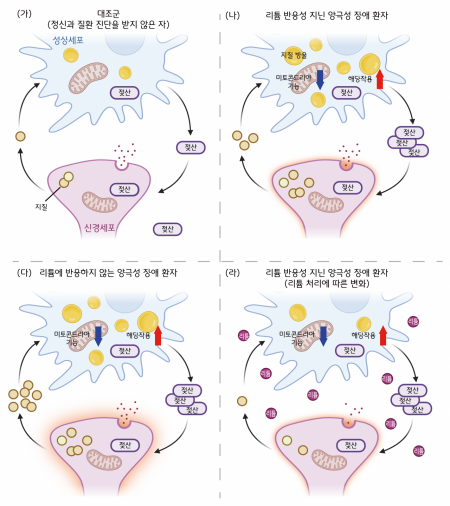
For example, in cases where there was no response to lithium, excessive accumulation of lipid droplets (tiny fat storage sites) occurred within the cells, and mitochondrial (the cell's power plant) function was reduced. Additionally, the process of glucose breakdown was excessively activated, and there was a marked increase in the secretion of lactate, indicating significant metabolic abnormalities.
In particular, astrocytes from patients who responded to lithium showed a decrease in lipid droplets upon lithium treatment, whereas no improvement was observed in non-responsive patients.
Differences were also found in the metabolites produced by astrocytes depending on patient type. Depending on lithium responsiveness, the cell's energy factories did not function properly, and excessive use of alternative pathways led to the accumulation of byproducts.
This study is significant in that it demonstrates astrocytes play a central role in regulating energy metabolism in bipolar disorder patients, explains differences in lithium responsiveness, and paves the way for personalized treatment strategies.
Professor Han stated, "This research is meaningful because it enables the development of new bipolar disorder treatments targeting astrocytes, offering better therapeutic strategies even for patients who have not responded to existing medications."
Meanwhile, the research was conducted with support from the National Research Foundation of Korea and the Korea Environmental Industry and Technology Institute. The results were published online on August 22 in the international journal 'Molecular Psychiatry,' which specializes in neuropsychiatric disorders.
© The Asia Business Daily(www.asiae.co.kr). All rights reserved.


















