Presiding over the Cabinet meeting, President Lee asks, "Can high-interest loans for low-credit borrowers really be called 'financial support for ordinary citizens'?"
When the Ministry of Economy and Finance reports "114.5 billion won in support for
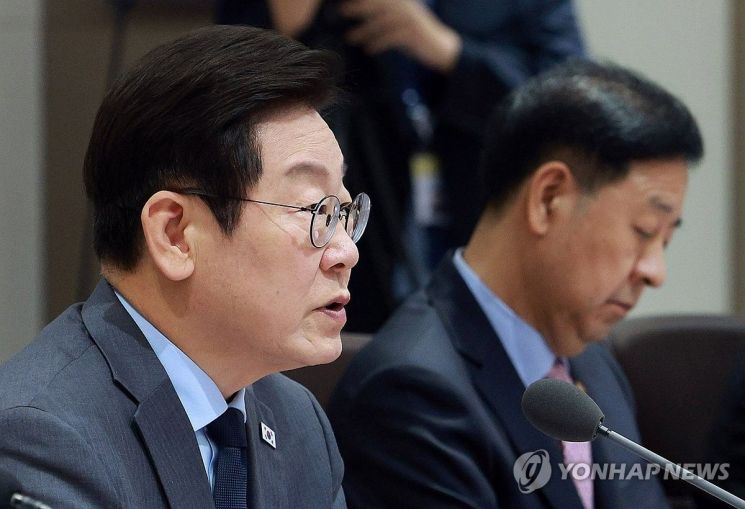 President Lee Jae-myung is speaking at the Cabinet meeting held on the 9th at the Yongsan Presidential Office building in Seoul.
President Lee Jae-myung commented on the 15.9% interest rates for loans to low-credit borrowers, stating, "Finance seems to be the most brutal sector." He pointed out that although these are being sold as financial products for ordinary people, the interest rates are so high that they actually disadvantage the lower-income class. President Lee then instructed the relevant ministries to improve the system. Regarding the recurring industrial accidents, he also raised his voice, saying, "How can someone just fall and die like that?" and urged for greater attention to the issue.
During the Cabinet meeting on public livelihood and the economy held at the Yongsan Presidential Office on the previous day (the 9th), President Lee said, "Low-credit borrowers are lent small amounts at high interest rates for short terms, and then they are chased for repayment," adding, "Finance seems to be the most brutal sector." President Lee's remarks came after Deputy Prime Minister and Minister of Economy and Finance Koo Yoon-cheol reported, "We will supply an additional 100 billion won for financial support to ordinary people."
After interrupting Deputy Prime Minister Koo, President Lee asked, "We are giving financial opportunities to ordinary people, but aren't the interest rates too high?" "Isn't the interest rate for the Sunshine Loan extremely high?" "For the 20 billion won in illegal private loan prevention loans, what is the interest rate?" In response, Vice Chairman Kwon Dae-young of the Financial Services Commission explained, "The interest rate is 7-8%, but the guarantee fee is also 7-8%," adding, "Because the bad debt ratio is 20-30%, it is inevitable." The bad debt ratio refers to the proportion of loans that financial institutions cannot recover. Vice Chairman Kwon explained that, since many low-credit borrowers do not repay their loans, the interest rates are inevitably high.
With Sunshine Loan interest rates at 15%, President Lee asks, "How can this be called financial support for ordinary people?"
President Lee's criticism led to a directive to improve the 'financial support for ordinary people' system in line with its original purpose. He said, "While it may be the essence of capital, how can you call this financial support for ordinary people?" He further pointed out, "In an era where the economic growth rate is less than 2%, how can ordinary people survive if they have to pay interest rates exceeding 15%, which is more than ten times the growth rate?"
President Lee continued, "Given South Korea's level of national competitiveness and fiscal strength, if ordinary people borrow 5 million or 10 million won, the likelihood of default is high, and they risk falling into bad credit. We need to come up with fundamental countermeasures." He strongly criticized, "Financial institutions are making 3 to 4 trillion won in profits from interest margins, so how much help is it really to make a few hundred billion won from these products?" President Lee also pointed out, "For high-credit borrowers, people who don't even need money, they lend at 1.9% or 2%. Because they lend cheaply to people who don't need it, it fuels real estate speculation and the like."
He also had harsh words for financial institutions that record tens of trillions of won in annual profits. Regarding the social contribution of financial institutions, President Lee said, "There may be objections as to why the profits of financial institutions should be used for financial support for ordinary people," but added, "Finance is not something that individuals or companies have created by developing technology, pioneering markets, or innovating management." He continued, "They are making money by using the currency issuance authority of the large community called the Republic of Korea," and "Since banks are doing this, the idea that they should monopolize 100% of the profits and that bank owners should take it all is dogma." He added, "Some may say I'm sounding like a socialist, but I think finance is different."
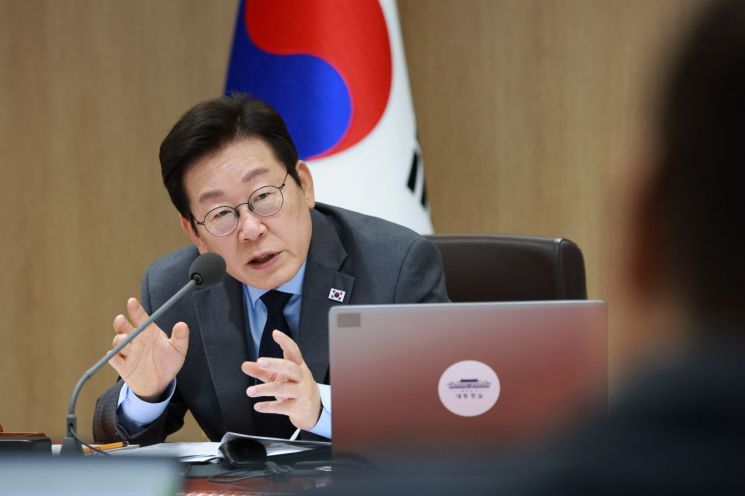
Food prices are too high... "Accelerate reforms of the irrational distribution structure"
President Lee also called for bold measures to control prices. In particular, ahead of the Chuseok holiday, he once again ordered improvements to the distribution structure of agricultural and livestock products and food items. According to the National Statistical Office's KOSIS portal, the consumer price inflation rate for food and beverages in the second quarter reached 2.9%. As prices continued to rise, average monthly household spending on food and beverages in the second quarter shrank to 423,000 won in nominal terms, the lowest level in nine years. Excluding the impact of price increases, real consumption expenditure decreased by 1.0% compared to a year earlier. With abnormal weather conditions also in play, the phenomenon of high prices for food became even more pronounced.
President Lee said, "Due to various factors, including a complex distribution structure, our food prices are reportedly nearly 50% higher than the OECD average," and emphasized, "We need to resolve the structural 'shopping basket price instability' for public livelihood stability." He continued, "The shock of high prices inevitably hits the vulnerable the hardest, deepening polarization and inequality. Naturally, economic vitality also declines." He stressed, "If we leave this situation unaddressed, measures to stabilize public livelihood will inevitably be limited in their effectiveness. Bold price control measures are needed." President Lee also urged, "As I have previously requested, please accelerate reforms of the irrational distribution structure so that both consumers and producers can feel the effects."
Strong criticism of 'industrial accidents' at Cabinet meeting... To Minister of Justice Jeong Seong-ho: "Please ensure swift punishment and pay closer attention"
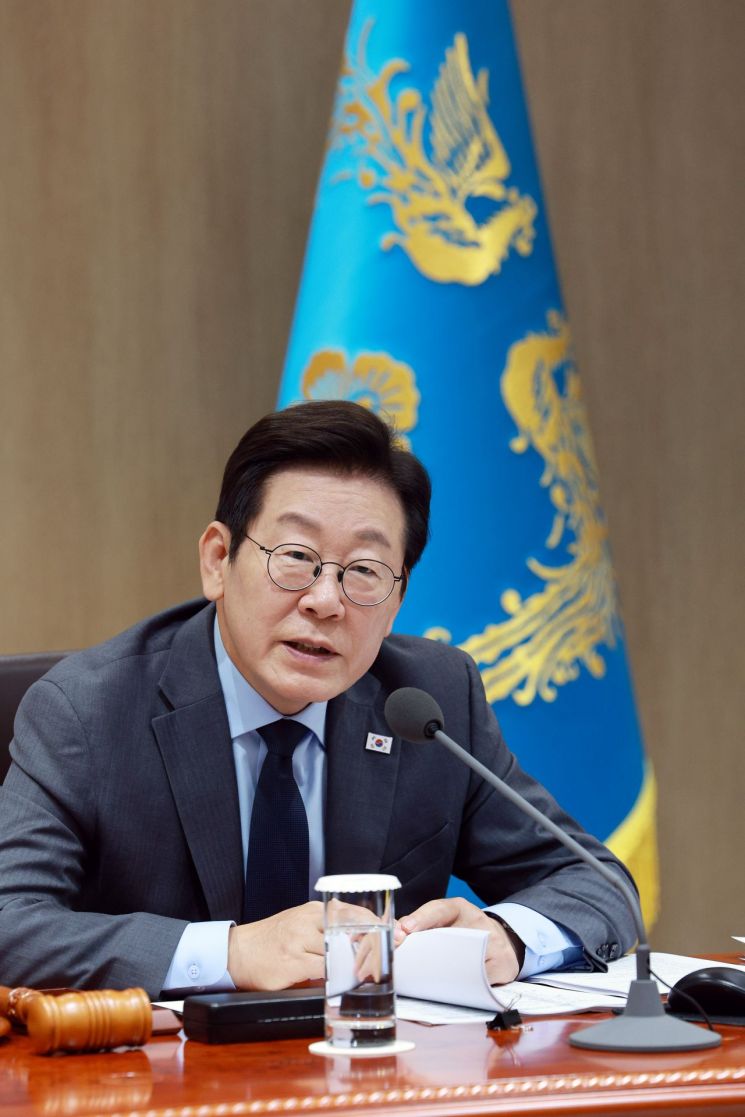
As always, the issue of industrial accidents was brought to the table at this Cabinet meeting. President Lee, referring to fatal falls at worksites, said, "I truly do not understand. There must be severe punishment." He added, "These obvious and entirely predictable fall accidents keep happening. If only standard safety measures had been taken, they would not have occurred." He emphasized, "How can it make sense to ruin someone's entire life and make money from it? We need to change the fundamental culture."
This time, President Lee also addressed Minister of Justice Jeong Seong-ho, saying, "We have been saying the same thing for months," and urged, "Please ensure swift and strict punishment for those who neglect predictable risks and cause workers to fall to their deaths. Pay closer attention." He further suggested that if it is difficult to anticipate risks, the number of labor inspectors should be increased and they should conduct surprise inspections at workplaces where industrial accidents are likely, punishing all violators. President Lee particularly stated, "Neglecting industrial accidents should be regarded as 'a path to prison for myself, a path to the company's collapse.'"
Meanwhile, President Lee also ordered measures to address the ongoing 'anti-Chinese protests' in Myeong-dong, Seoul. He said, "There are rallies insulting tourists from certain countries," and added, "They are deliberately trying to worsen relations by insulting tourists from specific countries." When Minister of the Interior and Safety Yoon Ho-joong responded, "We are strengthening security around major diplomatic missions and warning rally organizers," President Lee countered, "Warnings alone will not be enough."
When Minister Yoon further explained that, up until now, such 'anti-Chinese protests' have been considered a matter of freedom of expression and thus difficult to regulate, President Lee replied, "How can this be called freedom of expression? It's just causing chaos," and directed Cabinet members to find solutions.
© The Asia Business Daily(www.asiae.co.kr). All rights reserved.



















