Monitoring the Situation Amid Shock
"Long-standing Issues Have Finally Surfaced"
No Support from the Three Major Battery Companies for Visa Issuance
"Government Must Step In to Resolve Visa Problems"
"Sometimes, the ESTA (Electronic System for Travel Authorization) gets canceled just two days before a business trip. I have an exhibition in the United States next month, and I am anxious that my ESTA might be canceled."
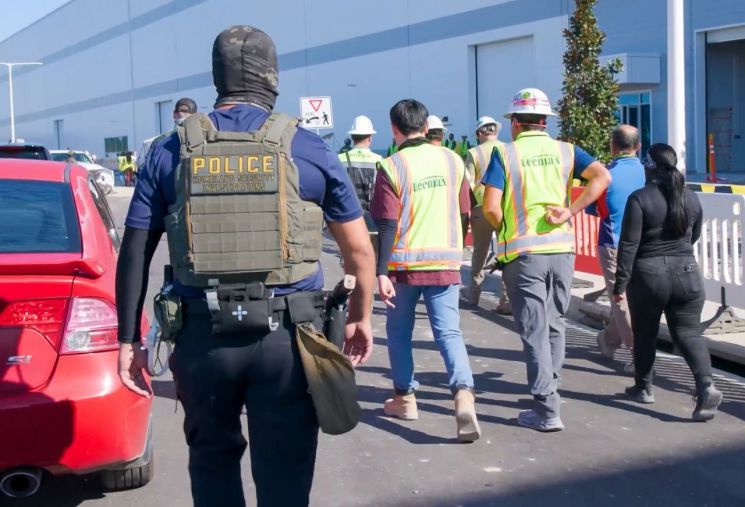
Domestic battery partners are expressing shock after more than 300 Korean workers employed at the HL-GA battery company, a joint battery plant between Hyundai Motor and LG Energy Solution in the United States, were detained by U.S. immigration authorities.
Representatives from battery partner companies remarked, "Long-standing issues have finally come to the surface," and unanimously called for the government to step in and resolve the visa problems. They also predicted that, until a fundamental solution is presented, delays in the construction of factories in the United States are inevitable.
A significant number of those detained by U.S. immigration authorities this time are reportedly employees of LG Energy Solution's partner companies. LG Energy Solution stated, "There are 47 employees from our company, and around 250 employees from equipment partner companies related to HL-GA battery company, most of whom are Korean."
Battery manufacturing plants first undergo exterior construction, followed by the installation of process equipment for actual battery production. Most of the production equipment for the HL-GA battery plant was planned to be installed by Korean small and medium-sized enterprises. The method involved transplanting production facilities used in Korean factories directly to the U.S. plant.
Accordingly, many employees from domestic battery equipment partner companies that had business relationships with LG Energy Solution were dispatched to HL-GA to assist with installation work. This is why a large portion of those detained this time were employees of these partner companies.
Industry insiders in the battery equipment sector lamented that, since the launch of the second Donald Trump administration, visa issuance has become more difficult, making it hard for partner company employees to obtain not only business visas (B1/B2) but even ESTA. An executive at a battery equipment company stated, "Partner companies had to secure visas on their own without any assistance from the three major battery companies," adding, "For second- and third-tier partners, even obtaining an ESTA was difficult."
The CEO of a battery equipment company said, "We even hired a lawyer to apply for a U.S. investor visa (E2), but ultimately failed," and added, "This time, two of our employees entered the United States with ESTA visas but were detained as illegal immigrants shortly after arrival."
Battery companies explained that, as visa issuance became stricter under the second Trump administration, they tried to resolve the issue on their own but have now reached their limit. They stressed that it is now up to the government to step in and resolve the problem.
An industry official said, "We have products to deliver to the U.S. factory early next year, so we are closely monitoring the current situation," and continued, "From the perspective of small and medium-sized enterprises, there is nothing we can do. We hope the government will take this opportunity to actively resolve the visa issue."
Battery equipment companies also expressed regret that they are now being perceived as if they committed illegal acts due to this incident. They predicted that, even if the detained employees return to Korea, it will be difficult for a while to resume construction work on U.S. production facilities. An executive at one equipment company said, "Even those who legally obtained B1/B2 visas were detained," and added, "This is practically the same as deportation. How can we send employees to the United States under these circumstances?"
© The Asia Business Daily(www.asiae.co.kr). All rights reserved.
![Clutching a Stolen Dior Bag, Saying "I Hate Being Poor but Real"... The Grotesque Con of a "Human Knockoff" [Slate]](https://cwcontent.asiae.co.kr/asiaresize/183/2026021902243444107_1771435474.jpg)















