Operated Under Vice Chairperson Lim Moonyeong
Goal to Secure 50,000 GPUs by 2030
"Grace Period" Planned Ahead of AI Basic Act Enforcement
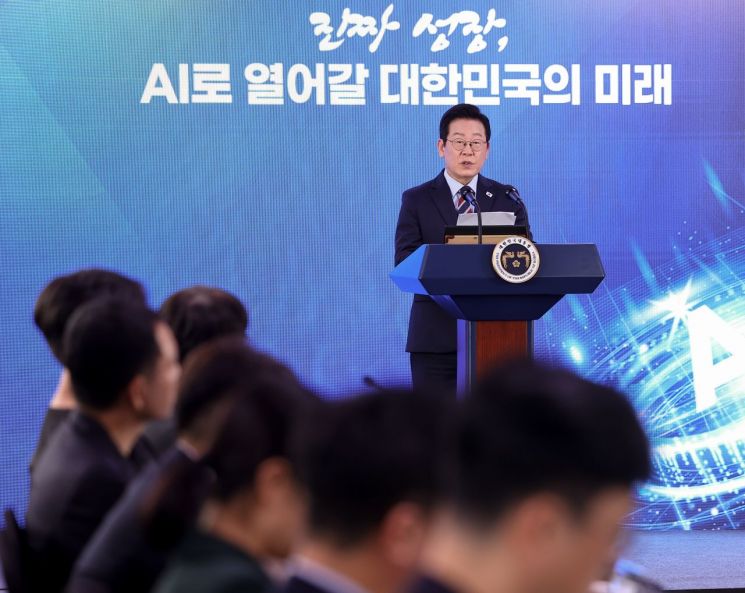
The National Artificial Intelligence Strategy Committee, chaired by President Lee Jaemyung, was officially launched on September 8. As the highest-level body overseeing the government's artificial intelligence (AI) policy, the committee plans to announce the "Korea AI Action Plan," which will include specific implementation measures, by November this year.
The committee held its inauguration ceremony and the first plenary meeting on the 17th floor of Seoul Square on the same day, marking the start of its full-scale activities. Lim Moonyeong, CEO of Future Transition, will serve as the standing vice chairperson and will be responsible for the committee's practical operations.
With the launch of this committee, the government aims to unify the previously fragmented AI policies of various ministries to increase momentum. In particular, 34 private sector experts will be assigned to eight subcommittees to ensure that insights from the field are reflected in policy-making.
The first agenda item reported at the meeting was the direction for advancing the Korea AI Action Plan. This includes a detailed roadmap for achieving the Lee Jaemyung administration's key pledge of making Korea one of the world's top three AI powerhouses. The plan sets out three main policy pillars: fostering an AI innovation ecosystem, facilitating a nationwide AI-driven transformation, and contributing to a global AI-based society. Under these pillars, 12 strategic areas have been identified. By November, the committee intends to compile and announce a comprehensive action plan that integrates detailed implementation tasks from each ministry. The committee also plans to significantly expand AI adoption in both industry and the public sector, and to actively utilize AI in the cultural and defense sectors to create new growth engines.
Another agenda item was the establishment of a National AI Computing Center. The government announced plans to create a special purpose company (SPC) through a public-private partnership, aiming to secure 15,000 advanced GPUs by 2028 and 50,000 by 2030. The previously proposed private sector shareholding cap of 49% has been raised to over 70%. The mandatory adoption requirement for domestic AI semiconductors (50%) has also been removed to ease the investment burden on the private sector.
Specific preparations regarding the AI Basic Act, which is scheduled to take effect in January next year, were also made public. To minimize confusion among businesses, the government will revise subordinate regulations and guidelines, and will implement a "grace period" during the initial phase, during which fines will not be imposed. The government also plans to clarify the criteria for determining high-impact AI and the obligations of service providers to reduce uncertainty for businesses. During the grace period, consulting and financial support for companies will be provided in parallel.
Vice Chairperson Lim Moonyeong emphasized, "The National Artificial Intelligence Strategy Committee will operate as a mission-oriented organization that leverages collective intelligence. By combining public value with private sector efficiency, we will prioritize speed and results."
Going forward, the committee will begin developing specialized policies within each subcommittee, while also strengthening policy implementation through the National Artificial Intelligence Officers Council, which is comprised of vice-ministerial officials from each ministry.
© The Asia Business Daily(www.asiae.co.kr). All rights reserved.

















