Manufacturing and Construction Weaken,
Service Sector Leads Job Growth
The domestic labor market is freezing. As of August, the number of jobs available per job seeker has hit its lowest point in 27 years since the 1998 International Monetary Fund (IMF) foreign exchange crisis.
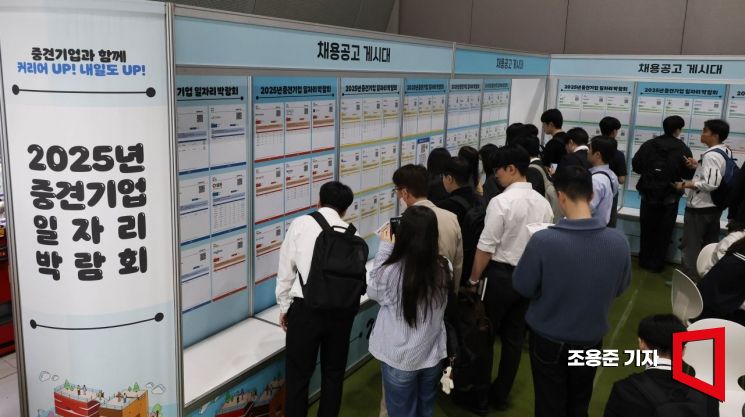 Job seekers visiting the job fair are looking at the recruitment notice board. Photo by Asia Economy Database
According to the "Labor Market Trends Based on Employment Administrative Statistics" released by the Ministry of Employment and Labor on September 8, the number of new job openings on the integrated employment service platform, Employment24, was 155,000 in August, a decrease of 27,000 (15%) compared to the same month last year. In contrast, the number of new job seekers registered on Employment24 last month was 352,000, an increase of 14,000.
The job openings-to-applicants ratio, which represents the number of jobs available per job seeker, was recorded at 0.44. This is lower than the same month last year (0.54) and marks the lowest level since August 1998 (0.26). However, the Ministry of Employment and Labor noted that the ratio has been rising since it hit 0.28 in January this year, expressing a positive outlook for the future job market.
The number of regular workers enrolled in employment insurance was 15,627,000, an increase of 182,000 (1.2%) from last year. Although the pace of increase has slowed since 2022, the number has continued to rise by around 180,000 for five consecutive months this year.

Manufacturing and Construction Slump, Service Sector Drives Employment
By industry, the number of employees in the service sector increased by 209,000, driving overall employment growth. However, the number of employees in manufacturing and construction decreased by 10,000 and 18,000, respectively. The manufacturing sector was affected by sluggish exports and an economic downturn, while the construction sector's decline was mainly attributed to a prolonged industry slump. In manufacturing, the decrease was particularly pronounced in metal processing, textiles, and machinery and equipment, and in construction, the overall construction sector saw a decline for the 25th consecutive month.
By age group, the number of employees increased among those in their 30s, 50s, and those aged 60 and above, but decreased among those under 29 and those in their 40s. By gender, the number of male employees was 8,594,000, an increase of 40,000 from the previous year, while the number of female employees was 7,033,000, an increase of 142,000.
The number of new unemployment benefit applicants was 81,000, a decrease of 5,000 (6.3%) from a year ago. In contrast, the number of recipients increased by 12,000 (2%) to 638,000, and the total amount paid rose by 7.4 billion won (0.7%) to 1.0329 trillion won. Cheon Kyungki, head of the Future Employment Analysis Division at the Ministry of Employment and Labor, predicted, "As involuntary unemployment is decreasing, there is a possibility that the total amount paid will decrease in the second half of the year."
© The Asia Business Daily(www.asiae.co.kr). All rights reserved.
![Clutching a Stolen Dior Bag, Saying "I Hate Being Poor but Real"... The Grotesque Con of a "Human Knockoff" [Slate]](https://cwcontent.asiae.co.kr/asiaresize/183/2026021902243444107_1771435474.jpg)
















