4th Hackathon Focuses on Applying AI to Business Operations
A Record 837 Participants from All Affiliates
Chairman Huh Taesu: "Combining On-Site Expertise with AI Is Key"
GS Group is accelerating its on-site AI innovation efforts.
On September 8, GS held the 4th GS Group Hackathon at the Harmony Ballroom of the Westin Hotel Chosun in Samseong-dong, Gangnam-gu, Seoul, aiming to integrate artificial intelligence (AI) into various business sites. This year's theme, "PLAI (Play with GenAI)," emphasizes the idea of joyfully utilizing generative AI to drive on-site innovation. A record 837 participants (256 teams) from 58 companies, including group affiliates and external organizations, joined the event, marking the largest scale to date. GS Chairman Huh Taesu toured the venue for about 30 minutes, reviewing each team's solutions and encouraging the participants.
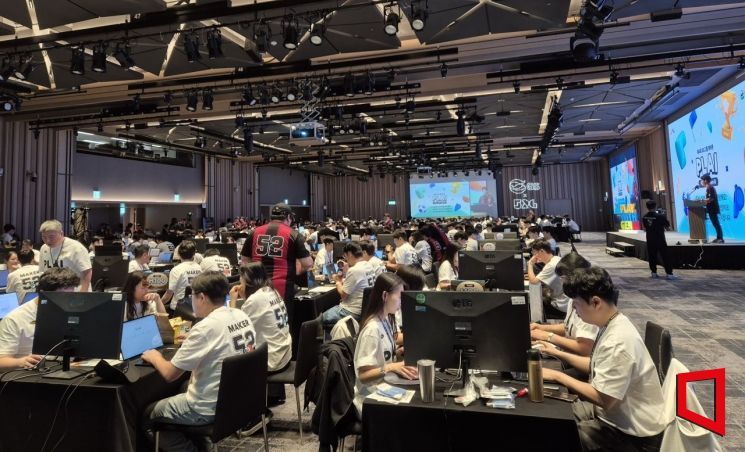
Over a period of approximately 30 hours during the two-day, one-night event, participants defined problems, proposed solutions, and created service prototypes. Ideas focused on business sites such as gas stations, convenience stores, and construction sites. GS Caltex proposed linking public information from the Korea Meteorological Administration and the Korea Forest Service to display alerts at individual gas stations in order to prevent disaster-related accidents. GS Power suggested ways to improve the accuracy of retail heat demand forecasting, while GS Gumi Cogeneration Power Plant proposed a system to digitize accumulated manuals and know-how and automatically provide pre-work preparation documents.
Selected outstanding teams will move forward with actual implementation, supported at the group level.
Starting this year, GS introduced its proprietary AI transformation platform "MISO" and Vercel's global tech company vibe coding tool "V0," drawing attention. By combining these two platforms, even employees without development experience can create software using only natural language input, which has significantly improved the quality of the hackathon outputs.
Jina Kim, Executive Director of GS 52G (Open Innovation GS), said at a morning press conference, "Voluntarism is the most important keyword, so there are no cash prizes or incentives," adding, "Our goal is to lower the barriers to AI so employees can define and solve problems themselves." The in-house innovation organization "52G," launched in 2020, has led over 200 projects to date and is working on about 60 projects this year alone.
On-site, tangible results are being achieved as employees directly solve problems, such as the GS Caltex safety chatbot, GS Power news clipping automation, and the GS EPS biomass chemical dispatch system. Executive Director Kim noted, "More than 40 external companies have inquired about benchmarking, reflecting the industry's high level of interest," and added, "We will actively share GS's cases based on on-site experience."
Chairman Huh stated, "When employees' on-site domain knowledge is combined with AI, it can provide the key to problem-solving," and added, "AI realizes its value only when it is applied to real business." He continued, "GS will actively develop and disseminate platforms and case studies to contribute to the advancement of South Korea's AI ecosystem."
Through this hackathon, GS Group aims to go beyond a simple idea competition by strengthening a virtuous cycle where on-site problem-solving leads to expanded AI utilization. The group also plans to broaden participation to affiliates and external organizations, presenting a field-oriented AI expansion model for the entire domestic industry.
© The Asia Business Daily(www.asiae.co.kr). All rights reserved.

















