Official Talks Between Business Community and Ruling Party Leadership
Ruling Party Seeks to Reassure Amid Corporate Backlash Over Regulations
Business Sector Calls for Adjustment of Economic Criminal Laws
The business community has officially requested the ruling party leadership to ease the requirements for the crime of breach of trust. This meeting was organized so that the Democratic Party of Korea leadership could listen to the opinions of business organizations ahead of the regular National Assembly legislative session. Sensitive issues for the business sector, such as the relaxation of breach of trust regulations, responses to U.S. tariffs, and amendments to the Commercial Act, were intensively discussed.
On September 8, the Korea Chamber of Commerce and Industry held a policy meeting on economic issues with the ruling party leadership, including Jeong Cheongrae, leader of the Democratic Party, Lee Eonju, Supreme Council member, and Han Jeongae, Chair of the Policy Committee. This is the first time that the business community and the ruling party leadership have officially discussed policy matters together.
This meeting is considered significant as it was held amid the continued push for economic criminal legislation following the launch of the Lee Jaemyung administration. The business sector has expressed dissatisfaction, arguing that the passage of the Yellow Envelope Act (amendments to Articles 2 and 3 of the Trade Union and Labor Relations Adjustment Act) and the Commercial Act amendment amounts to excessive "corporate regulation." Some interpret the ruling party's engagement with economic organizations as an effort to appease businesses.
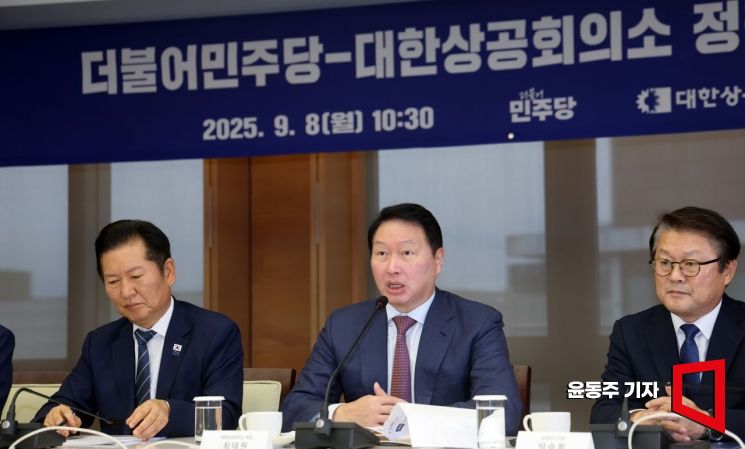 On the 8th, at the Korea Chamber of Commerce and Industry in Jung-gu, Seoul, Choi Taewon, chairman of the Korea Chamber of Commerce and Industry, is delivering opening remarks at the "Democratic Party of Korea-Korea Chamber of Commerce and Industry Policy Meeting." Photo by Yoon Dongjoo
During his opening remarks, Chairman Choi Taewon pointed out the slowdown in South Korea's economic growth and stressed the need for a new strategy. He said, "Over the past five years, the economy grew at an average annual rate of 2.7%, but it fell to 2.0% in the following five years, and this year it is expected to remain in the 0% range." He added, "It will be difficult to achieve growth above 1% over the next five years." He further emphasized, "The recovery of the real economy is slow, economic fundamentals have weakened, and we are facing both tariff shocks and the limits of export-driven growth. Therefore, a new growth strategy is needed."
In response, Leader Jeong Cheongrae said, "I fully agree with Chairman Choi's point that the key is to provide safeguards and rewards in the market so that companies can grow on their own." He added, "This awareness of the issue is also closely aligned with the fair economy, a core task of the Lee Jaemyung people's sovereignty government." He also emphasized that communication with the business sector would be strengthened by meeting quarterly.
The main point of contention in the breach of trust discussion is the extent to which executive decision-making should be subject to criminal liability. Critics argue that the current legal provisions are too vague, resulting in repeated indictments for breach of trust even for unavoidable losses incurred during new business investments or overseas expansion. The business community stressed the need to revise legal standards, calling for the codification of the business judgment rule, clarification of the requirements for damages, and strengthening of the "intent to gain benefit" requirement.
During the closed-door meeting, major issues facing companies were brought to the table. First, in relation to high U.S. tariffs and negotiations over the Make America Secure and Grow Act (MASGA), there was a request to devise support measures for the entire industry. Companies urged the government and the National Assembly to establish institutional mechanisms to minimize the burden on businesses, as uncertainty in the U.S. market is increasing.
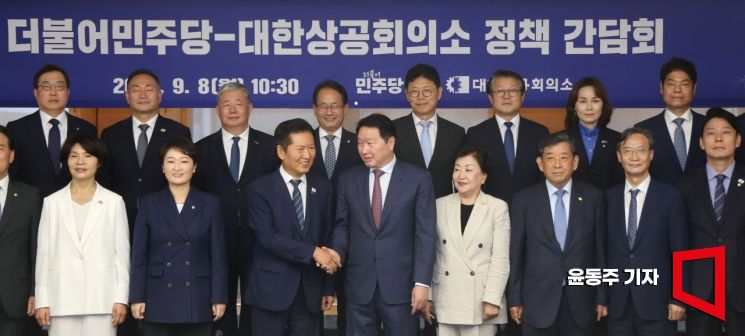 On the 8th, at the Korea Chamber of Commerce and Industry in Jung-gu, Seoul, participants including Jeong Cheongrae, leader of the Democratic Party, and Choi Tae-won, chairman of the Korea Chamber of Commerce and Industry, are taking a commemorative photo before the start of the "Democratic Party-Korea Chamber of Commerce and Industry Policy Meeting." Photo by Yoon Dongju
Concerns were also raised about the amendments to the Commercial Act and the Yellow Envelope Act. The business community argued that recent legislative measures could excessively constrain management activities and labor relations, and called for supplementary measures. There was also an opinion that various economic criminal regulations that restrict executive decision-making should be reasonably adjusted. It was pointed out that the revised legal framework imposes excessive burdens on businesspeople, negatively affecting innovative investment and job creation.
Regarding energy transition policy, companies continued to make suggestions about the government's plan to create "RE100 industrial complexes." While they agreed on the need for a transition to renewable energy, they insisted that tax support or institutional improvements must accompany the plan to address real-world issues such as power infrastructure and cost burdens. In addition, with about 50 days remaining until the Asia-Pacific Economic Cooperation (APEC) summit in Gyeongju, there were calls for support from the National Assembly in preparing for the event.
At the meeting, the response to the incident in which about 300 Korean workers were detained during an immigration crackdown at the Hyundai Motor Group and LG Energy Solution joint battery plant in Georgia, U.S., was also a major topic of discussion. Chairman Choi Taewon said, "Last weekend, workers were arrested and detained at the Hyundai-LG joint battery plant in Georgia, U.S., but thanks to the government's swift response, they were released in three days." He added, "We ask for the Democratic Party's attention and support in addressing structural issues such as measures to prevent recurrence and securing visa quotas."
In addition to Chairman Choi, the meeting was attended by the heads of major regional chambers of commerce and executives from leading companies such as Samsung, SK, LG, POSCO, Hanwha, Emart, and CJ.
© The Asia Business Daily(www.asiae.co.kr). All rights reserved.


















