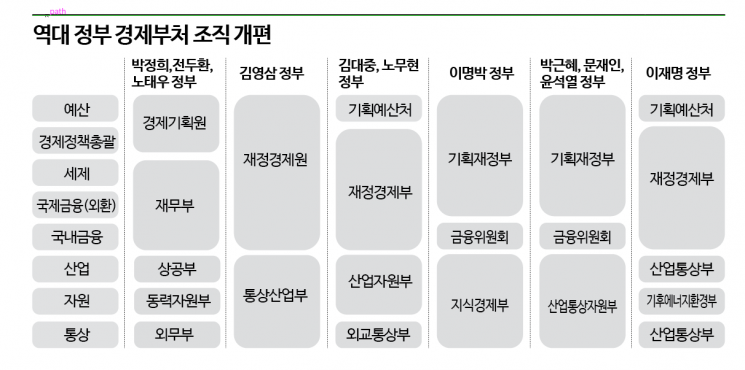
The Ministry of Economy and Finance, which has overseen economic and fiscal policy, will be split for the first time in 18 years as of January 2 next year. The government has finalized a reorganization plan that will divide the ministry into the Ministry of Finance and Economy and the Ministry of Planning and Budget, and will also restructure the Financial Services Commission into the Financial Supervisory Commission. There are concerns that, as these two organizations are separated, competition between ministries over policy capabilities may intensify, which could reduce the efficiency of decision-making within the government.
With this reorganization, the system of 'Ministry of Finance and Economy - Ministry of Planning and Budget - Financial Supervisory Commission,' which operated during the Kim Dae-jung and Roh Moo-hyun administrations from 1999 to 2008, will effectively be revived. The Ministry of the Interior and Safety explained on the 7th, "This measure is intended to disperse the excessively concentrated authority of the Ministry of Economy and Finance and to lay the foundation for addressing complex tasks such as the climate crisis and the major transition to artificial intelligence (AI)."
The Ministry of Finance and Economy will be responsible for overseeing and coordinating economic policy, taxation, the national treasury, finance, and the management of public institutions, with the minister concurrently serving as Deputy Prime Minister for Economic Affairs. Domestic financial policy, previously handled by the Financial Services Commission, will also be transferred to the Ministry of Finance and Economy and unified with international finance. The Ministry of Planning and Budget will be newly established as a ministerial-level agency under the Prime Minister, overseeing budget formulation, fiscal policy and management, and mid- to long-term national development strategies.
This is the first reorganization in 18 years since the Lee Myung-bak administration merged the Ministry of Finance and Economy and the Budget Office to launch the Ministry of Economy and Finance in 2008. At the time, the need for a 'one-voice' control tower was emphasized to respond to the global financial crisis and to ensure policy consistency. However, over time, criticism grew that the Ministry of Economy and Finance was "dominating all other ministries," and concerns were raised that the monopoly over budget authority hindered policy diversity and transparency.
However, some point out that, in reality, the two ministries could end up competing over the role of policy planning, which may actually reduce the efficiency of policy implementation. The most significant change in this reorganization is that the Ministry of Planning and Budget is explicitly tasked with "formulating the budget, fiscal policy and management, and establishing mid- to long-term national development strategies that require large-scale fiscal resources." In particular, the responsibility for establishing mid- to long-term national development strategies stands out. This was previously the role of the Economic Planning Board, which was a deputy prime minister-level ministry, but will now be handled by the Ministry of Planning and Budget rather than the Ministry of Finance and Economy. As a result, there are expectations within the Ministry of Economy and Finance that the separation of the ministry could lead to a system in which the two ministries compete for leadership in policy planning.
An official from the Ministry of Economy and Finance stated, "During the Roh Moo-hyun administration, the Budget Office produced highly successful policies such as 'Vision 2030,'" adding, "This reorganization is essentially intended to foster competition between the two ministries over policy." The official continued, "Since we have worked together for over a decade, there may be cooperation immediately after the reorganization, but as time passes, cooperation could become more difficult." Another official commented, "In the past, officials at the Budget Office even referred to themselves as the 'Planning Office,' with both ministries emphasizing their own planning capabilities. Even now, the Budget Bureau has absorbed and emphasizes policy capabilities through the budget, so if the organizations are completely separated, there will likely be competition between the two ministries for policy leadership."
It is also pointed out that the policy capabilities of the Ministry of Finance and Economy, which will not have budget authority, could be relatively weakened. If the budget function is separated into another ministry, the ability to discover and coordinate policy tasks through persuasion and negotiation with other ministries could lose momentum. There are also concerns that, as the Deputy Prime Minister for Economic Affairs loses influence, various meetings chaired by the Deputy Prime Minister-such as the Economic Ministers' Meeting and the External Economic Ministers' Meeting-may not be managed as smoothly.
An official from the Ministry of Economy and Finance said, "Even before the reorganization was announced, there were concerns that the loss of leverage to persuade other ministries could significantly reduce work efficiency." The National Assembly Research Service also pointed out in its July report, "Issues and Tasks in the Reorganization of Economic Ministries," that "under the Ministry of Finance and Economy-Budget Office system, the policy coordination power of the Ministry of Finance and Economy without budget authority was weakened," and called for supplementary measures.
There are also concerns that mediation could become even more complicated if the Ministry of Finance and Economy, as the control tower for economic policy, and the Ministry of Planning and Budget, which holds the authority to formulate the budget, come into conflict. Even within the current Ministry of Economy and Finance, the growth-oriented policy line and the budget line, which emphasizes fiscal soundness, have often clashed, with the Deputy Prime Minister stepping in as the final mediator to maintain balance. However, if the ministries are separated, there will be no central figure to play this role, and subtle power struggles over policy direction may become a reality.
With the announcement of the reorganization, there is intense interest within the Ministry of Economy and Finance regarding which departments will be transferred to the Ministry of Planning and Budget. The Future Strategy Bureau and the Economic Structure Reform Bureau, which are responsible for mid- to long-term national development strategies, are possible candidates, but there is much speculation about which divisions or teams within each bureau will move. For example, it is unclear whether the Human Resources Policy Division or the Population Economy Division, which are responsible for developing mid- to long-term strategies, will be transferred to the Ministry of Planning and Budget or remain with the Ministry of Finance and Economy. In addition to these bureaus, it is also uncertain whether the Fiscal Management Bureau, which is in charge of long-term fiscal projections, will be transferred to the Ministry of Planning and Budget.
© The Asia Business Daily(www.asiae.co.kr). All rights reserved.
![Clutching a Stolen Dior Bag, Saying "I Hate Being Poor but Real"... The Grotesque Con of a "Human Knockoff" [Slate]](https://cwcontent.asiae.co.kr/asiaresize/183/2026021902243444107_1771435474.jpg)
















