Store Expansion Reaches Its Limit... Cosmetics as the Breakthrough for Growth
'Following Daiso's Lead' in the Retail Industry
'Low Margins but Stable Sales'... A Win-Win for Cosmetics Brands
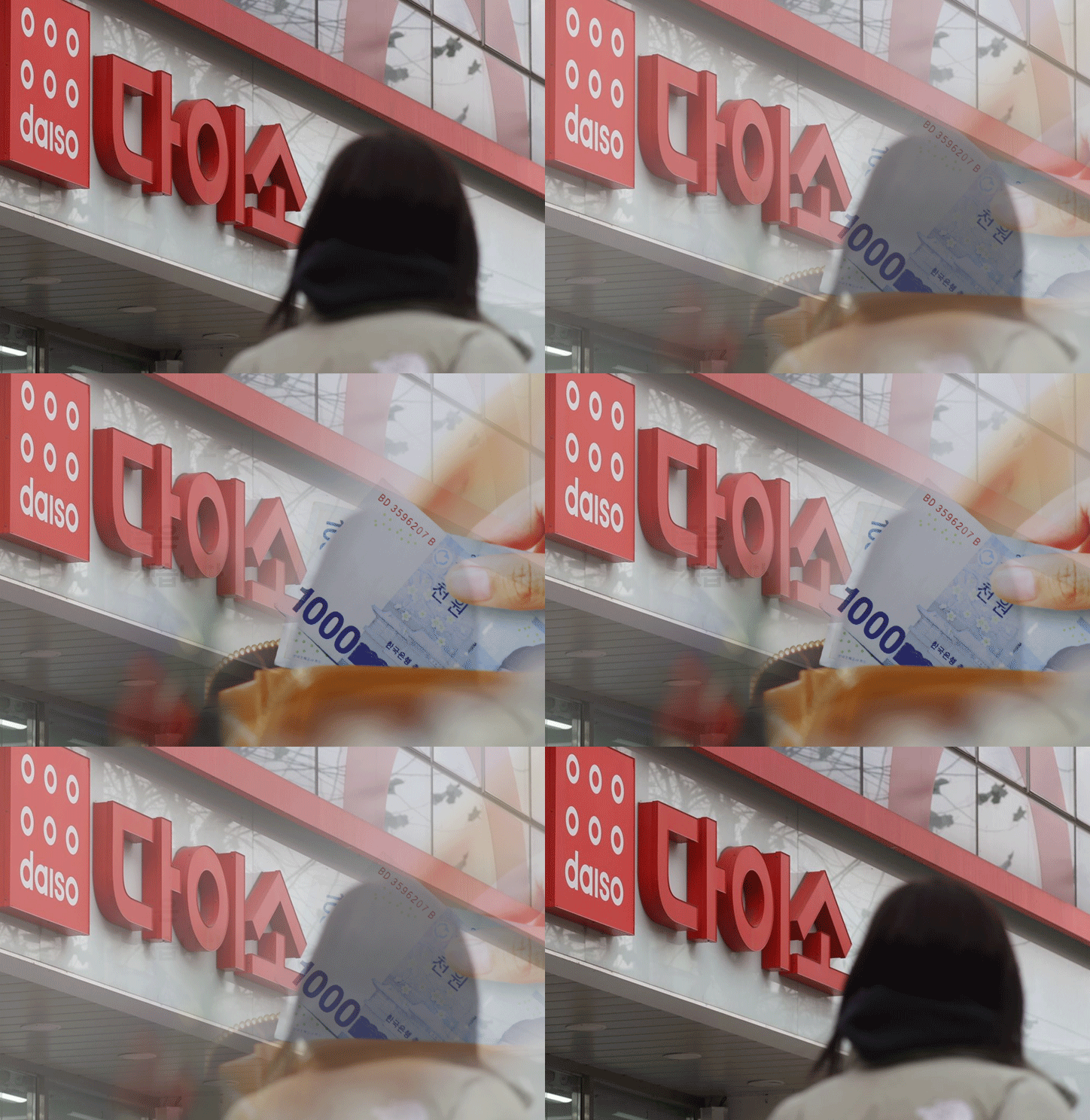
Daiso has issued a challenge to Olive Young, which effectively holds a monopoly in the domestic offline cosmetics channel, leveraging cost-effectiveness as its main weapon. Daiso has expanded its cosmetics shelves to a near "shop-in-shop" scale, and has begun to introduce not only major brands but also small and medium-sized independent brands. On September 8, Meritz Securities analyzed in its report "Rapidly Changing Domestic Cosmetics Distribution Market" that Daiso's strategy has started to spread to other domestic retailers such as Emart and Lotte Mart.
Store Expansion Reaches Its Limit... Cosmetics as a Breakthrough for Growth
Daiso initially filled its shelves with the second brands of major brands that had succeeded at Olive Young, or with Daiso-exclusive brands. However, it has recently opened its doors to small and medium-sized indie brands as well. Daiso is also requesting ODM companies to produce exclusive brands. Park Jongdae, an analyst at Meritz Securities, explained, "The reason Daiso is aggressively pushing into the cosmetics category is likely because growth through increasing the number of stores has reached its limit."
In Korea, there is an unwritten rule that, based on commercial districts and profit structures, there are no more locations to open once a company exceeds 1,500 directly managed stores. Aritaum's growth also stalled at 1,500 stores, and Olive Young began to see a decline in per-store sales after reaching 1,500 outlets. Now, Daiso has also reached 1,500 stores. Analyst Park stated, "Improving the category mix has become extremely important for Daiso, and it appears they have chosen cosmetics as the breakthrough. The recent increase in cosmetics demand from inbound foreign customers also seems to have played a role." Over the past year, Daiso's sales to foreign customers are reported to have increased by 50%.
'Following Daiso's Lead' in the Retail Industry
Since April, Emart has also begun launching products priced at 4,950 won. The company has expanded its cosmetics-related merchandising (MD) team. By collaborating with existing in-store brands such as Traders and Everyday, the number of brands has rapidly increased. Some products have reportedly been reordered multiple times due to strong performance.
Regarding Emart's strategy, Analyst Park commented, "Olive Young, as a store limited to the cosmetics category, was not a threat to Emart. However, Daiso is a comprehensive household goods retailer, and 30% of its categories overlap with Emart. If Daiso attracts more customers by expanding its cosmetics category, it could be problematic for Emart." He added, "If Emart aggressively expands its cosmetics category, Lotte Mart will also find it difficult to stand by. The offline market competition that began with Daiso is gradually intensifying."
'Low Margin but Stable Sales'... A Win-Win for Cosmetics Brands
The domestic cosmetics distribution network is thus becoming more diverse. While Olive Young, the "offline powerhouse," targets consumers in their 20s and 30s with mid-priced products, Daiso focuses on teenagers with ultra-low prices, and home shopping channels target consumers in their 50s and 60s with mid-to-high-priced products. Daiso is now expanding its categories beyond teenagers to include women in their 20s and 30s, as well as men. Recently, as requests to enter home shopping channels have increased, these channels are also considering expanding into mid-priced products.
Domestic cosmetics brands are welcoming the expansion of distribution channels. According to Meritz Securities, Olive Young has traditionally passed product prices onto consumers while shifting marketing costs onto brand companies. This has led more brands to forgo entering Olive Young and instead directly enter markets in Japan or the United States due to the marketing cost burden.
However, as brand companies gain more opportunities to enter various offline channels such as Daiso, Emart, and Lotte Mart, they are able to test their brands domestically. Even with lower margins, they can secure stable sales. This allows them to pursue strategies to generate profits overseas while minimizing risk.
© The Asia Business Daily(www.asiae.co.kr). All rights reserved.
![Clutching a Stolen Dior Bag, Saying "I Hate Being Poor but Real"... The Grotesque Con of a "Human Knockoff" [Slate]](https://cwcontent.asiae.co.kr/asiaresize/183/2026021902243444107_1771435474.jpg)















