Omokgyo Underpass Construction Halted Due to Resident Inconvenience
Central Median to Be Removed for Lane Expansion
Surface-Level Conversion to Be Reconsidered After Seoul-Gwangmyeong Expressway Completion
The Seoul Metropolitan Government has decided to halt the surface-level road construction project on the Seoul Western Arterial Road. The project aimed to remove the underpass and convert the area into a surface-level road, but the city determined that the construction was causing increased inconvenience for local residents.
On September 8, the Seoul Metropolitan Government announced that it would completely suspend construction on the Omokgyo Underpass, which is the first phase of the surface-level road project on the Seoul Western Arterial Road that began in June. Instead, the city will shift its approach to expanding road capacity.
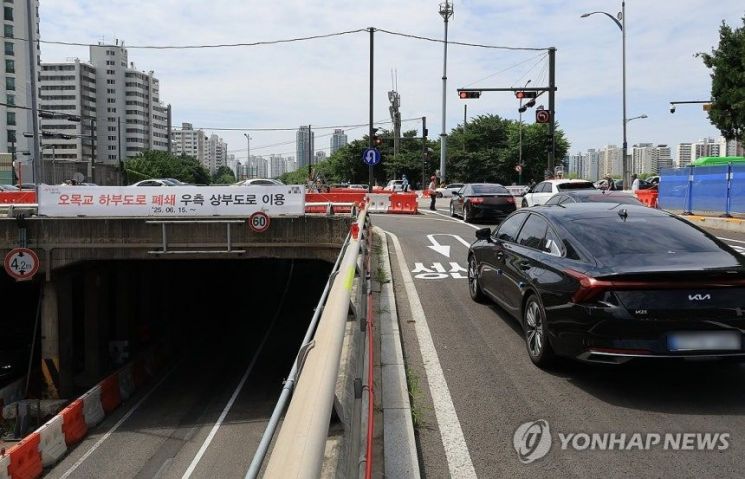
This project involved removing the underpass on the Seoul Western Arterial Road and transforming the ground level into a surface road and pedestrian space. The aim was to improve accessibility between areas separated by the road, create a waterfront-friendly city, and secure more green space by narrowing lane widths through the conversion to a general road. With a total project cost exceeding 120 billion won, the Seoul Metropolitan Government had initially planned to complete the project ahead of the originally scheduled date of June 2026.
However, due to a lack of alternative roads, traffic inconveniences increased during construction, and concerns were raised that vehicle flow would worsen after the intersection was converted to a surface road. Although the initial basic plan established in 2013 focused on "pedestrian-friendly" and "green space expansion" design, critics pointed out that these plans no longer fit the current traffic situation.
In response, the Seoul Metropolitan Government will immediately halt construction of the east-west underpass and complete restoration work before the Chuseok holiday to minimize inconvenience for citizens. Instead, the city will prioritize alleviating rush hour traffic congestion, quickly restore road functionality, and focus on improving traffic flow by increasing road capacity.
The central median in the middle of the road will be reduced in size. In its place, an additional lane will be added, increasing the number of lanes from four to five. The city is considering operating the new lane as a reversible lane, depending on traffic volume during peak commuting hours. Traffic signals at intersections, which were originally planned for the general road conversion, will be put on hold to maintain continuous vehicle flow.
Although the surface-level road project has been suspended, the city will continue to explore ways to connect the east-west residential areas in the southwest that have been divided by the Seoul Western Arterial Road. Plans include actively pursuing new uses of space, such as installing wide and accessible pedestrian overpasses and creating park spaces above the road, to maintain transportation functions while also enhancing residents' quality of life and urban vitality.
The city will also reconsider whether to resume the general road and surface-level conversion of the Seoul Western Arterial Road after the government-led Seoul-Gwangmyeong Expressway is completed. The expectation is that the addition of alternative roads will help disperse traffic volume. Han Byungyong, Director of Disaster and Safety at the Seoul Metropolitan Government, said, "The Seoul Metropolitan Government prioritizes easing traffic congestion and minimizing inconvenience for citizens," adding, "We will gradually implement policies that can increase the benefits for both road users and nearby residents, taking into account both the need to address traffic issues and reconnect divided neighborhoods."
© The Asia Business Daily(www.asiae.co.kr). All rights reserved.
![Clutching a Stolen Dior Bag, Saying "I Hate Being Poor but Real"... The Grotesque Con of a "Human Knockoff" [Slate]](https://cwcontent.asiae.co.kr/asiaresize/183/2026021902243444107_1771435474.jpg)















