The Party and Government to Enhance Response Capabilities for Comprehensive Natural Disaster Measures
On September 7, in addition to announcing a government reorganization plan, the ruling party and the government also introduced measures for the prevention of major industrial accidents and responses to natural disasters. To improve the prevention of major industrial accidents, they decided to elevate the Industrial Safety and Health Bureau, which is responsible for industrial safety and health policies within the Ministry of Employment and Labor, to a vice-ministerial level.
Han Jeongae, Policy Committee Chair of the Democratic Party of Korea, gave a briefing after the high-level party-government council meeting, stating, "The party and the government discussed a comprehensive labor safety plan to protect workers' lives and safety and to eradicate major industrial accidents in the workplace. The party has requested the government to strengthen support for small businesses with limited safety management capacity so that they can prevent major accidents in advance, and to prepare effective sanctions to prevent recurrence at companies with frequent accidents."
In this regard, the government proposed introducing effective sanctions and incentives. First, for workplaces where accidents occur repeatedly, the government will prepare effective economic sanctions to prevent recurrence. Since the root cause of industrial accidents often lies in the pursuit of profit, the aim is to curb the incentive for profit-seeking through strong economic sanctions. Conversely, for workplaces that excel in safety prevention efforts, the government will guarantee tangible benefits, creating a structure where accident prevention is advantageous for both labor and management.
In addition, local governments and private organizations will also cooperate to establish prevention systems from the perspective of industrial accident prevention.
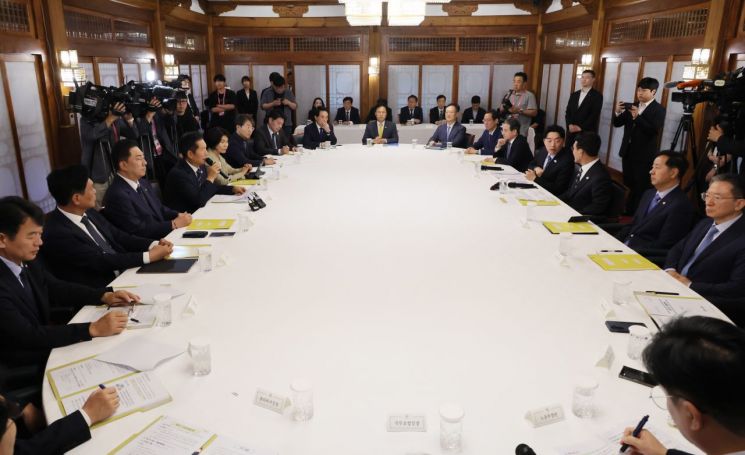 Jeong Cheongrae, leader of the Democratic Party of Korea, is speaking at the high-level party-government council held at the Prime Minister's official residence in Jongno-gu, Seoul on the 7th. Photo by Yonhap News Agency
In connection with this, the party and the government decided to elevate the Industrial Safety and Health Bureau, which is responsible for industrial safety and health policies within the Ministry of Employment and Labor, to a vice-ministerial level through the government reorganization. Yoon Hojoong, Minister of the Interior and Safety, explained the purpose of this reorganization, stating, "We will establish an industrial safety and health system that covers all workers and strengthen the overall coordination function for the prevention and response to various industrial accidents."
Jeong Cheongrae, leader of the Democratic Party of Korea, promised in his public remarks that day, "At the party level, we will actively support any measures we can, including amendments to the Industrial Safety and Health Act."
The Party and Government to Enhance Response Capabilities for Comprehensive Natural Disaster Measures
The party and the government also prepared a comprehensive, all-government plan for natural disasters.
Policy Committee Chair Han explained, "The party has urged the government to establish fundamental measures to reduce natural disaster damage from a long-term perspective and to secure sufficient budgets for these efforts. In particular, we requested active consideration of ways to provide substantial support for recovery budgets that are directly linked to the livelihoods and daily lives of affected residents." In response, the government stated, "We will gradually expand the physical infrastructure to cope with extreme weather, diversify temporary housing such as modular homes, and secure additional essential relief supplies to strengthen recovery and support for disaster victims." Furthermore, the government will actively utilize technologies such as artificial intelligence (AI). The party and the government also announced, "We will strengthen AI-based disaster prediction and response capabilities, and reinforce a national integrated response system so that the central government, local governments, and civil society can cooperate in responding to disasters."
Leader Jeong emphasized in his public remarks, "If we only chase after damage and focus on recovery, we risk repeating the same makeshift responses every time. After visiting disaster and flood recovery sites, I have seen that local government leaders are now talking about recovery that goes beyond simply restoring things to their original state. Now is the time when efforts for improved recovery that reduces the root causes and strengthens prevention are more urgently needed."
© The Asia Business Daily(www.asiae.co.kr). All rights reserved.
![Clutching a Stolen Dior Bag, Saying "I Hate Being Poor but Real"... The Grotesque Con of a "Human Knockoff" [Slate]](https://cwcontent.asiae.co.kr/asiaresize/183/2026021902243444107_1771435474.jpg)















