Prosecutors' Office to Be Replaced by Public Prosecution Office and Serious Crime Investigation Office
Ministry of Economy and Finance to Be Split into Ministry of Planning and Budget and Ministry of Finance and Economy
Ministries of Environment
The Lee Jaemyung administration has finalized its government reorganization plan, which includes the abolition of the Prosecutors’ Office, the separation of the Ministry of Economy and Finance, and the expansion and restructuring of the Ministry of Gender Equality and Family.
On the afternoon of September 7, the Ministry of the Interior and Safety announced the finalized government reorganization plan following a high-level party-government consultation. After the reorganization, the number of central administrative agencies will increase from the current “19 ministries, 3 offices, 20 agencies, and 6 commissions (48 in total)” to “19 ministries, 6 offices, 19 agencies, and 6 commissions (50 in total).”
At the briefing, Minister of the Interior and Safety Yoon Hojoong stated, “This government reorganization is the first step in implementing key national policy tasks that the public desires and supporting the new administration’s policy goals. The aim is to streamline government functions and establish a foundation to address complex issues such as the climate crisis and the major transformation brought by artificial intelligence (AI).”
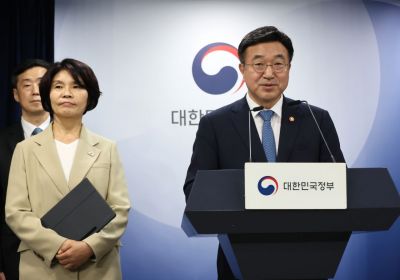
First, the Ministry of Economy and Finance will be divided into the Planning and Budget Office and the Ministry of Finance and Economy. This decision was made due to the excessive concentration of functions such as economic policy formulation and coordination, revenue, and expenditure within the existing ministry. The newly established Planning and Budget Office, under the Prime Minister, will be responsible for budget formulation, fiscal policy and management, and establishing mid- to long-term national development strategies to respond to future societal changes. The Ministry of Economy and Finance will be reorganized as the Ministry of Finance and Economy, overseeing economic policy, tax policy, and treasury functions. The Minister of Finance and Economy will also serve as the Deputy Prime Minister for Economic Affairs, a role previously held by the Minister of Economy and Finance.
There will also be significant changes to the financial policy organizations. The domestic finance functions of the Financial Services Commission will be transferred to the Ministry of Finance and Economy. This aims to enhance consistency between domestic and international financial policies and strengthen the response to financial crises.
Furthermore, the Financial Services Commission will be reorganized as the Financial Supervisory Commission, which will focus on financial supervision. Under the Financial Supervisory Commission, the Securities and Futures Commission and the Financial Consumer Protection Commission will be established. The Financial Consumer Protection Office, currently an internal organization within the Financial Supervisory Service, will be separated and newly established as the Financial Consumer Protection Agency, and both the Financial Supervisory Service and the Financial Consumer Protection Agency will be designated as public institutions.
The Ministry of Environment will be reorganized as the Ministry of Climate, Energy, and Environment by integrating the energy functions of the Ministry of Trade, Industry, and Energy. Accordingly, the Ministry of Trade, Industry, and Energy will be renamed the Ministry of Trade and Industry. Minister Yoon explained the reason for the reorganization, stating, “Carbon neutrality has long been emphasized as a national task requiring a strong control tower, but the current fragmented government structure has been evaluated as insufficient for comprehensive climate change response.”
In order to unify broadcasting policy functions that have been divided between the Korea Communications Commission and the Ministry of Science and ICT, the Korea Communications Commission will be abolished and the Broadcasting, Media, and Communications Commission will be established. Broadcasting promotion policy functions from the Ministry of Science and ICT will be transferred to this new commission. The number of commissioners will be changed from five standing members to a total of seven, consisting of three standing and four non-standing members, to strengthen public interest.
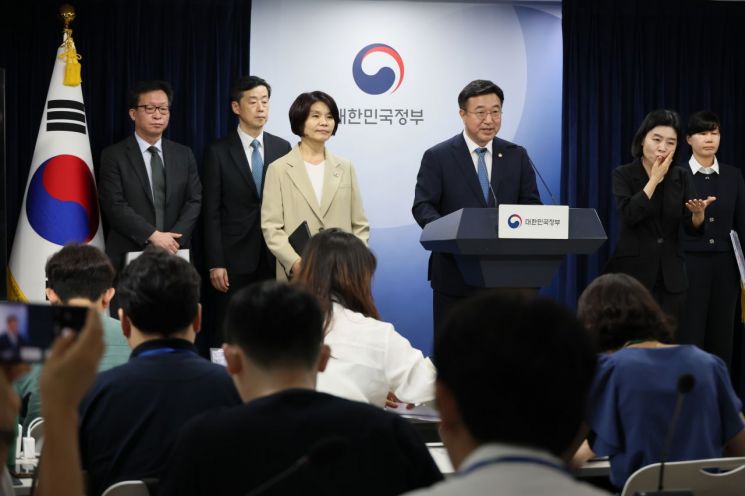
The plan also includes the abolition of the Prosecutors’ Office, a key focus of “prosecutorial reform.” The government will abolish the Prosecutors’ Office and establish the Prosecution Office and the Serious Crimes Investigation Office. The Prosecution Office, under the Minister of Justice, will be responsible for filing and maintaining prosecutions. The Serious Crimes Investigation Office, under the Minister of the Interior and Safety, will take over the serious crime investigation functions previously held by the prosecution. The government will also establish an Intergovernmental Task Force for Prosecutorial Reform under the Prime Minister’s Office and develop detailed plans through close consultation among the party, government, and presidential office.
To oversee and coordinate science and technology and AI, the position of Deputy Prime Minister for Science and Technology will be newly established. The Minister of Science and ICT will concurrently serve in this role, while the position of Deputy Prime Minister for Social Affairs, previously held by the Minister of Education, will be abolished. In addition, the functions of the National Artificial Intelligence Strategy Committee will be expanded and reorganized to focus on essential functions for building the AI ecosystem.
The Ministry of SMEs and Startups will introduce a dual vice-minister system by appointing a second vice minister dedicated to small business owners. The first vice minister will be responsible for small and medium-sized enterprises and startups. Policies for small business owners will be developed and implemented, focusing on support and growth, under the leadership of the dedicated vice minister.
In line with the government’s emphasis on strengthening industrial safety, the Industrial Safety and Health Headquarters under the Ministry of Employment and Labor will be upgraded from director-general to vice-minister level. Minister Yoon stated, “We will establish an industrial safety and health system covering all workers and strengthen the overall coordination and management functions for the prevention and response to various industrial accidents.”
Other changes include: ▲ Upgrading Statistics Korea to the National Data Office ▲ Expanding and restructuring the Ministry of Gender Equality and Family into the Ministry of Gender Equality and Family Affairs ▲ Upgrading the Korean Intellectual Property Office to the Intellectual Property Office.
This reorganization plan will be implemented as soon as the relevant amendments to the Government Organization Act and other laws are promulgated. However, considering the budget review schedule, the reorganization of the Planning and Budget Office, the Ministry of Finance and Economy, and the Financial Supervisory Commission is scheduled to take effect from January 2 next year. The establishment of the Prosecution Office and the Serious Crimes Investigation Office will take effect one year after the promulgation of the relevant laws, taking into account the time needed to prepare detailed reorganization plans.
Minister Yoon added, “Although the plan includes a considerable number of changes, we focused on creating a structure that enables efficient work rather than simply expanding government organizations, in line with the principle of minimizing the burden on national finances and operating government organizations efficiently.”
© The Asia Business Daily(www.asiae.co.kr). All rights reserved.
![Clutching a Stolen Dior Bag, Saying "I Hate Being Poor but Real"... The Grotesque Con of a "Human Knockoff" [Slate]](https://cwcontent.asiae.co.kr/asiaresize/183/2026021902243444107_1771435474.jpg)
















