Impact of Rising Ocean Temperatures Due to Climate Change Suspected
A man who was surfing at a beach in Sydney, Australia, died after being bitten by a shark. This marks the fourth fatal shark attack in Australia this year. Experts report that encounters between sharks and humans are becoming more frequent as ocean temperatures rise due to climate change.
On September 7 (local time), major foreign media outlets such as AP and AFP, citing local police, reported that around 10 a.m. the previous day, a 57-year-old man died after being attacked by a creature believed to be a shark at Long Reef Beach in Sydney, New South Wales, in southeastern Australia.
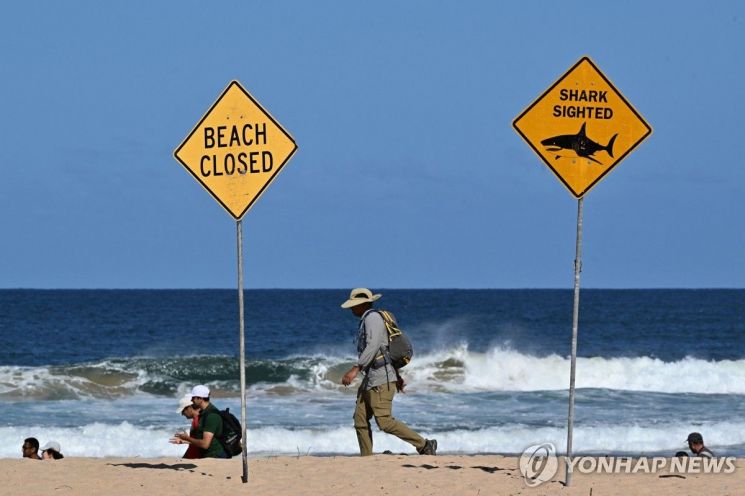 A man who was surfing at the beach in Sydney, Australia, on the 6th (local time) died after being bitten by a shark. Signs indicating 'Shark Sighting' and 'Beach Closure' were installed. Photo by AFP Yonhap News
Australian government biologists analyzed photos of the victim's surfboard and stated that a great white shark, estimated to be about 3.4 to 3.6 meters long, was most likely responsible for the attack.
Following the incident, the beach was temporarily closed. The New South Wales Surf Life Saving team deployed helicopters and drones to monitor shark activity at the site. In addition, rescuers on jet skis patrolled the ocean to watch for any signs of sharks.
According to related databases, more than 1,280 shark attacks have occurred across Australia since 1791, with about 250 of those resulting in fatalities, AFP reported.
Shark sightings at popular beaches are also frequently reported in South Korea.
On August 22, a shark carcass over 3 meters long was discovered in the waters off Yeongdo District, Busan.
At the time, the Busan Coast Guard announced, "We found a shark carcass in the waters in front of the pier in Bongnae-dong, Yeongdo District, Busan, and recovered it at around 6:30 a.m." The shark, measuring 3 meters in length and weighing 100 kilograms, was identified as a salmon shark.
In July last year, a shark was also caught by a fishing boat operating near Taejongdae in Busan.
In September of the same year, the carcass of a shark believed to be a highly aggressive shortfin mako was found in the waters in front of the Jagalchi Cruise dock. Later that month, a crew member night fishing near Saengdo, Yeongdo District, was injured in an attack by a blue shark.
According to the National Institute of Fisheries Science, the number of reports of shark sightings or catches along the East Coast increased dramatically from just one in 2022 to 29 in 2023, and 44 last year.
Experts cite climate change as a reason sharks are increasingly spotted in Korean waters. As sea temperatures rise, the populations of warm-water fish species such as yellowtail, horse mackerel, and Spanish mackerel have increased, leading sharks chasing prey to move closer to shore.
© The Asia Business Daily(www.asiae.co.kr). All rights reserved.
![Clutching a Stolen Dior Bag, Saying "I Hate Being Poor but Real"... The Grotesque Con of a "Human Knockoff" [Slate]](https://cwcontent.asiae.co.kr/asiaresize/183/2026021902243444107_1771435474.jpg)















