"Selection" Authority for 119 Emergency Dispatch Control Center Needed
to Address Emergency Room Ping-Pong
Calls for Legislative Amendment to Allow Direct Hospital Assignment
There has been a recommendation to amend the law so that the 119 Emergency Dispatch Situation Management Center can directly designate hospitals for patient transfers without obtaining prior approval from hospitals, in order to reduce the so-called "emergency room ping-pong," where emergency patients are repeatedly transferred between hospitals.
The National Assembly Research Service stated in its report, "Issues and Measures to Secure Effectiveness of the Emergency Room Admission Refusal Notification Guidelines," published on September 7, that "emergency room ping-pong" essentially refers to a situation where emergency medical teams make multiple phone calls to different medical institutions to obtain transfer approval, amounting to a 'phone ping-pong.' The report explained that, during the COVID-19 pandemic, the process of verifying the capacity of emergency medical institutions became established as a practice of requiring prior approval.
Emergency room ping-pong refers to situations where 119 transfers a patient, but the emergency room refuses to accept them, resulting in another transfer to a different hospital. Despite the amendment to the law in December 2022 to restrict refusal of emergency medical care and the implementation of standard guidelines by the Ministry of Health and Welfare in April last year, the number of re-transfers increased from 4,227 cases in 2023 to 5,657 cases last year. The situation has worsened due to the mass resignation of medical residents.
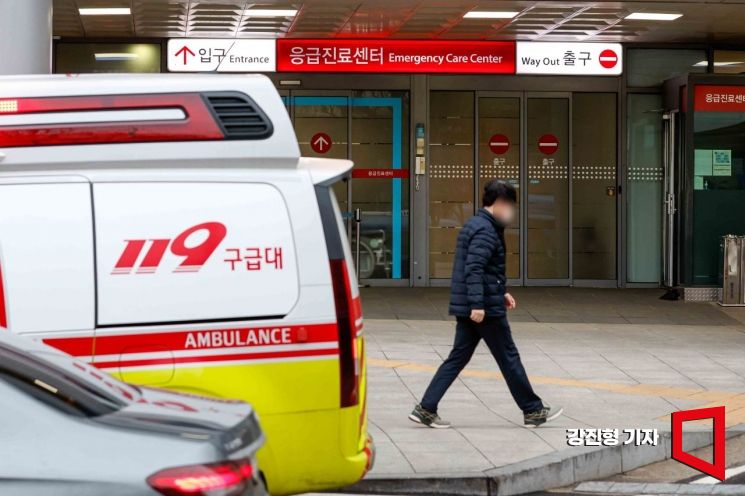
In fact, the reasons for re-transfer reported by 119 emergency teams included "absence of a specialist," "lack of available beds," and "completion of primary emergency care." It was often difficult to determine on-site whether these refusals were legitimate under the law or guidelines.
The National Assembly Research Service pointed out that simply revising the guidelines without addressing the fundamental causes of emergency patient admission refusals at the field level would not effectively resolve emergency room ping-pong. The report recommended that, through follow-up legislation, an information system necessary for selecting transfer hospitals should be established, and the authority to designate hospitals should be granted to the 119 Emergency Dispatch Situation Management Center.
It was suggested that the current 119 Rescue and Emergency Medical Services Act, which defines the authority as "guidance," should be amended to "selection and guidance," and that emergency medical institutions should be required to admit patients accordingly.
Additionally, the report stated that the Emergency Medical Service Act should be revised so that information necessary for selecting transfer hospitals can be provided by linking the National Fire Agency's emergency activity logs, the National Emergency Medical Information System, and the Health Insurance Review and Assessment Service's claims data.
The report further emphasized that unless the fundamental causes of refusal to admit emergency patients-such as emergency room overcrowding, lack of capacity and personnel in 119 emergency teams, and the reluctance of doctors-are resolved, it will be difficult to reduce emergency room ping-pong.
© The Asia Business Daily(www.asiae.co.kr). All rights reserved.
![Clutching a Stolen Dior Bag, Saying "I Hate Being Poor but Real"... The Grotesque Con of a "Human Knockoff" [Slate]](https://cwcontent.asiae.co.kr/asiaresize/183/2026021902243444107_1771435474.jpg)















