U.S. Immigration Authorities Raid Hyundai-LG Plant in Georgia
Over 300 Korean Workers Arrested
"Investment Welcomed, Visas Ignored... Workers Treated as Illegal"
After U.S. immigration authorities raided the joint battery plant of Hyundai Motor and LG Energy Solution in Georgia and arrested more than 300 Koreans, local observers are pointing out that this incident exposes a contradiction in President Donald Trump's economic and immigration policies, which are now coming into direct conflict.
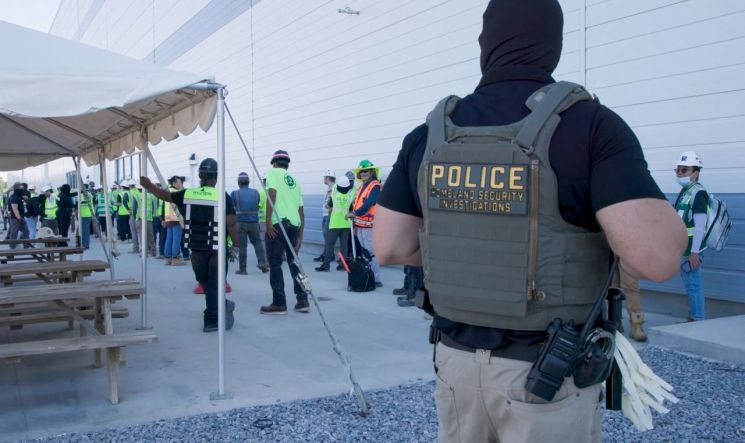
On September 6 (local time), U.S. media reported that this crackdown highlights the double standards of the Trump administration's policies.
The New York Times noted, "Within the Trump administration, this wave of arrests has revealed conflicting interests," adding, "While pushing for the expansion of American manufacturing, the administration has simultaneously carried out aggressive immigration crackdowns, leading to a collision between the two policies." The report pointed out the policy inconsistency of the U.S. government demanding large-scale investments from foreign companies such as those from Korea, while classifying and arresting the very workers needed for factory construction as undocumented immigrants.
Tami Overby, Senior Advisor at Albright Stonebridge Group and former head of the American Chamber of Commerce in Korea, told The New York Times that companies from other countries are receiving mixed messages from the Trump administration: "They want our money, but they don't want us." She added, "This has sent shockwaves across Asia."
The U.S. online media outlet Axios also pointed out, "The fundamental economic policy of the Trump administration is to encourage companies to build factories in the United States," but "at the same time, the intensified immigration crackdowns are causing a shortage of skilled engineers in the U.S., making it difficult to construct factories." The report went on to say, "The raid on the Georgia battery plant demonstrates the contradictions in Trump's economic growth strategy."
In 2023, Korea ranked first among foreign countries in terms of new investment in the U.S. Hyundai Motor also announced that, in addition to its existing $20.5 billion investment, it would invest an additional $21 billion from this year through 2028. In this context, the mass arrest of Korean workers at a core investment site has led to analysis that the South Korea-U.S. relationship is being put to the test. The shock is compounded by the fact that this raid took place just ten days after the South Korea-U.S. summit on August 25.
Mark Kim, president of the Korean American Institute, a policy research organization, criticized, "Raiding a plant where a record amount of money has been invested is not the right way to treat foreign investment." Abraham Kim, president of the Korean American Council, also pointed out, "This mass arrest is unproductive and could fuel resentment."
The New York Times noted, "Businesspeople and experts are concerned that this raid could inflict significant damage on South Korea-U.S. relations, undermine trust, and amplify anger."
Some point out that this situation stems from structural issues related to visa issuance, and that Korean companies have also routinely used expedient practices in this process. Most of the arrested Korean workers held Electronic System for Travel Authorization (ESTA) or short-term business (B-1) visas, which, in principle, do not permit employment activities. To work on-site in the U.S., a professional employment (H-1B) visa is required, but the application process is complicated and subject to quotas. As a result, the industry has routinely dispatched workers using ESTA or B-1 visas. The Trump administration regards this as taking jobs away from Americans.
On the previous day, Representative Buddy Carter (Republican, Georgia) also posted on X (formerly Twitter), "If you think you can take jobs from hardworking Americans and give them to illegal immigrants, you should know that, at least as long as Donald Trump is around, that will not happen."
The New York Times reported, "This raid has sparked conflicting emotions in the region over who will fill the newly created jobs."
Kim Dongseok, president of the Korean American Grassroots Conference (KAGC), commented on the situation, saying, "Rather than deliberately targeting Korea, the issue may have arisen from the use of visas that did not match the purpose of visit or stay," and added, "Under the stricter immigration policies of the Trump era, practices that were previously tolerated are no longer accepted and have become grounds for enforcement."
© The Asia Business Daily(www.asiae.co.kr). All rights reserved.

















