A technology has been developed that allows health conditions to be diagnosed using only sweat, without the need for a blood test, through a patch attached to the skin.
KAIST announced on September 7 that a research team led by Professor Kihoon Jung in the Department of Bio and Brain Engineering has developed a wearable sensor capable of real-time, simultaneous analysis of metabolites in sweat.
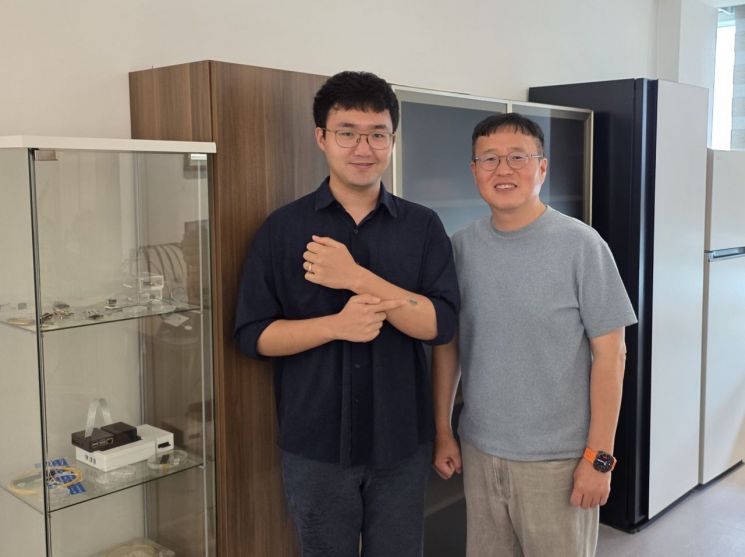 (From left) Jaehoon Jeon, PhD candidate in Bio and Brain Engineering, Kihoon Jung, Professor. Provided by KAIST
Research on wearable sensors that monitor the physiological state of the human body by analyzing metabolites in sweat has been actively pursued for some time.
However, both conventional label-based sensors, which require fluorescence or dye labeling, and label-free methods have faced limitations in effectively collecting and controlling sweat. This has restricted the precise observation of metabolites that change over time in the human body.
To overcome these limitations, the research team developed a thin and flexible wearable sweat patch that can be directly attached to the skin. This patch is equipped with an ultrafine "nanoplasmonic structure" that collects sweat and uses microchannels and light to precisely analyze the components in sweat, enabling simultaneous analysis of multiple metabolites with a single application.
The nanoplasmonic structure refers to an optical sensor design in which nano-sized metallic patterns interact with light, allowing for highly sensitive detection of the presence or concentration changes of molecules in sweat.
The patch developed by the research team integrates "nano-optical technology," which manipulates light at the nanoscale-one hundred-thousandth the thickness of a human hair-to read molecular properties, with "microfluidic technology," which precisely controls sweat within channels thinner than a strand of hair.
By applying microfluidic technology that collects sweat in chronological order to the patch, it has become possible to easily measure changes in various metabolites within the body. Inside the patch, there are between 6 and 17 chambers (storage spaces), and the microfluidic structure is designed so that sweat secreted during exercise sequentially fills each chamber.
The research team also succeeded in continuously tracking changes in the composition of sweat excreted during exercise over time by attaching the patch to the human body.
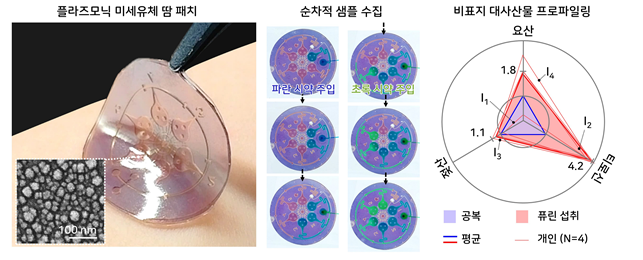
In particular, this study demonstrated that three key metabolites-uric acid, lactic acid, and tyrosine-important biomarkers related to metabolism, exercise, and disease, can be quantitatively analyzed for changes according to exercise and diet.
Through this, the research team emphasized that it is now possible not only to monitor endurance and muscle mass changes during activities such as running, marathons, and fitness training, but also to detect potential risks of conditions such as gout, liver dysfunction, and kidney disease by observing changes in these values.
Professor Jung stated, "This study is significant in that it establishes a foundation for real-time, precise monitoring of metabolic changes in the body using only a sweat patch, without the need for blood sampling."
He added, "The patch is expected to enable not only daily health monitoring but also the detection of muscle changes and diseases in people who enjoy exercise. Based on this, the research team hopes that the technology will be applied in various fields such as chronic disease management, drug response tracking, environmental exposure monitoring, and the discovery of next-generation biomarkers for metabolic diseases."
Meanwhile, this research was supported by the National Research Foundation of Korea, the Ministry of Science and ICT, the Ministry of Health and Welfare, and the Ministry of Trade, Industry and Energy. Jaehoon Jeon, a PhD candidate, participated as the first author. The research results were published online in the international journal Nature Communications on August 27.
© The Asia Business Daily(www.asiae.co.kr). All rights reserved.
![Clutching a Stolen Dior Bag, Saying "I Hate Being Poor but Real"... The Grotesque Con of a "Human Knockoff" [Slate]](https://cwcontent.asiae.co.kr/asiaresize/183/2026021902243444107_1771435474.jpg)
















