Employment of Elderly Workers in Large Corporations Soars by 492% in 20 Years
Youth Employment Declines, Widening Generational Divide
Job Growth Concentrated in Large Corporations,
Entry Barriers for Young Job Seekers Rise
The dual structure of South Korea's labor market has deepened over the past 20 years, resulting in a continuous decline in jobs for small and medium-sized enterprises and for young people. In contrast, employment among elderly workers in large corporations has steadily increased, intensifying intergenerational conflict over jobs.
According to the report "Current Status and Implications of the Dual Structure in South Korea's Labor Market" released by the Korea Employers Federation on September 7, employment of elderly workers in permanent positions at large corporations increased by 492% over the past 20 years (2004-2024), while youth employment declined by 1.8%. In this survey, elderly workers are defined as those aged 55-59, and youth as those aged 23-27.
In particular, among large corporations with labor unions, employment of elderly workers in permanent positions surged by 777% compared to 2004, whereas youth employment actually decreased. As of 2024, the proportion of elderly workers in permanent positions at large corporations reached 9.3%, surpassing the proportion of youth, which stood at 7.3%.
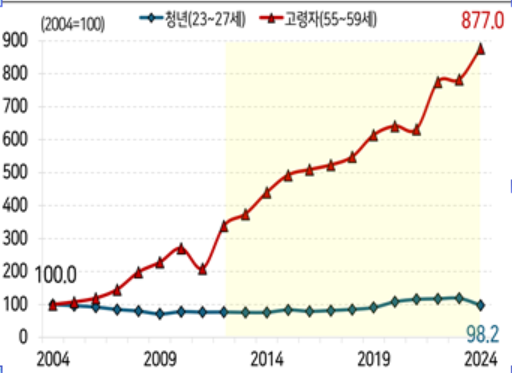 Trends in Employment Index for Elderly and Youth by Major Sector (Based on Large Corporations with Labor Unions). Provided by Korea Employers Federation
The employment situation in large corporations contrasted with that of small and medium-sized enterprises. Over the past 20 years, permanent employment in large corporations increased by 83%, while employment in small and medium-sized enterprises or non-regular positions grew by only 48%. This indicates that employment in South Korea over the past two decades has been mainly concentrated in permanent positions at large corporations.
During the same period, the average length of service for permanent employees at large corporations increased (from 10.4 to 12.1 years), while the rate of new hires declined. A Korea Employers Federation official explained that this suggests the entry barrier to permanent positions at large corporations has become even higher.
Compared to permanent employees at large corporations, the wage level in small and medium-sized enterprises (including non-regular positions) remained stagnant in the mid-to-high 50% range, and the average length of service was less than half that of permanent employees at large corporations. The rates of social insurance enrollment and welfare benefits also remained at the 60-70% level, still lower than those of permanent employees at large corporations.
Lim Youngtae, head of Employment and Social Policy at the Korea Employers Federation, stated, "Since the mid-2010s, employment of elderly workers in permanent positions at large corporations has increased rapidly, while youth employment has contracted. This is the result of fiercer competition for jobs between generations in permanent positions at large corporations, following the legislation of the retirement age at 60."
© The Asia Business Daily(www.asiae.co.kr). All rights reserved.

















