Lowering the Barriers to Palaces and Discovering Modern Heritage
Accelerating K-Heritage’s Entry onto the Global Stage
Securing Policy Momentum through Organizational Innovation
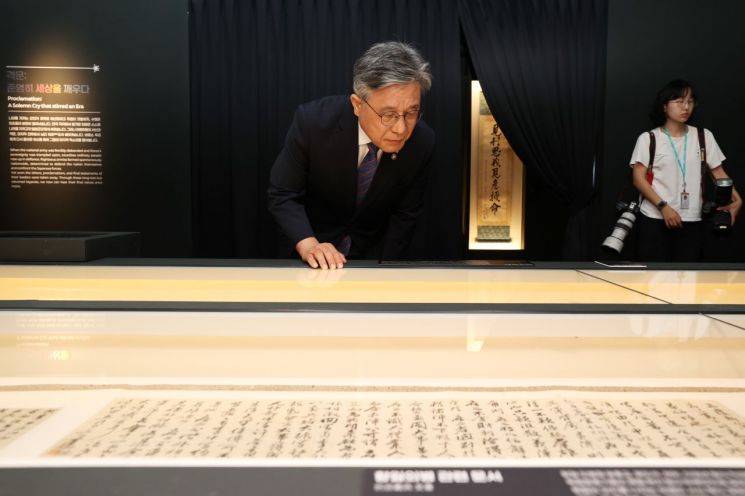 Heo Min, Commissioner of the Cultural Heritage Administration, is examining documents related to the anti-Japanese righteous army at the press preview of the special exhibition "Anti-Japanese Heritage Capturing the Light," held on the 11th of last month at Dondeokjeon Hall, Deoksugung Palace, Jung-gu, Seoul. Photo by Yonhap News Agency
The direction of national heritage policy is shifting from preservation to utilization and dissemination.
On September 8, the National Heritage Administration announced the new government’s national heritage policy vision, “K-Heritage: The Source of a Cultural Powerhouse, Closer to the People and to the World,” at Seokjojeon Hall in Deoksugung Palace, Seoul. This marks a strategic change following the agency’s reorganization from the Cultural Heritage Administration to the National Heritage Administration, and comes at a time when global interest in Korean culture is surging due to the K-Culture phenomenon.
Commissioner Heo Min stated, “The starting point of our policy is to ensure that national heritage becomes a source of pride for the people,” and pledged, “We will develop policies and secure funding so that the value of K-Heritage spreads beyond Korea to the world.”
The three main goals presented are: ▲ Realizing open national heritage ▲ Advancing as a global heritage powerhouse ▲ Enhancing administrative efficiency. Commissioner Heo emphasized, “We will pursue policies that engage and communicate with people on the ground so that national heritage improves quality of life, while also proactively responding to various environmental changes.”
Lowering the Barriers to Palaces and Discovering Modern Heritage
The National Heritage Administration will create “open national heritage” accessible to everyone. The agency will significantly expand the scope of management to include modern and contemporary industrial heritage such as railway stations, power plants, and shipyards, as well as early materials on pop music and film, records related to democratization movements, and everyday cultural heritage, which have previously been overlooked. The establishment of the National Natural Heritage Center and strengthening the foundation for the popularization of intangible heritage will further advance the preservation and transmission system.
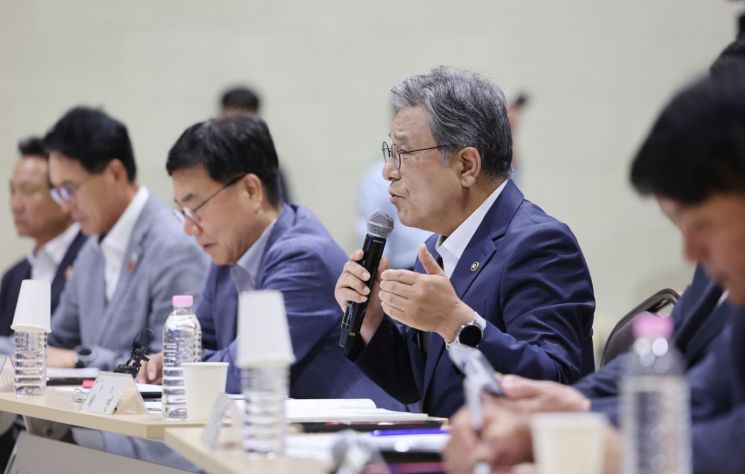 On the 1st of last month, Heo Min, the Commissioner of the National Heritage Administration, attended the town hall meeting "Petroglyphs of Bangucheon, Listening to the Sounds of Ulsan" held at the Ulsan Exhibition Convention Center in Samnam-eup, Ulju-gun, Ulsan City, where he listened to and responded to citizens' opinions. Photo by Yonhap News
The agency will also pursue innovations in accessibility. The phased expansion of nighttime openings at royal palaces, which has led to increased visitors at Gyeongbokgung Palace, will continue, and previously inaccessible spaces such as Joseon royal tombs and historic scenic trails will be opened to provide unique cultural experiences. Through on-site joint support teams and the pre-impact consultation system, the agency will implement “field-centered regulatory reforms” to reduce conflicts over heritage protection in large-scale development projects.
The National Heritage Administration will also utilize heritage as a driving force for the revitalization of areas at risk of decline. The successful model of Hwangridan-gil in Gyeongju will be expanded to nine major historical and cultural regions nationwide, and modern historical and cultural spaces in cities such as Mokpo, Gunsan, and Yeongju will be renovated to improve underdeveloped local landscapes. Programs like the National Heritage Visitor Passport Tour and village natural heritage utilization initiatives will enable people to directly experience the value of local cultural resources.
Efforts to address the climate crisis will also be strengthened. Fire prevention systems for wooden cultural heritage will be upgraded by 2030, and customized management systems will be established for each type of disaster, including wildfires, floods, and biological damage. In addition, an AI-based disaster management system will enhance damage prediction capabilities and provide immediate response to unexpected situations.
Accelerating K-Heritage’s Entry onto the Global Stage
The core of advancing as a global heritage powerhouse is the globalization of K-Heritage. The National Heritage Administration will develop AI models specialized in national heritage to provide interpretation services, visualization, and 3D source material, as well as connect with content industries such as games, films, and dramas. The agency believes that, just as the Netflix series “Kingdom” achieved global success using the Annals of the Joseon Dynasty as its theme, Korean heritage can become a source for global content.
 Heo Min, Commissioner of the Cultural Heritage Administration, had a cordial meeting with Teresa Patrizio, Chairperson of the International Council on Monuments and Sites, on the 28th of last month at the National Palace Museum of Korea in Jongno-gu, Seoul, discussing South Korea's activity directions as the chair country of the 48th World Heritage Committee to be held in 2026. Photo by Yonhap News
Programs tailored to foreign tourists will also be significantly enhanced. Specialized experiences for foreigners at palaces will be expanded, and a flagship store will be established within Gyeongbokgung Palace to promote the sale of national heritage cultural products. Immersive content utilizing cutting-edge technologies such as VR and media art will be developed to showcase the appeal of K-Heritage to the world.
The agency will also focus on hosting international events. At next month’s APEC summit, the value of Korean heritage will be highlighted to world leaders through projects such as the renovation of the Gyeongju Historic Areas, the World Heritage Festival, and media art performances. The 48th session of the UNESCO World Heritage Committee, to be held in Busan next year, is seen as a golden opportunity to elevate Korea’s international standing.
The agency will also systematize the repatriation and preservation of heritage dispersed overseas. Strategies will be developed for the repatriation of heritage located in the United States, Japan, Europe, and elsewhere, while expanding cooperative projects such as preservation treatments and joint exhibitions. The globalization of traditional landscaping will also be promoted, including the renovation of the Korean Garden in Frankfurt, requested by the Korean community in Germany.
Reestablishing cultural heritage exchanges between South and North Korea has also been set as a long-term goal. Although difficult at present, if conditions allow, the agency will resume joint investigations of the Goryeo Palace in Kaesong and establish a private-sector cooperation system to support the restoration of Yujeomsa Temple in Mount Kumgang. At the same time, Korea’s technology and expertise will be provided to help protect global heritage sites such as Machu Picchu, the Mortuary Temple of Ramses II, and the Kultepe archaeological site.
Securing Policy Momentum through Organizational Innovation
To achieve the first two goals, the National Heritage Administration will strengthen organizational capabilities. A performance-based personnel management system will be introduced, and investment in new growth areas such as AI utilization and the global branding of K-Heritage will be expanded. In particular, the agency will prioritize performance and capability in promotions, strengthen internal communication, and improve organizational culture. Consultations with the National Heritage Administration labor union will also be conducted to protect employee rights and enhance administrative productivity.
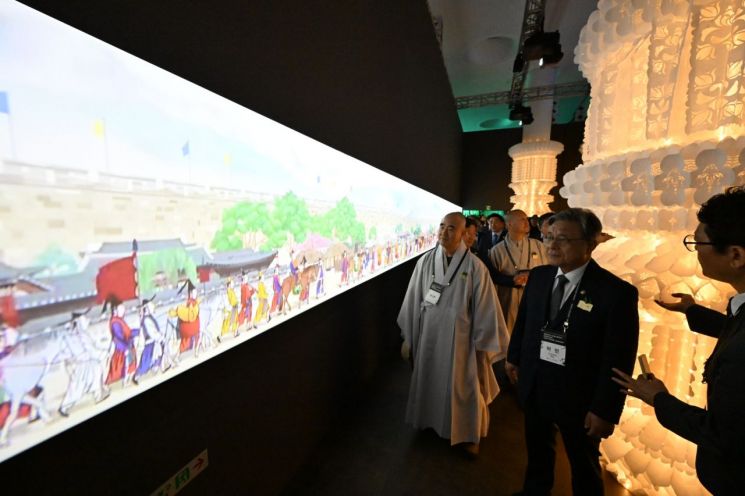 Heo Min, commissioner of the Cultural Heritage Administration, is viewing the media art "Procession Scene of the Joseon Royal Family" at the special digital exhibition "Heritage: The Future Fantasy" held on the 22nd of last month at the Dongdaemun Design Plaza Museum in Seoul. Photo by Yonhap News Agency
Commissioner Heo repeatedly emphasized that this policy shift moves the focus beyond simple preservation to utilization and dissemination. “National heritage should not be limited to preserving the past, but must become an asset for future generations while accompanying the lives of our people,” he said. “We will devote all our capabilities to ensure that K-Heritage shines on the global stage as the source of Korean culture.”
© The Asia Business Daily(www.asiae.co.kr). All rights reserved.



















