Japan will benefit from reduced automobile tariffs and reciprocal tariff cuts from the United States, but there are concerns that Japan may be subject to U.S. influence due to the prerequisite of large-scale investment in the U.S.
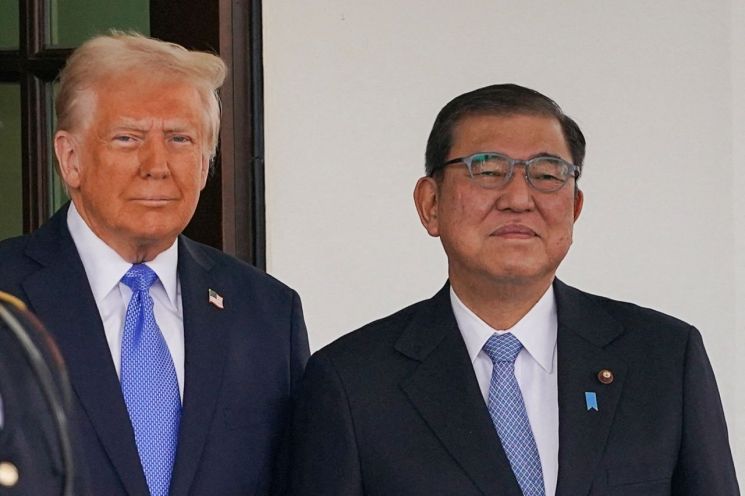 Donald Trump, President of the United States, is welcoming Shigeru Ishiba, Prime Minister of Japan, at the White House in the United States. Photo by Reuters Yonhap News
Major foreign media outlets, including the Nihon Keizai Shimbun, reported on September 6 that President Donald Trump's executive order has made tariff reductions certain, with automobile tariffs dropping from the current 27.5% to 15%. However, they warned that if Japanese investment in the U.S. does not proceed smoothly, there is a risk that tariffs could be raised again.
Japan became eligible for reduced automobile and reciprocal tariffs under the July trade agreement following President Trump's executive order. However, as a result, Japan signed a memorandum of understanding (MOU) with the United States, centered on a large-scale investment of 550 billion dollars (approximately 76.5 trillion yen) in the U.S. The MOU also stipulates that if Japan does not provide the funds, the U.S. may raise tariffs again.
Some have pointed out that there are several unfavorable provisions for Japan, including the fact that President Trump will determine the investment destinations. If the U.S. government's investment committee, chaired by the Secretary of Commerce, recommends candidates, the U.S. President will select the final destinations from among them, and the investments will continue until January 19, 2029, when President Trump's term ends.
Nikkei noted, "For Japan, this leaves the possibility of being swayed by President Trump's intentions." The Mainichi Shimbun also expressed concern that the formal documentation of the MOU "could further intensify the pressure to invest in the U.S.," and warned, "If the U.S. pushes for investments in destinations with questionable profitability, Japan may ultimately bear the cost."
Meanwhile, the Japanese government has stated that it will raise funds through investments, loans, and loan guarantees from organizations such as Nippon Export and Investment Insurance and the Japan Bank for International Cooperation (JBIC, formerly the Export-Import Bank of Japan).
© The Asia Business Daily(www.asiae.co.kr). All rights reserved.
![Clutching a Stolen Dior Bag, Saying "I Hate Being Poor but Real"... The Grotesque Con of a "Human Knockoff" [Slate]](https://cwcontent.asiae.co.kr/asiaresize/183/2026021902243444107_1771435474.jpg)















