Over 100 Women Journalists and Experts from Korea and Japan Attend
Women journalists and experts from Korea and Japan gathered to discuss "gender diversity across various sectors."
On September 5, the Korean Women Journalists Association (President Haimsook) held the 3rd Korea-Japan Women Journalists Forum under the theme "Gender Diversity in Public, Corporate, and Media Sectors in Korea and Japan."
The forum, which began at 10 a.m. at the Korea Press Center, was attended by over 100 women journalists and experts from both countries. They exchanged views across three sessions: "Why the proportion of women in politics and government remains among the lowest in the world," "The glass ceiling and employment discrimination in corporations," and "The underrepresentation of women in the media."
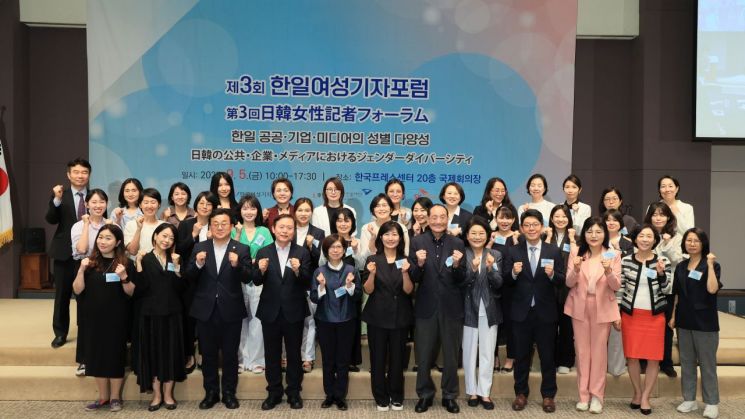 The Korean Women Journalists Association held the 3rd Korea-Japan Women Journalists Forum on the 5th at the Korea Press Center in Jung-gu, Seoul, under the theme "Gender Diversity in Public, Corporate, and Media Sectors in Korea and Japan." (From the bottom row, right to left) Kyunghee Ma, Senior Research Fellow at the Korean Women's Development Institute; Kyungsun Kim, former Vice Minister of Gender Equality and Family; Onam Kwon, President of the Korean Federation of Women in Science and Technology; Byungmin Kim, Deputy Mayor for Political Affairs of Seoul; Hyehun Lee, Executive Director of Korean Women in Politics; Hyojae Kim, Chairman of the Korea Press Foundation. Korean Women Journalists Association.
The first session focused on gender diversity in the public sector, including politics. The Korean side presented the proportion of women elected to the National Assembly in the 22nd general election in 2024. For the first time, the proportion of women lawmakers surpassed 20%, but it still lags 13.7 percentage points behind the OECD average of 34.0%. Kyunghee Ma, Senior Research Fellow at the Korean Women's Development Institute, identified gender-discriminatory stereotypes, a male-dominated political culture, and passive institutional design as the main causes. She proposed institutional reforms, such as mandating that at least 30% of candidates in electoral districts be women, as alternatives to overcome these barriers.
Haruyo Miyamoto, Editor-in-Chief of news23 at TBS, a Japanese private broadcaster, pointed out the structural barriers faced by women politicians in Japan, including sexual harassment. She also addressed the backlash phenomenon that emerged during the July House of Councillors election, when the far-right Sanseito party made significant gains. Editor Miyamoto emphasized that economic insecurity is fueling rhetoric that excludes women and foreigners.
In the subsequent discussion, Kyungsun Kim, former Vice Minister of Gender Equality and Family and current Distinguished Professor at Korea Polytechnic University, stressed the importance of identifying objective indicators that demonstrate the benefits of increased female representation. Misa Ogawa, Deputy Editor of the Social Affairs Department at Kyodo News, highlighted the need to visualize gender equality levels by region, as seen in Japan's prefectural gender gap index. Jungah Yoon, Deputy Editor of the Political Desk at Munhwa Ilbo, added that the current system must be reformed so that women political leaders are recognized as equals by their peers and are not ostracized for forming their own power bases.
How Should Companies Respond to Discrimination?
The second session focused on gender diversity within corporations, with Hoonsang Yoon, Executive Director at Samjong KPMG, serving as the presenter. Yoon revealed data showing that while Korean women have long surpassed men in university graduation rates, their employment rates and wages remain far below the OECD average. He introduced the case of Lotte Group, which has increased the proportion of women on its board of directors and operates various family-friendly policies, as well as Unilever, which has raised the percentage of women in management positions to over 50%.
Yuko Seki, Deputy Group Editor at Nikkei Asia, reported on new changes emerging in Japan's business sector. She shared the example of Canon, where a significant number of institutional investors with voting rights opposed the chairman's reappointment to the board due to the absence of female directors, and Itochu Corporation, which dramatically increased the proportion of female executives within a year, despite Japan's traditionally conservative corporate culture.
In the ensuing discussion, Hyeju Kim, CEO of Lotte Members, who rose to the top after 32 years in the workforce, highlighted the seriousness of Korea's glass ceiling index, which has ranked among the lowest for several years. She proposed "quantifying the current situation, reforming systems, and improving perceptions" as solutions.
More Women Journalists, But Deeper Reflection Needed
The following session addressed gender diversity in the media. Sua Kim, Associate Professor in the Department of Communication at Seoul National University, examined gender equality in Korean media by focusing on the proportion of female sources and women journalists. As of 2023, male sources accounted for 78.5% of news sources, while female sources made up only 16.8%. Professor Kim stated, "Journalists must strive to diversify their sources, and there should be more competition for in-depth reporting rather than just breaking news." She also emphasized that "although the proportion of women journalists in Korea is increasing, it is crucial to implement structural improvements to ensure that job segregation does not hinder women journalists from fully utilizing their abilities."
Azusa Mishima, Head of the Metropolitan News Center at Asahi Shimbun, introduced the newspaper's efforts and changes based on its "Declaration of Gender Equality." Asahi has set targets for the proportion of women featured in articles and the number of women in management positions, regularly publishes updates on gender equality, and significantly revised its in-house gender guidebook last year. Mishima noted, "Thanks to these efforts, it is now common in the newsroom to hear questions like, 'How does this expression look from a gender perspective?'" Sanae Okamoto, Deputy Editor of the News Department at Kyoto Shimbun, added, "Increasing the proportion of women within the media is essential to raising the proportion of female sources."
Meanwhile, attendees at the forum included Hyehun Lee, Executive Director of Korean Women in Politics; Hyojae Kim, Chairman of the Korea Press Foundation; Byungmin Kim, Deputy Mayor for Political Affairs of Seoul; and Kazuhiro Kawase, Director of the Public Information and Cultural Center at the Embassy of Japan in Korea.
© The Asia Business Daily(www.asiae.co.kr). All rights reserved.
![Clutching a Stolen Dior Bag, Saying "I Hate Being Poor but Real"... The Grotesque Con of a "Human Knockoff" [Slate]](https://cwcontent.asiae.co.kr/asiaresize/183/2026021902243444107_1771435474.jpg)















