5-Minute Free Speech: "Possibility of Large-Scale Underground Facilities"
"Urban Military Bases Should Be Utilized as Historical and Cultural Assets"
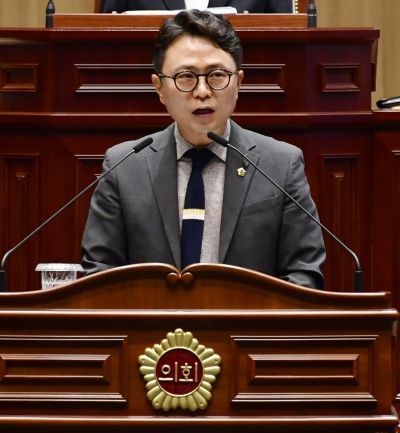 Park Sugi, a member of the Gwangju Metropolitan Council, urged the excavation and investigation of the remaining Japanese colonial military facilities in the Sangmu district of downtown Gwangju during the "5-minute free speech" at the 336th extraordinary session plenary meeting held on the 5th. Provided by Gwangju Metropolitan Council
On September 5, Park Sugi, a member of the Gwangju Metropolitan Council (Democratic Party of Korea, Gwangsan District 5), asserted that a comprehensive excavation and investigation should be conducted on the large-scale military facilities from the Japanese colonial period located within the Gwangju May 18th Memorial Park.
During a "5-minute free speech" at the 336th extraordinary session plenary meeting held that day, Assemblyman Park urged a full-scale excavation and investigation of the underground military fortress facilities from the Japanese colonial era that remain in the Sangmu district of downtown Gwangju.
Referring to a recently confirmed floor plan and construction status report of the Gwangju Naval Air Base, estimated to be from 1944, Park stated, "There is a high possibility that large-scale underground facilities are still buried in the current May 18th Memorial Park and the Sangmu district area."
He emphasized, "If we neglect such historical heritage, we may lose even the right to speak out justly in the international community when controversies over the distortion of the history of Japanese colonial rule and forced mobilization arise again."
He further pointed out, "Japan is attempting to repackage sites like Battleship Island and the Sado Mine as modern industrial heritage in an effort to erase the painful history of invasion and forced mobilization from the international community. If we ourselves fail to properly investigate the relics on our own land, we will leave behind a shameful legacy for future generations."
Assemblyman Park stated, "As we mark the 80th anniversary of liberation, we must systematically excavate and preserve the underground military facilities in the Sangmu district and utilize them as historical and cultural assets." He added, "The city of Gwangju must immediately begin excavation and investigation, as well as secure the necessary budget for these efforts."
Meanwhile, Assemblyman Park plans to continue follow-up discussions at the Gwangju Metropolitan Council level to initiate a full-scale investigation into the actual conditions of Japanese colonial-era military base facilities and to discuss policies for their academic research, preservation, and management.
© The Asia Business Daily(www.asiae.co.kr). All rights reserved.

















