Mayor Lee Chungwoo: "Administration for Citizens"
vs. Former Mayor Lee Hangjin: "Distorted Procedures"
"Old and Inconvenient City Hall"
vs. "Concerns About Wasteful Spending": Citizens’ Divided Views
New City Hall Construction: 152 Billion Won
vs. Urban Regeneration: 128 Billion Won
Expanding Debate Over Financial Burden
"Yeoju-Style Silencing" Controversy:
Abuse of Administrative Power vs. Preventing Public Confusion
The issue of relocating Yeoju City Hall has emerged as the most pressing concern in the local community, with public opinion sharply divided between supporters and opponents. The conflict between current Mayor Lee Chungwoo and former Mayor Lee Hangjin has escalated beyond political confrontation, spreading into complex issues such as local economic stagnation and the hollowing out of the old downtown, heightening tension throughout the region.
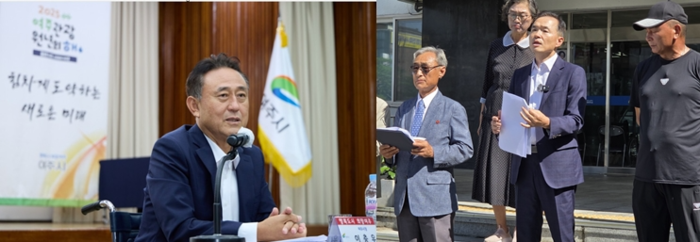 Press conference scenes of current mayor Lee Chungwoo and former mayor Lee Hangjin regarding the construction of Yeoju City Hall. Provided by Yeogang Press Corps.
According to local political circles as of September 5, the city hall relocation project, a key pledge of Mayor Lee Chungwoo’s eighth term, has triggered multifaceted problems, including the distortion of the public consensus process, concealment of the possibility of acquiring alternative sites, concerns about the hollowing out of the old downtown, and a significant financial burden. As a result, public opinion is deeply polarized and local conflict has reached its peak.
Mayor Lee Chungwoo: "Administration for Citizens" vs. Former Mayor Lee Hangjin: "Distorted Procedures"
Mayor Lee Chungwoo is pushing for the relocation of the new city hall to Gaeopdong as a core pledge of his eighth term.
He emphasized the need for an integrated city hall, stating, "The current city hall, which is over 40 years old, is outdated and cramped, reducing the efficiency of administrative services and causing significant inconvenience for citizens."
Accordingly, he has been pursuing the construction of a new integrated administrative space to enhance citizen convenience, making the city hall relocation his first official order upon taking office as the eighth-term mayor.
Mayor Lee Chungwoo explained that a public consensus committee was formed based on a 2022 survey and deliberative forum to reflect citizens’ opinions, stressing that the selection of the Gaeopdong site was "not a personal decision by the mayor, but a citizen-centered democratic process."
In contrast, former Mayor Lee Hangjin and some local political figures are strongly objecting, pointing to alleged distortion of the public consensus process, exclusion of key candidate sites, and concealment of the possibility of acquiring the Yeoju Elementary School site.
In particular, regarding the exclusion of the current city hall site from discussions, former Mayor Lee criticized, "Citizens’ right to choose was restricted," arguing that "the report itself is a distorted outcome" and "an intentionally guided conclusion."
In response, a Yeoju City official stated, "The current city hall site is too small, and even if combined with the Yeoju Elementary School site, there is insufficient room for expansion, which is why the Gaeopdong site was chosen. The city plans to foster the Gaeopdong area as a new urban center by constructing the new city hall and expanding urban planning roads and infrastructure."
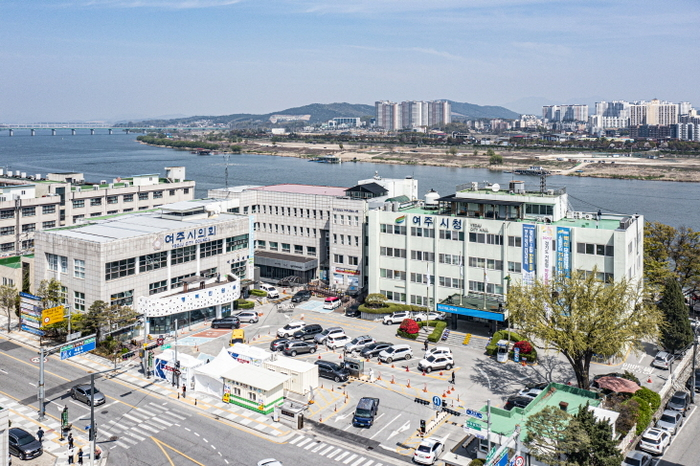
"Old and Inconvenient City Hall" vs. "Concerns About Wasteful Spending": Citizens’ Divided Views
Despite the city’s position, public opinion among citizens remains sharply divided.
Supporters argue that "the city hall is so old that it leaks when it rains, and parking is a serious problem," stressing the need for a new city hall. Opponents, however, point out, "Spending nearly 200 billion won at once is excessive," arguing that priorities such as transportation and welfare are more important.
Some citizens are calling for a reasonable compromise, saying, "As long as the mayor and city council continue to fight, only the citizens suffer."
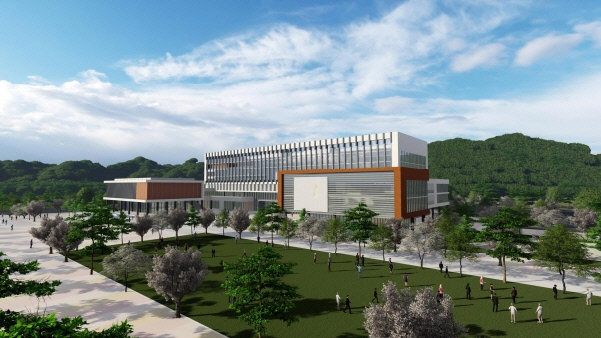
New City Hall Construction: 152 Billion Won vs. Urban Regeneration: 128 Billion Won... Expanding Debate Over Financial Burden
In particular, as the city hall relocation gains momentum, signs of the hollowing out of the old downtown are becoming a reality. According to the local real estate industry, following a slump in the real estate market and the decision to relocate the current city hall, the average land price in the commercial district surrounding city hall has begun to decline, with vacancy rates rising and almost no new leasing inquiries.
Furthermore, actual apartment transaction prices are falling and listings are piling up, visibly accelerating the downturn in the area.
In contrast, the area around the planned Gaeopdong site is seeing a surge in speculative transactions and a sharp increase in land prices, exacerbating regional imbalances. For example, industry sources report that asking prices for nearby land have risen two to three times compared to last year, with properties coming onto the market at these higher prices.
Self-employed business owners and elderly residents in the old downtown are voicing concerns that "if administrative agencies leave, hospitals, pharmacies, and banks could also disappear," expressing fears about the collapse of their living environment and threats to their livelihoods.
Yeoju City has applied for a 128 billion won urban regeneration innovation district project to revitalize the old downtown, but excluding 32.5 billion won in national funds and 5 billion won in provincial funds, the estimated local government burden exceeds 90 billion won.
Some local voices are strongly criticizing this as "irresponsible administration putting citizens in debt without detailed plans."
Additionally, the new city hall construction project is estimated at a total of 152 billion won, with about 99 billion won drawn from a city hall construction fund accumulated since 2004, and the remaining shortfall to be covered by the general account and the Integrated Fiscal Stabilization Fund.
As a result, the city’s fiscal independence ratio is expected to remain at around 21 percent, raising concerns about financial pressure from the new city hall construction, the potential issuance of local bonds, and possible reductions in essential administrative services.
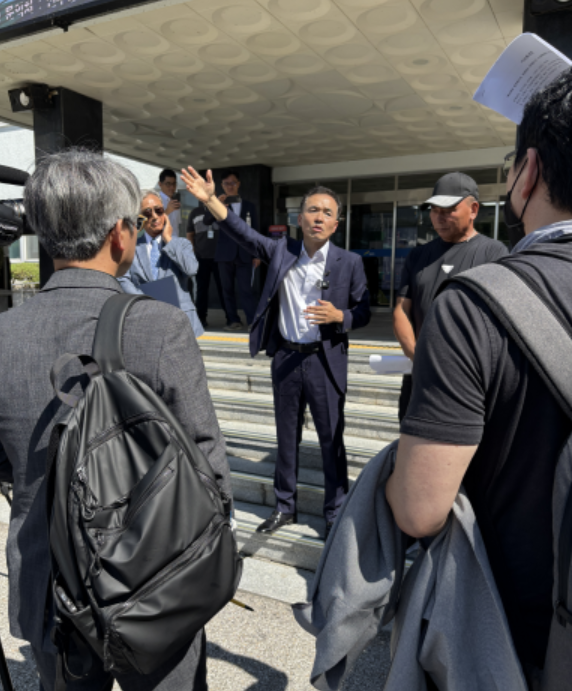 Former Mayor Lee Hangjin of Yeoju City is urging the suspension of the relocation of the Gaeopdong New City Hall during a press conference held in front of Yeoju City Hall on the 3rd. Photo by Yeogang Press Corps
"Yeoju-Style Silencing" Controversy: Abuse of Administrative Power vs. Preventing Public Confusion
Political conflict is also intensifying.
Former Mayor Lee Hangjin suggested legal action, calling the refusal to allow a press conference "an abuse of administrative power that violates the principles of democracy." In response, city hall explained, "At a time when groundbreaking is imminent, a press conference that could cause public misunderstanding is inappropriate," but former Mayor Lee protested, calling this "Yeoju-style silencing."
On September 1, Mayor Lee Chungwoo delivered a strong criticism of the Democratic Party during a monthly briefing at city hall regarding the conflict over the new city hall construction.
He demanded a public apology, stating, "The Democratic Party has made absurd claims such as 'the Gaeopdong relocation should not happen' and 'the relocation will cost 300 billion won,' which have caused public confusion."
Former Mayor Lee Hangjin countered, "Demanding an apology because of differing opinions is something only seen in dictatorial times," arguing that "Mayor Lee’s one-sided administration has led to a hasty process."
Some in civil society view this controversy not simply as the relocation of an administrative building, but as a "test of civic sovereignty and administrative responsibility."
A local citizen, Mr. Lee, emphasized, "The relocation of Yeoju City Hall is not just about moving a building; it is a matter that tests the essence of civic sovereignty and administrative responsibility. Since it is causing complex problems such as the collapse of the old downtown, property losses for residents, and a divided local opinion, the city urgently needs to develop comprehensive measures for balanced regional development and the protection of living environments if it truly aims to serve its citizens."
© The Asia Business Daily(www.asiae.co.kr). All rights reserved.
![Clutching a Stolen Dior Bag, Saying "I Hate Being Poor but Real"... The Grotesque Con of a "Human Knockoff" [Slate]](https://cwcontent.asiae.co.kr/asiaresize/183/2026021902243444107_1771435474.jpg)

















