Policy Differentiation to Provide Relief for Companies
Accelerating Supplementary Legislation for the Yellow Envelope Act
Democratic Party Focuses on Appeasing Businesses
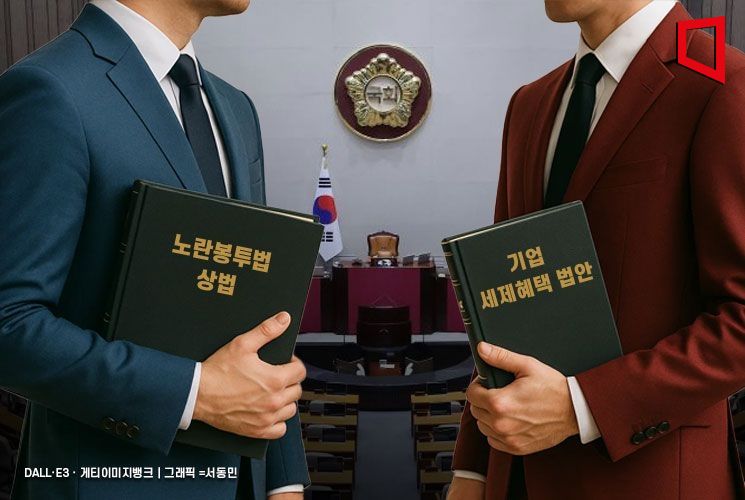
The People Power Party has introduced a series of bills aimed at expanding corporate tax benefits in time for the regular session of the National Assembly. With the Yellow Envelope Act (the amendment to Articles 2 and 3 of the Trade Union and Labor Relations Adjustment Act) and the stronger Commercial Act amendment having passed the National Assembly plenary session under the leadership of the Democratic Party, the People Power Party is seeking to differentiate its policies by offering measures to ease the burden on businesses. The Democratic Party has also been reaching out to the business community, discussing issues such as easing the crime of breach of trust, in an effort to appease companies.
According to the National Assembly’s bill information system on September 5, Assemblyman Kim Sanghoon of the People Power Party sponsored an amendment to the Restriction of Special Taxation Act that would lower the maximum rate of the minimum tax by 2 percentage points. The minimum tax is the baseline amount of tax that companies must pay even if they receive tax credits or exemptions. Currently, the maximum rate (for companies with a tax base of 100 billion won or more) is 17%. The bill aims to lower this to the global minimum tax rate of 15%, thereby increasing the perceived benefit of tax credits for companies and encouraging greater investment. The Korea Economic Research Institute has analyzed that a 1 percentage point reduction in the minimum tax rate would increase total corporate investment by approximately 2.2459 trillion won.
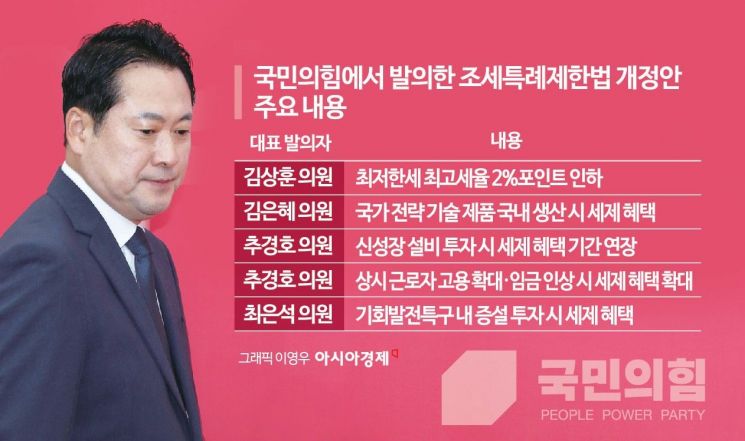
Assemblywoman Kim Eunhye of the People Power Party has proposed an amendment that would allow companies producing national strategic technology products domestically to deduct 10% of production costs from their income or corporate taxes. This would apply to industries such as semiconductors, secondary batteries, future vehicles, biotechnology, and clean hydrogen. The intent is to go beyond tax incentives focused on research and development or facility investment and instead provide incentives at the production stage to protect the domestic manufacturing base. While countries such as the United States and Japan offer production tax credits for strategic sectors, Korea has no such support at the production stage, putting it at a disadvantage in global competition.
A bill has also been introduced to extend the period for tax credits for companies that increase investment or employment. Assemblyman Choo Kyungho of the People Power Party has proposed an amendment to the Restriction of Special Taxation Act to extend the sunset of the temporary investment tax credit for facility investment companies by one year. Introduced in 2013, the temporary investment tax credit increases the tax credit rate for companies investing in facilities for new growth businesses or R&D, and is set to expire at the end of this year.
Assemblyman Choo has also proposed an additional amendment to extend the tax credit period for companies that increase regular employment or raise wages from the end of this year to the end of 2028. The amount of the tax credit has been increased. For companies hiring vulnerable groups such as young people, people with disabilities, and those who have experienced career interruptions, the tax credit amount has been expanded to a maximum of 17.5 million won.
The People Power Party is also preparing supplementary legislation for the Yellow Envelope Act and the stronger Commercial Act amendment. Kim Doo-eup, the party’s Policy Committee Chairman, stated at a party strategy meeting that day, "The Yellow Envelope Act is not only causing confusion in the workplace but is also holding back the national economy," adding, "We will come up with policy solutions, including the recently proposed supplementary legislation for the Yellow Envelope Act."
The Democratic Party is also increasing its engagement with the business community to gather opinions on livelihood-related bills. Following Democratic Party leader Jung Cheongrae’s recent meeting with the Korea Federation of Micro Enterprises and representatives from the small and medium-sized business sector, Kim Byungki, the Democratic Party’s floor leader, met with the heads of six major economic organizations. At this meeting, the party pledged support for small business owners and the SME sector, while also discussing the issue of easing the crime of breach of trust with the business community. The Democratic Party, which launched the Economic Criminal Penalty Rationalization Task Force on September 2, plans to accelerate efforts to revise criminal penalty regulations, a long-standing demand of the business sector.
© The Asia Business Daily(www.asiae.co.kr). All rights reserved.
![Clutching a Stolen Dior Bag, Saying "I Hate Being Poor but Real"... The Grotesque Con of a "Human Knockoff" [Slate]](https://cwcontent.asiae.co.kr/asiaresize/183/2026021902243444107_1771435474.jpg)
















