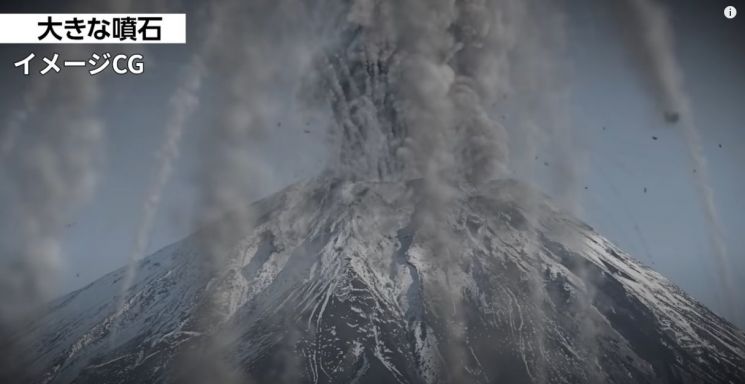
 A portion of the CGI video produced by the Japanese Cabinet Office simulating damage in the event of a Mount Fuji eruption
For Japanese people, the worst natural disasters are considered to be major earthquakes and a Mount Fuji eruption. What would happen if Mount Fuji were to erupt?
On August 26, the Japanese Cabinet Office released a computer-generated video for the first time, simulating the potential damage from a Mount Fuji eruption to mark "Volcano Disaster Prevention Day." According to Japanese media outlets such as Kyodo News and Fuji TV, the Cabinet Office estimated the scale of the damage in a roughly 10-minute video by referencing the magnitude of the 1707 eruption. In the event of a large-scale eruption at Mount Fuji, not only would numerous large volcanic rocks be ejected in all directions, but lava flows and pyroclastic flows (a mixture of volcanic ash and hot gases) traveling at over 100 kilometers per hour are also expected to occur.
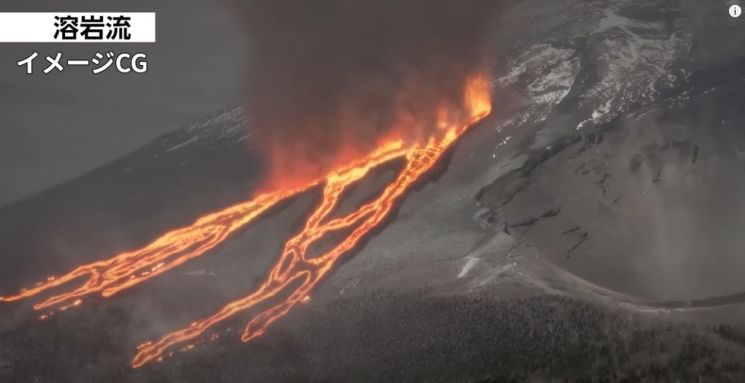 A segment of a computer-generated video simulating damage from a Mount Fuji eruption, produced by the Japanese Cabinet Office
In Sagamihara, Kanagawa Prefecture, located about 60 kilometers from Mount Fuji, 20 centimeters of volcanic ash would accumulate two days after the eruption. Depending on the wind direction, even in Shinjuku, Tokyo, which is about 100 kilometers from Mount Fuji, fine volcanic ash could fall, and two days after the eruption, the ash could accumulate to a thickness of more than 5 centimeters. In particular, if it rains on this volcanic ash, the moisture would make it heavier, raising concerns about the collapse of wooden houses, and roads could become impassable for vehicles.
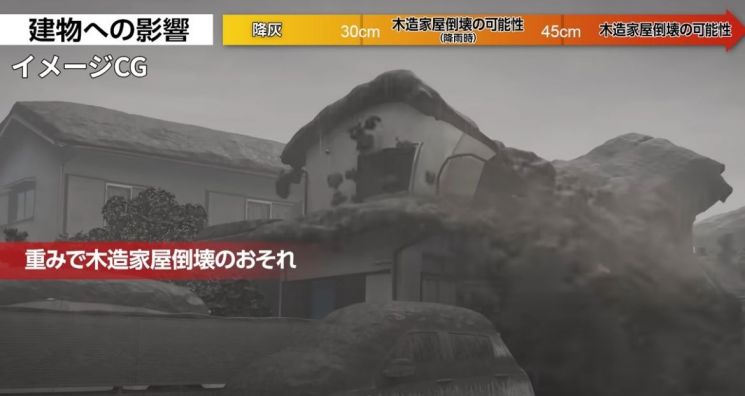 A portion of the CG video produced by the Japanese Cabinet Office simulating damage in the event of a Mount Fuji eruption
In addition, widespread disruptions such as water outages, power failures, and suspension of railway operations are expected, and the Cabinet Office forecasts that by the fifteenth day after the eruption, these effects would spread throughout the entire Tokyo metropolitan area. Toshitsugu Fujii, Professor Emeritus at the University of Tokyo, stated in the video, "Mount Fuji has erupted on average once every 30 years in the past, but it has been quiet for more than 300 years now. There would be nothing unusual if the next eruption were to occur at any time."
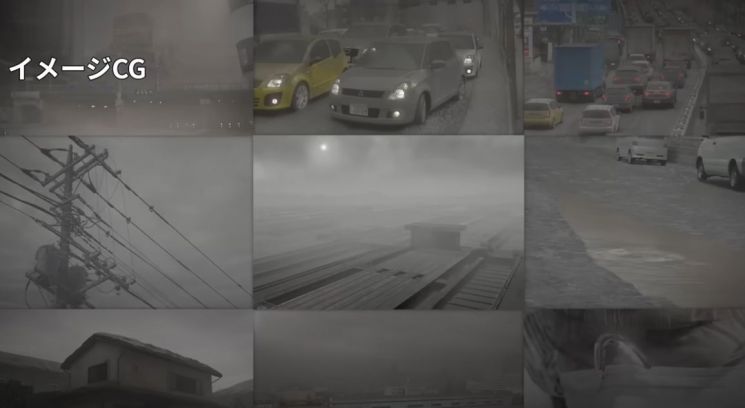 A portion of the CGI video produced by the Japanese Cabinet Office simulating damage in the event of a Mount Fuji eruption
Back in March, the Cabinet Office had already announced the "Metropolitan Area Volcanic Ash Response Guidelines," which classify recommended actions into four stages according to the amount of volcanic ash. Based on these guidelines, the government plans to discuss concrete countermeasures with local governments, businesses, and public institutions. "Volcano Disaster Prevention Day" was established to commemorate the installation of Japan's first volcano observatory on Mount Asama on August 26, 1911 (Meiji 44). When releasing this video, the Cabinet Office urged the public to stock up on food and other supplies in advance, as logistics could be disrupted in the event of an eruption.
<A segment of a CGI video created by the Japanese Cabinet Office simulating damage from a Mount Fuji eruption>
© The Asia Business Daily(www.asiae.co.kr). All rights reserved.
![Clutching a Stolen Dior Bag, Saying "I Hate Being Poor but Real"... The Grotesque Con of a "Human Knockoff" [Slate]](https://cwcontent.asiae.co.kr/asiaresize/183/2026021902243444107_1771435474.jpg)

















