Signs of a Cooling Labor Market Continue
August ADP Private Employment Rises by 54,000, Missing Expectations
Weekly New Unemployment Claims Hit Highest Since June
Momentum Builds for Rate Cuts... 48% Chance of Three Cuts This Year
Private sector employment in the United States saw an unexpected sharp decline last month. The number of new unemployment claims also reached its highest level in over two months, signaling further signs of a cooling labor market. As a result, the market is now treating a September rate cut as a foregone conclusion, while also raising expectations for a larger rate reduction within the year.
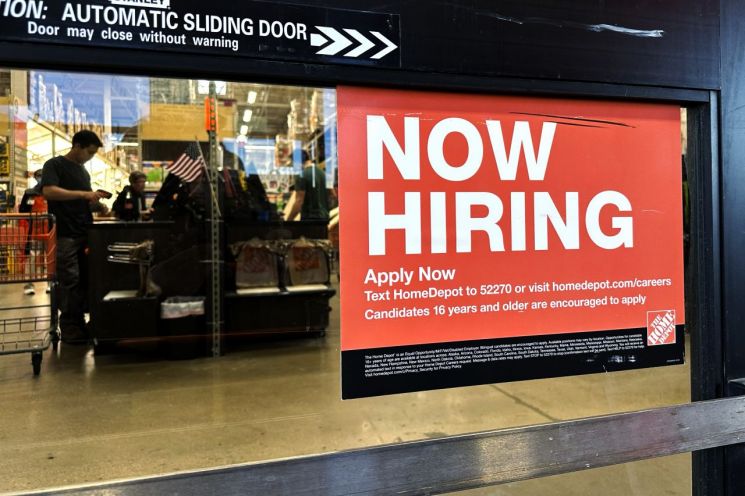
On September 4 (local time), U.S. private labor market research firm ADP reported that new jobs in the private sector increased by only 54,000 in August. This figure falls short of the Dow Jones estimate of 75,000 and is also about half the number from the previous month (106,000).
The number of new unemployment claims also rose. According to the Department of Labor, new claims for unemployment benefits for the week of August 24-30 totaled 237,000, up by 8,000 from the previous week’s 229,000, surpassing Bloomberg’s estimate of 230,000. This is the highest level since June.
There are also indicators that companies are increasing layoffs and becoming more cautious about new hiring. According to employment data firm Challenger, Gray & Christmas, the number of layoffs in August was 85,979, a 39% increase from the previous month, marking the highest level since the height of the COVID-19 pandemic in 2020. The cumulative number of layoffs this year reached 892,362, also the highest since 2020. In contrast, companies’ plans for new hires in August stood at only 1,494, the lowest since 2009.
On Wall Street, there is analysis that President Donald Trump’s aggressive tariff policies are placing a burden on the U.S. economy, especially in the labor market. This comes as the Department of Labor reported the previous day that job openings in July fell to 7.181 million, the lowest in ten months, and the cooling trend in employment is becoming increasingly pronounced.
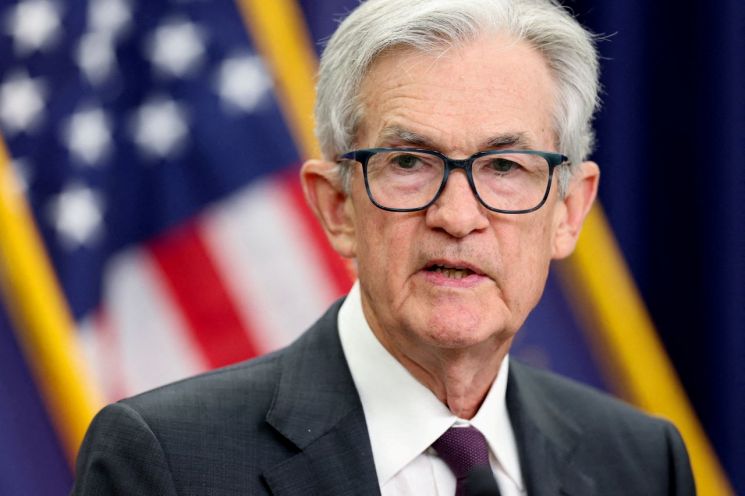
These consecutive signs of slowing employment have further heightened expectations for a rate cut. According to the Chicago Mercantile Exchange (CME) FedWatch, the federal funds futures market is pricing in a 99.4% probability that the Federal Reserve will cut its current benchmark rate of 4.25-4.5% by 0.25 percentage points in September. This is up from 86.7% a week ago. Additionally, the probability of a total 0.75 percentage point cut by the end of the year, with rate reductions at all three remaining meetings, has risen to 48.4%, up from 37% a week earlier. Treasury yields are also trending downward across both short- and long-term maturities in response to rate cut expectations. The 10-year U.S. Treasury yield, a global bond benchmark, fell by 1 basis point (1bp = 0.01 percentage point) from the previous day to 4.16%, while the 2-year Treasury yield, which is sensitive to monetary policy, dropped by 2 basis points to 3.59%.
As investors’ expectations for rate cuts grew, all three major New York stock indexes rose by nearly 1% on the day, with the S&P 500 index reaching an all-time high. Investors interpreted the employment slowdown not as a sign of recession, but as a ‘Goldilocks’ scenario-neither too hot nor too cold-prompting increased stock buying.
Market attention is now focused on the U.S. Department of Labor’s August employment report, to be released on September 5. Nonfarm payrolls are expected to increase by only 75,000 last month. While this is a slight uptick from July’s 73,000, it would mark the fourth consecutive month of increases below 100,000, the weakest trend since 2020. The unemployment rate is expected to edge up from 4.2% in July to 4.3% in August.
Steve Sosnick, chief strategist at Interactive Brokers, commented, “Many investors clearly want a rate cut, but we need to carefully consider what we’re wishing for,” adding, “A gradual slowdown in the indicators and a labor market that is not severely weak would align with our goals, but if the data plummets, it could raise concerns that the central bank is falling too far behind.”
© The Asia Business Daily(www.asiae.co.kr). All rights reserved.
![Clutching a Stolen Dior Bag, Saying "I Hate Being Poor but Real"... The Grotesque Con of a "Human Knockoff" [Slate]](https://cwcontent.asiae.co.kr/asiaresize/183/2026021902243444107_1771435474.jpg)
















