The Supreme Court has dismissed the appeal of a man in his twenties who was convicted of assaulting and causing the death of his ex-girlfriend, upholding the 12-year prison sentence handed down by both the lower and appellate courts.
The Supreme Court's Second Division, presided over by Justice Park Youngjae, announced on the 4th that it had rejected the appeal of Mr. A, a man in his twenties indicted on charges including causing bodily injury resulting in death, excessive contact (stalking), and trespassing. The court confirmed the 12-year prison sentence imposed by the previous courts.
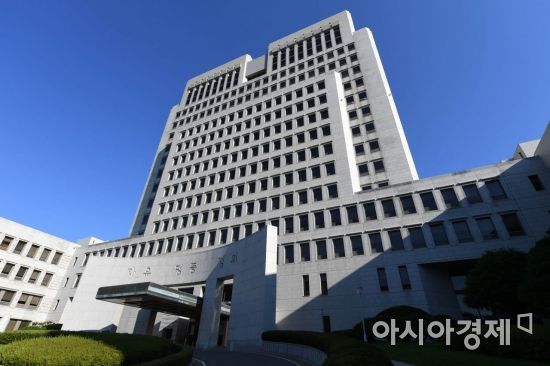
Mr. A, the defendant in the so-called "Geoje Dating Violence Death" case, was accused of breaking into the residence of his ex-girlfriend, Ms. B, also in her twenties, on April 1 last year. He allegedly climbed on top of Ms. B while she was sleeping, struck her head and face, strangled her, and violently assaulted her, resulting in her death.
Due to Mr. A's assault, Ms. B suffered serious injuries including traumatic subdural hemorrhage, which required six weeks of medical treatment. She died ten days later from multiple organ failure caused by sepsis while undergoing treatment in the hospital.
It was found that Mr. A had repeatedly committed acts of violence, such as slapping Ms. B, after they began dating as high school classmates around April 2022.
Even after breaking up with Ms. B shortly before the incident, Mr. A called her 14 times and, when she did not answer, went to her residence.
The court of first instance stated, "Mr. A inflicted injuries by strangling the victim, who was asleep or had just woken up, and by punching her, ultimately causing her death." The court sentenced Mr. A to 12 years in prison and ordered him to complete 40 hours of a stalking treatment program.
The appellate court also sentenced Mr. A to the same term, stating, "The defendant did not fully acknowledge his guilt, made no active efforts to compensate the bereaved family or heal their pain, and it is questionable whether he truly repented."
Throughout the trial, the prosecution sought a 20-year sentence in both the first and second trials, while Mr. A's side continued to appeal, denying the charges by arguing the possibility of medical malpractice by the hospital that treated Ms. B and claiming that her death could not have been foreseen.
The bereaved family repeatedly called for the application of murder charges through national petitions, solo protests in front of the court, and press conferences, but murder charges were ultimately not applied.
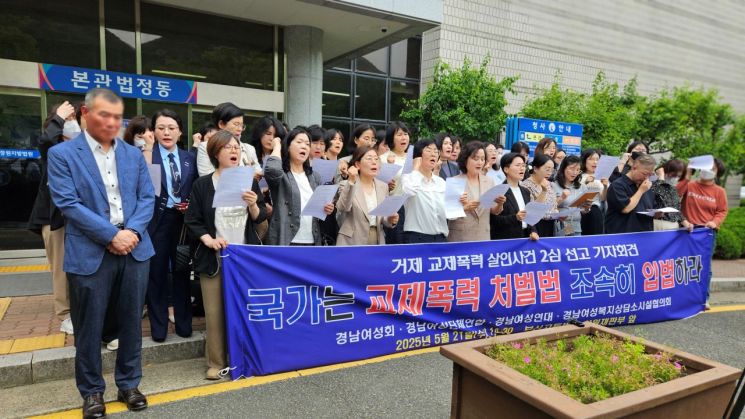 After the appellate court ruling on the "Geoje Dating Violence Death" case on May 21, women's organizations in the Gyeongnam region condemned the verdict and called for legislation on the Dating Violence Punishment Act. Photo by Lee Seryoung
After the Supreme Court's ruling, women's organizations in the Gyeongnam region, including the Gyeongnam Women's Association, issued a statement saying, "A mere 12 years is the price for taking away the future of a young woman and tearing apart the hearts and home of her family," and criticized, "Because the case was treated as bodily injury resulting in death rather than murder, the perpetrator received an absurdly light sentence compared to the gravity of the crime."
Nevertheless, they noted, "It is noteworthy that the judiciary is now at least addressing the seriousness of dating violence and dating-related murders with greater scrutiny."
They went on to urge, "The government must promptly enact the Dating Violence Punishment Act to prevent any further victims."
© The Asia Business Daily(www.asiae.co.kr). All rights reserved.


















