Policy Proposals Continue, Including Topic-Based Discussions and Utilization of Vacant Houses
Uiryeong County in South Gyeongsang Province announced on September 4 that its biweekly "3-Mu (No) Executive Meeting" has become firmly established in the organizational culture after two years of implementation. The groundbreaking meeting format, which eliminates documents, reports, and assigned seats, has proven effective and is driving changes in internal communication.
Two years ago, County Governor Oh Tae-wan declared, "From now on, executive meetings should be ▲No Paper ▲No Reports ▲No Assigned Seats. First, meetings without formal documents; second, meetings without sequential presentations or unilateral instructions; and third, meetings without predetermined seating arrangements." The absence of assigned seats means that working-level staff, rather than department heads, can attend the meetings.
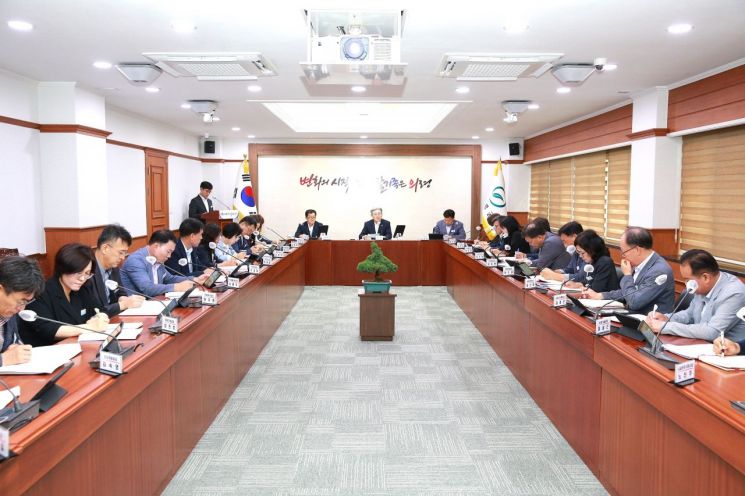
The "3-Mu Executive Meeting" attracted significant attention when it was introduced, as it broke away from standardized and hierarchical meeting practices. The system aims to enhance the productivity of county administration through the sharing of practical work insights and in-depth discussions on specific topics, leveraging expertise and capabilities.
At the executive meeting held on September 2, the seating arrangement was newly organized. Instead of presiding alone from the head seat, County Governor Oh Tae-wan sat with the Deputy Governor and the Director of the Safety and Construction Bureau on either side. In line with the "No Assigned Seats" principle, the Head of the Audit Team attended in place of the Planning and Budget Officer, and the Head of the Agricultural Infrastructure Team participated instead of the Head of the Construction and Transportation Division.
Notably, on this day, the head of Uiryeong-eup, who does not usually attend executive meetings, was present. Uiryeong-eup Chief Choi Yong-seok participated to explain plans for the "Village-by-Village Resident Meetings."
During the meeting, there were no formal documents or reporting sequences; instead, discussions centered on topics based on statistical data. Departments held a discussion on Uiryeong County's high "vacant house rate," and meaningful ideas were proposed, such as operating guesthouses using vacant homes and creating public land after demolition, leading to productive exchanges.
In addition, during discussions on flood recovery, another department head suggested the need to improve criteria for landslide-prone areas and to establish a database for practical management. The responsible department expressed willingness to review these suggestions, resulting in constructive dialogue.
County Governor Oh Tae-wan stated, "By discarding formality and choosing effectiveness, our meeting culture is enhancing both the productivity and depth of communication in county administration. We will continue to realize administration that residents can truly feel through practical discussions and collaboration."
© The Asia Business Daily(www.asiae.co.kr). All rights reserved.
![Clutching a Stolen Dior Bag, Saying "I Hate Being Poor but Real"... The Grotesque Con of a "Human Knockoff" [Slate]](https://cwcontent.asiae.co.kr/asiaresize/183/2026021902243444107_1771435474.jpg)















