Ministry of Health and Welfare: 1,068 Non-Covered Items Total 576 Billion Won in September Last Year
Significant Increase at Korean Medicine and Long-Term Care Hospitals Compared to March
The annual non-covered medical expenses at hospital-level medical institutions in South Korea have nearly reached 7 trillion won. Among medical specialties, orthopedics accounted for the largest share of non-covered expenses, while the most costly individual procedures were single-patient premium hospital rooms and manual therapy.
The Ministry of Health and Welfare and the National Health Insurance Service released the results of their analysis of the '2024 Second Half Non-Covered Medical Expense Reporting System' data for hospital-level medical institutions on September 4.
The Non-Covered Medical Expense Reporting System was introduced in September 2023 to track the status of non-covered services not included under the national health insurance, ensuring the public's right to information and freedom of medical choice. Under this system, all medical institutions, including clinics, report their non-covered service details based on March data in the first half of the year, while hospital-level institutions submit additional reports based on September data in the second half.
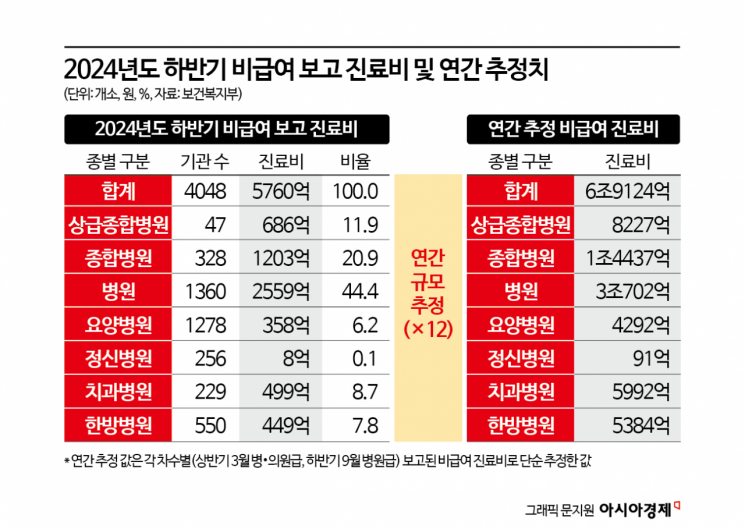
In the second half of last year, 4,104 out of 4,166 hospital-level institutions reported September data for 1,068 items not covered by health insurance (623 items with price disclosure and 445 reporting items). The total non-covered medical expenses for these institutions amounted to 576 billion won, an increase of 3.8 billion won compared to the first half of 2024 (March data). When extrapolated to an annual figure, non-covered medical expenses at hospital-level institutions are estimated to reach approximately 6.9124 trillion won per year.
By type of institution, hospitals accounted for the largest share of non-covered expenses at 255.9 billion won (44.4%), followed by general hospitals at 120.3 billion won (20.9%), tertiary general hospitals at 68.6 billion won (11.9%), dental hospitals at 49.9 billion won (8.7%), Korean medicine hospitals at 44.9 billion won (7.8%), and long-term care hospitals at 35.8 billion won (6.2%). Compared to the first half of the same year, Korean medicine hospitals saw an increase of 4.8 billion won and long-term care hospitals an increase of 4 billion won in non-covered expenses.
The average non-covered medical expense per institution was 142.3 million won. Tertiary general hospitals had the highest average at 1.45869 billion won, followed by general hospitals at 366.8 million won and dental hospitals at 218.05 million won.
By medical specialty, orthopedics had the highest non-covered expenses at 153.4 billion won (26.6%), followed by neurosurgery at 81.6 billion won (14.2%), internal medicine at 59.2 billion won (10.3%), general surgery at 38.5 billion won (6.7%), and obstetrics and gynecology at 29.8 billion won (5.2%).
For individual items, the largest non-covered expense was for single-patient premium hospital rooms at 55.3 billion won (9.6%), followed by manual therapy at 47.8 billion won (8.3%), and zirconia dental implants at 23.4 billion won (4.1%). Additionally, the top 10 non-covered items-including spine and lumbar MRI, spinal epidural adhesion barrier, other tumor treatments such as Thymosin Alpha 1, and extracorporeal shock wave therapy-accounted for 41.6% of all non-covered medical expenses.
Notably, the cost of treatment materials for soft tissue reconstruction and secondary processed bone derived from human tissue increased significantly. The Ministry of Health and Welfare also noted a sharp rise in the use of 'other tumor treatments such as Thymosin Alpha 1' at long-term care and Korean medicine hospitals.
Since April of this year, the government has been providing a wide range of information on non-covered medical services through the 'Non-Covered Medical Information Portal,' including analysis of reporting data, itemized prices, total expenses by disease and surgery, and safety and efficacy evaluations of non-covered procedures. While respecting the autonomy of medical institutions and the rights of patients to choose, the government plans to convert non-covered services with high risk of overuse to covered services to ensure appropriate care and pricing. For non-covered services with significant concerns about overuse, the government will also require written patient consent before such procedures are performed, to further enhance patient choice.
Kwon Byungki, Director of Essential Medical Support at the Ministry of Health and Welfare, stated, "We will continue to expand the provision of information on non-covered services using the reporting data to guarantee the public's right to know," adding, "We will strengthen the management of excessive non-covered services that burden national healthcare costs through thorough discussions with patient and consumer groups and the medical community."
© The Asia Business Daily(www.asiae.co.kr). All rights reserved.

















