Supplying LNG Fuel to Hyundai Glovis Vessels
Building Eco-Friendly Shipping Infrastructure in the Southeastern Region
Aiming to Expand the Market in Response to IMO Carbon Neutrality
SK Gas is accelerating its entry into the liquefied natural gas (LNG) bunkering business. Bunkering refers to the act of supplying fuel to ships.
On September 4, SK Gas announced that its LNG bunkering subsidiary, Eco Marine Fuel Solution, and Hyundai Glovis had signed a contract for LNG ship fuel supply based in the southeastern region of Korea at the SK Gas headquarters in Seongnam, Gyeonggi Province, on the previous day, September 3. Through this agreement, Eco Marine Fuel Solution will supply LNG for ship fuel to Hyundai Glovis. The signing ceremony was attended by Yoon Byungseok, CEO of SK Gas, Lee Hakchul, CEO of Eco Marine Fuel Solution, Lee Gyubok, CEO of Hyundai Glovis, and other key executives.
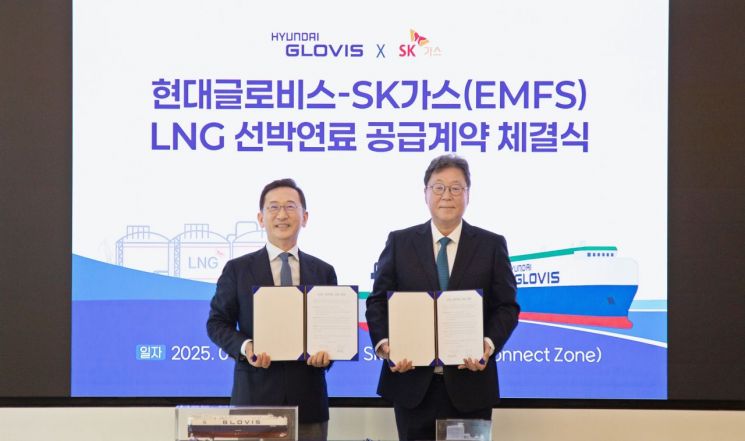 Yoon Byungseok, CEO of SK Gas (left), and Lee Gyubok, CEO of Hyundai Glovis, are taking a commemorative photo after signing a contract for LNG ship fuel supply based in the southeastern region of Korea. SK Gas
Based on this contract, SK Gas will begin full-scale construction of LNG bunkering infrastructure to support Hyundai Glovis’s eco-friendly pure car and truck carrier (PCTC) operations. In particular, the company plans to establish an LNG bunkering ecosystem centered around Hyundai Glovis’s main domestic ports of call, such as Ulsan, Busan, and Gwangyang in South Jeolla Province, aiming to lead the domestic market.
With the International Maritime Organization (IMO) setting a target for carbon neutrality across the shipping and shipbuilding industries by 2050, Hyundai Glovis plans to introduce more than 30 LNG dual-fuel pure car and truck carriers by 2028. Once port infrastructure is established in the southeastern region, Hyundai Glovis vessels will be able to receive a stable supply of fuel.
Yoon Byungseok, CEO of SK Gas, emphasized, "Decarbonization of the shipping industry is a global challenge, and building LNG bunkering infrastructure is the first step. SK Gas will expand eco-friendly energy solutions and actively support the global competitiveness of Korea’s shipping and logistics industries."
Meanwhile, SK Gas has designated this year as the inaugural year for expanding its LNG business and is fostering LNG bunkering as a mid- to long-term growth engine. With the Korea Energy Terminal (KET) in Nam-gu, Ulsan, which has the largest dedicated LNG bunkering pier in Korea, as its base, the company is focusing on the market potential to grow from several hundred thousand tons to over 1 million tons annually.
© The Asia Business Daily(www.asiae.co.kr). All rights reserved.
![Clutching a Stolen Dior Bag, Saying "I Hate Being Poor but Real"... The Grotesque Con of a "Human Knockoff" [Slate]](https://cwcontent.asiae.co.kr/asiaresize/183/2026021902243444107_1771435474.jpg)















