Inspired by China's "Yi Gu Huan Xin" Policy for Industrial Facility Improvement
Proposing a Large-Scale Transition to High-Efficiency Smart Homes and Acceleration of Green Mobility
The Korea Economic Association (KEA) on September 4 presented the "K-Renewal Seven Key Initiatives," aimed at simultaneously revitalizing domestic demand and achieving carbon neutrality.
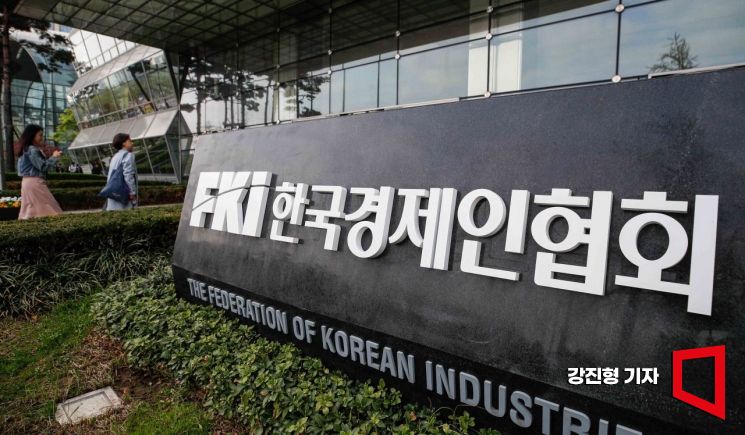 Employees of tenant companies are moving at the Korea Economic Association in Yeouido, Seoul. Photo by Jinhyung Kang aymsdream@
The seven initiatives were inspired by China's "Yi Gu Huan Xin" policy-which promotes replacing old goods with new ones to boost consumption-and related industrial facility improvement policies.
The main initiatives include a large-scale transition to high-efficiency smart homes, acceleration of green mobility, advancement of industrial infrastructure, a drive for residential innovation, renovation of aging social overhead capital (SOC), upgrading of artificial intelligence (AI) infrastructure, and stepping up support for K-Culture.
The transition to high-efficiency smart homes and acceleration of green mobility aim to stimulate large-scale consumption by replacing outdated home appliances and vehicles. The KEA stated, "The period for operating purchase subsidies for high-efficiency home appliances should be extended and the scope of eligibility expanded." It also emphasized, "Subsidies should be provided for scrapping old vehicles, including internal combustion engine cars, and both subsidies and tax benefits should be increased for the purchase of electric and hydrogen vehicles."
Regarding the advancement of industrial infrastructure, the association proposed expanding support projects such as Smart Green Industrial Complexes and establishing carbon reduction incentives. For residential innovation, it suggested easing regulations to promote redevelopment, relaxing floor area ratio limits for green remodeling, and offering incentives to encourage private sector participation.
For SOC renovation, the association recommended increasing budgets and systematizing maintenance. In terms of AI infrastructure, it called for expanding network bandwidth and supporting the remodeling and expansion of aging data centers. As for supporting K-Culture, it proposed constructing landmarks tailored to each city's characteristics and modernizing outdated tourism, accommodation, and cultural facilities.
Lee Sangho, Head of the Economic and Industrial Division at the KEA, stated, "The seven initiatives proposed by the KEA are a roadmap to revitalize the stagnant economy and secure future growth engines," adding, "The government should actively consider them as a means to improve the structure of the Korean economy by enhancing overall productivity."
© The Asia Business Daily(www.asiae.co.kr). All rights reserved.
![Clutching a Stolen Dior Bag, Saying "I Hate Being Poor but Real"... The Grotesque Con of a "Human Knockoff" [Slate]](https://cwcontent.asiae.co.kr/asiaresize/183/2026021902243444107_1771435474.jpg)















