800 km Driving Range on a Single Charge
300,000 km Lifespan Achieved
Second Publication in "Nature Energy"
On September 4, LG Energy Solution and the Frontier Research Laboratory (FRL), a joint research center with KAIST, announced that their research on lithium metal batteries, which can achieve a driving range of over 800 km on a single charge, a lifespan of more than 300,000 km, and a charging time reduced to just 12 minutes, has been published in the world-renowned energy journal "Nature Energy."
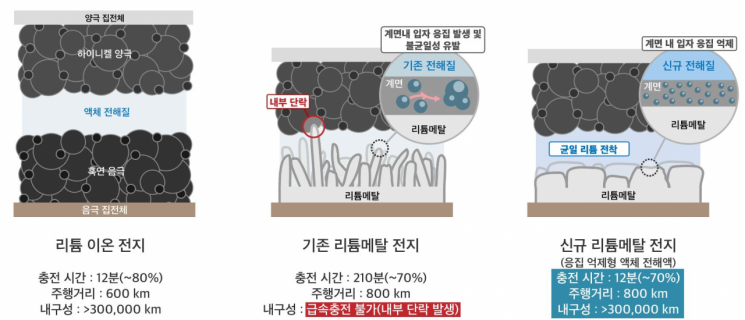 Infographic of the new lithium metal battery technology from the joint research center FRL of LG Energy Solution and KAIST. LG Energy Solution
This technology is a follow-up study to the "low-corrosive borate-pyran liquid electrolyte-based lithium metal battery" that was published in "Nature Energy" in 2023. The latest results are significant in that they not only improve discharge efficiency and energy density but also present advanced research outcomes regarding the "charging speed" issue, which has long been considered a major challenge for lithium metal batteries.
Lithium metal batteries replace the graphite anode, a key material in lithium-ion batteries, with lithium metal. This substitution significantly reduces the weight and volume of the anode material, greatly enhancing both energy density and driving range. In practice, lithium metal batteries can improve the average driving range of high-performance electric vehicles from 600 km to over 800 km.
However, lithium metal batteries have faced technical challenges, particularly the "dendrite" phenomenon-lithium deposition that compromises lifespan and safety. Dendrite formation becomes especially severe during rapid charging, potentially causing internal short circuits in the battery. As a result, it has been difficult to develop rechargeable lithium metal batteries suitable for fast-charging conditions until now.
To address this, the FRL joint research team identified that the fundamental cause of dendrite formation during rapid charging is the uneven interfacial aggregation reaction on the lithium metal surface. They have developed, for the first time in the world, a new liquid electrolyte that suppresses aggregation. This new electrolyte uses an anion structure with weak binding to lithium ions, minimizing interfacial irregularities and effectively suppressing dendrite growth even during rapid charging.
This technology maintains high energy density while overcoming the "slow charging speed" problem that has limited conventional lithium metal batteries, enabling stable operation even during fast charging. With the charging time reduced to just 12 minutes, this advancement is expected to accelerate the commercialization of lithium metal batteries.
Kim Jeeyoung, Executive Vice President and Chief Technology Officer (CTO) of LG Energy Solution, stated, "The four years of collaboration between LG Energy Solution and KAIST through FRL are producing meaningful results. We will continue to strengthen industry-academia cooperation to solve technical challenges and achieve the best outcomes in the next-generation battery sector."
© The Asia Business Daily(www.asiae.co.kr). All rights reserved.
![Clutching a Stolen Dior Bag, Saying "I Hate Being Poor but Real"... The Grotesque Con of a "Human Knockoff" [Slate]](https://cwcontent.asiae.co.kr/asiaresize/183/2026021902243444107_1771435474.jpg)















