Launch of RISE Consortium: 77.31 Billion Won and 65 Projects Over Five Years
Talent Development Linked to AI, Mobility, Energy, and Semiconductors
Building a Virtuous Cycle Ecosystem for Education, Industry, Welfare, and Community Settlement
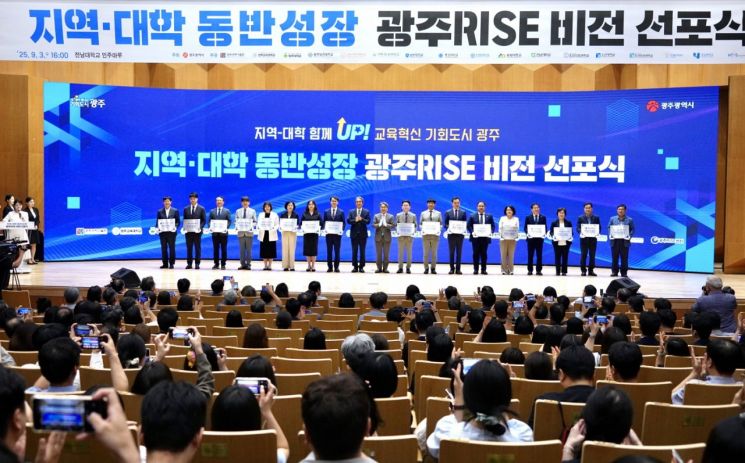 Kang Kijeong, mayor of Gwangju, is attending the 'Gwangju RISE Vision Proclamation Ceremony' held at Chonnam National University on the 3rd, posing for a commemorative photo. Photo by Gwangju City
Gwangju City and 17 local universities are taking the lead in regional innovation through the RISE (Regional Innovation-led University Support System) project. Gwangju City and the 17 universities will implement the RISE project over five years, carrying out 65 initiatives with a total budget of 77.31 billion won.
On September 3, Gwangju City held the 'Gwangju RISE Vision Declaration Ceremony' at Chonnam National University, officially announcing the launch of the Gwangju RISE project. The joint launch ceremony, attended by 17 universities, brought together Mayor Kang Gi-jung, Gwangju City Council Chairperson Shin Su-jeong, Gwangju Metropolitan Office of Education Superintendent Lee Jeong-seon, university presidents, heads of RISE project teams, business leaders, and approximately 300 other participants. Attendees reaffirmed their shared commitment to building an education-industry virtuous cycle ecosystem through collaboration among the region, industry, universities, and research institutes.
The event began with opening remarks from Mayor Kang Gi-jung and Chonnam National University President Lee Geun-bae, who served as co-chairs, followed by congratulatory addresses from City Council Chairperson Shin Su-jeong and Superintendent Lee Jeong-seon. The ceremony also featured the reading of the vision declaration by the Gwangju 17 Universities RISE Project Council. The declaration included commitments to: establishing a Gwangju-style regional innovation system and governance among the region, industry, universities, and research institutes; creating a talent development ladder and lifelong learning system; driving industrial innovation and addressing local issues; building a city where young people choose to stay or return; and carrying forward Gwangju’s history and philosophy as it moves toward becoming a global innovation city.
The program also included a special lecture by Professor Park Cheol-woo of Korea Polytechnic University, a member of the Central RISE Committee, on "Understanding RISE and Performance Management," as well as kick-off meetings for each RISE project subcommittee. These sessions provided an opportunity to share future tasks and cooperation strategies, strengthening the foundation for practical implementation.
This year, the city selected 17 universities to carry out 14 unit projects under four major initiatives in the first half of the year. The RISE project will proceed with a total of 65 detailed projects, with a combined budget of 77.31 billion won.
The selected 17 universities plan to focus all their capabilities over the next five years, until 2029, to achieve the core goals of producing 1,000 master’s and doctoral graduates, launching 35,000 start-ups, and reaching a 40% local employment rate among university graduates in Gwangju’s key industries: mobility, energy, semiconductors, and artificial intelligence (AI).
The RISE project aims to go beyond simply supporting universities, striving instead for an integrated ecosystem that encompasses the region, universities, industry, students, employees, and the general public. It is expected to establish itself as a sustainable growth model tailored to Gwangju.
Mayor Kang Gi-jung stated, "This vision declaration ceremony marks a symbolic starting point for transforming Gwangju into a city where young people return, where businesses grow, and where citizens enjoy a high quality of life. The city and the 17 universities will work together to make Gwangju the center of educational innovation in Korea and a global innovation city."
© The Asia Business Daily(www.asiae.co.kr). All rights reserved.
![Clutching a Stolen Dior Bag, Saying "I Hate Being Poor but Real"... The Grotesque Con of a "Human Knockoff" [Slate]](https://cwcontent.asiae.co.kr/asiaresize/183/2026021902243444107_1771435474.jpg)















