40th Anniversary Press Conference of the Korea Specialty Contractors Association
"Infringement on Specialty Construction Market After Restructuring of the Construction Industry Production System"
Intensifying Competition in Specialty Construction... Concerns Over Proliferation of New Illegal Subcontracting
"Securing Appropriate Construction Costs and Raising Safety Management Budgets Are Essential to Reduce Accidents"
The Korea Specialty Contractors Association has urged for a restructuring, arguing that the abolition of business boundaries allowing mutual construction between general and specialty contractors threatens the survival of the specialty construction industry and leads to a decline in construction quality.
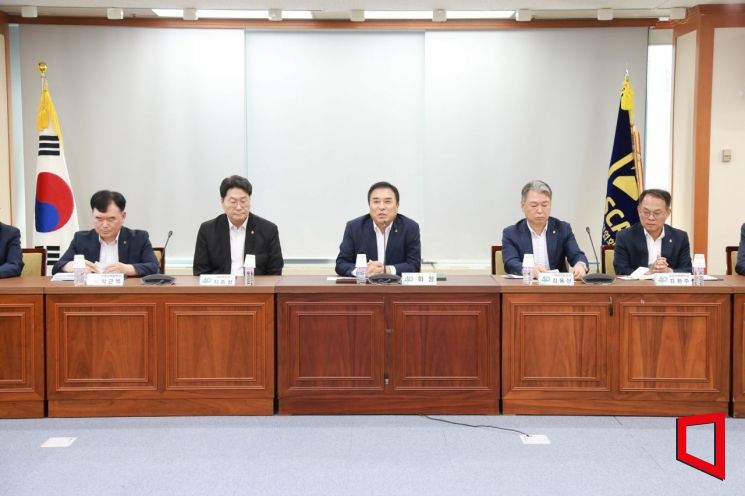 Yoon Haksoo, president of the Korea Specialty Contractors Association, is speaking at the 40th anniversary press conference held on the 3rd at the Specialty Construction Hall in Dongjak-gu, Seoul.
At the association's 40th anniversary press conference held on the 3rd at the Specialty Contractors Hall in Dongjak-gu, Seoul, Yoon Haksoo, president of the Korea Specialty Contractors Association, pointed out, "The government has restructured the 'construction industry production system' and opened up specialty construction work to general contractors, but the general contractors have encroached on the specialty construction market." He lamented, "General contractors are winning contracts for even local retaining wall projects and subcontracting them to specialty contractors. Specialty contractors need to secure comprehensive projects that combine 12 types of work, but this is practically difficult, resulting in poor outcomes."
The 'restructuring of the construction industry production system' refers to the government's 2021 policy that abolished business boundaries, allowing general and specialty contractors to enter each other's markets and enabling both primary and subcontracting. Currently, projects up to 430 million won are designated as a mutual entry protection zone. General contractors typically handle large-scale projects such as civil engineering, architecture, landscaping, and environmental facilities, while specialty contractors specialize in specific processes such as rebar and concrete work, interior construction, painting and waterproofing, and water and sewage systems.
The specialty construction industry claims that, since the abolition of business boundaries, their market has been infringed upon, resulting in lost contract opportunities and threats to their survival. While competition in specialty construction has intensified, it remains difficult to meet the registration requirements for general contracting, leading only to the proliferation of new types of illegal subcontracting. Yoon pointed out, "General contractors win contracts at 100 won and subcontract them at 80 won. As a result, the prices do not match, and there are problems with safety and construction quality."
There is also criticism that, while other countries are subdividing construction categories, South Korea is consolidating them into broader categories, which leads to the proliferation of illegal and expedient subcontracting. Yoon noted, "Japan has subdivided construction into 27 categories, and Tennessee in the United States has 170 categories. In South Korea, merging different categories into one makes it difficult to maintain expertise and develop technology." He continued, "Although subcontracting between general contractors is permitted, since they cannot perform specialty work themselves, they subcontract again. This drives up construction costs and sale prices, ultimately harming the public."
Amid a series of recent construction site safety accidents, President Lee Jaemyung has repeatedly emphasized safety, and the construction industry is also raising its awareness. There are also moves to strengthen penalties, such as the proposed 'Construction Safety Special Act,' which would impose fines of up to 3% of sales in the event of a fatal accident. Regarding this, Yoon stated, "Punishing only managers is unreasonable. If accidents are to be prevented, all members should be held responsible, and there must be a clear understanding that anyone can be held accountable."
He pointed out that, to reduce safety accidents, it is essential to first address structural issues directly linked to costs, such as sufficient construction periods, appropriate construction costs, and budgets for safety management. Yoon said, "Due to laws such as the Serious Accidents Punishment Act, safety management costs are bound to increase by about 25 to 30%. Safety management budgets should be raised and appropriate construction costs ensured," adding, "Construction costs in South Korea are truly 'the lowest.' Demanding safety and quality under these circumstances is excessive."
With ongoing labor shortages at construction sites, the association is also pursuing a pilot project to deploy foreign general skilled workers (E7-3) in certain construction categories to address labor shortages in less desirable sectors. According to workforce structure statistics from the Construction Workers Mutual Aid Association, as of this year, the number of domestic workers in the construction industry is estimated at 1.58 million. An association official explained, "The workforce needed at sites is 1.75 million, so more than 200,000 positions are being filled by illegal foreign workers. In processes where foreign labor is legally permitted, such as civil engineering, over 90% are foreigners, and in processes avoided by domestic workers, such as aluminum formwork, the proportion of illegal workers is quite high."
Yoon stated, "Foreign workers are not taking jobs away from domestic workers; rather, they are being legally deployed in sectors where domestic workers are unable or unwilling to work, and the government also agrees with this approach. This will provide an opportunity for greater transparency, rather than relying on illegal labor."
© The Asia Business Daily(www.asiae.co.kr). All rights reserved.

















