Hyundai Development Raises Construction Costs Without Initial Benefits
Increase Unavoidable Due to Rising Raw Material and Labor Costs
Association: "Project Stability and Swift Execution Are Top Priorities"
Emergency Committee: "Excessive Construction Costs Harm Members"
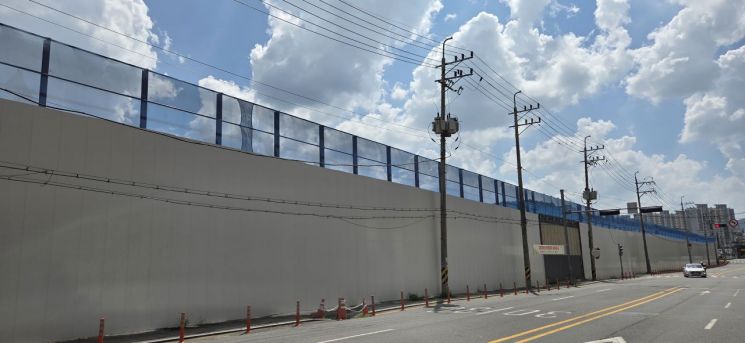 On the 3rd, fences were installed at the housing redevelopment maintenance project site in Hakdong 4 District, Dong-gu, Gwangju. Photo by Min Chanki
The Hakdong 4 District housing redevelopment maintenance project in Gwangju, where 17 people were killed or injured during the demolition process, is set to begin construction at the end of the year. However, disagreements within the association have intensified over the increased construction costs compared to the original plan.
Benefits proposed by HDC Hyundai Development Company (Hyundai Development), such as 'no margin' and 'construction costs with no additional burden,' which were initially offered as part of fulfilling social responsibility after the disaster, have mostly disappeared. With only the construction cost increased in the final decision, criticism has emerged that this has only sown the seeds of further disputes.
As the project has stalled for an extended period, the conflict between the executive committee, which is calling for 'securing project stability and swift execution,' and the emergency response committee, which insists that 'excessive construction costs are unacceptable,' is deepening.
According to the Hakdong 4 District Housing Redevelopment Maintenance Project Association (the association) on the 3rd, the association is preparing to hold a general meeting to discuss agenda items, including amendments to the management and disposal plan. If the agenda is approved at this general meeting, an agreement with the contractor, including a commitment to commence construction and obtain permits within the year, will be drafted. However, if the agenda is rejected, construction cannot begin within the year, and the project may be delayed.
The general meeting was initially scheduled for the end of this month, but the association is expected to postpone it due to concerns that the agenda may be rejected. Recently, the association's emergency response committee has continued to argue that "Hyundai Development, the contractor, has excessively increased the construction costs," leading to a standoff with the association's executive committee.
◇ Where did the internal conflict within the Hakdong 4 District redevelopment association begin?
This conflict stems from the 14 benefits proposed by Hyundai Development in June 2022 to maintain its construction rights and fulfill its social responsibility. In 2021, Hyundai Development was responsible for the demolition work in Hakdong 4 District, during which a building collapsed, resulting in 17 casualties. The disaster led to calls for replacing the contractor, and Hyundai Development proposed these benefits to retain its construction rights.
The proposal made by Hyundai Development in June 2022 included 14 items: construction costs of 5,085,000 won per pyeong with no margin, construction costs with no additional burden after actual commencement, 10 million won in move-in support per household, all foreign and domestic finishing materials and appliances, and 100% compensation in kind for unsold units, among others. The clause stipulated that construction costs would be negotiated based on inflation rates until actual commencement.
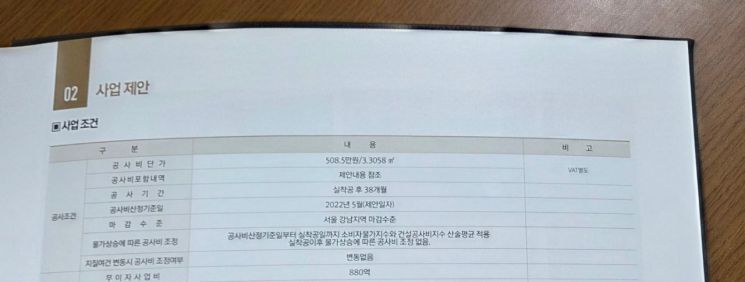 The business terms proposed by Hyundai Development Company in June 2022 to the Hakdong 4 District Housing Redevelopment Maintenance Project Association. The clause regarding construction cost adjustments due to inflation does not include a proviso stating that "construction costs may increase if the delay is not attributable to the contractor after actual construction begins." Photo by Min Chanki
This agreement was reached at a general meeting in August 2023, one year and two months later. The clause regarding construction costs included a proviso stating, "Construction costs may increase if the delay is not attributable to the contractor after actual commencement." The emergency response committee argues that "since inflation is not the contractor's fault, construction costs could be increased at any time." However, the association maintains that "this refers to unavoidable circumstances such as natural disasters, war, legal amendments, or additional design or finishing material changes requested by the association after commencement. Construction costs cannot be increased simply due to inflation after commencement."
Furthermore, in September last year, Hyundai Development requested a construction cost of 6,980,000 won per pyeong, citing rising raw material prices and labor costs. They claimed this was based on applying inflation to the base construction cost of 5,085,000 won per pyeong.The association expressed its position that this was 'unacceptable' and formed a construction cost negotiation committee consisting of seven members: one executive, three delegates, and three association members, to negotiate with Hyundai Development.
◇ 6,980,000 won → 6,730,000 won → 6,198,000 won
The negotiations dragged on for several months. The association was unable to change the contractor or raise the general sales price in a situation where raw material prices were rising, the construction market was deteriorating, and unsold units could occur. The longer the negotiations continued, the longer the move-in for association members was delayed. Even if the association terminated the contract with the contractor, it would be difficult to find a new contractor in the weakened construction market and could be liable for damages. Unlike in 2022, the positions of the association and the contractor had been reversed.
Nevertheless, the association insisted that the construction cost, reflecting the inflation rate, should be around 5,400,000 to 5,500,000 won per pyeong. In February, Hyundai Development proposed 6,730,000 won per pyeong to the negotiation committee, arguing that this was the construction cost with no margin.
This proposal was also rejected by the association, and after negotiations lasting about ten months, it was decided in June to set the construction cost at 6,198,000 won per pyeong, on the condition that benefits such as move-in bonuses and appliances would be canceled.
◇ "Swift project execution" vs. "Cannot accept excessive construction costs"
The association stated, "Redevelopment projects in the Gwangju area are being carried out at 7,000,000 to 8,000,000 won per pyeong. 6,198,000 won is by no means excessive. We have been negotiating for several months, and if the project is delayed, uncertainty will increase. The vast majority of association members want the project to proceed quickly."
However, the emergency response committee maintains that it cannot accept the excessive construction cost demands, which exceed the inflation rate initially promised by the contractor, as well as the months-long delay in negotiations.
The emergency response committee stated, "Interest on PF loans and association operating expenses amount to about 700 million won per month. The ten months of meaningless construction cost negotiations have caused 7 billion won in losses to the association. The construction cost stipulated in the agreement could be set at 5,400,000 to 5,500,000 won per pyeong, but agreeing to 6,198,000 won has resulted in more than 10 billion won in losses. The cancellation of benefits such as appliances and move-in bonuses has caused a loss of 44 million won per person."
There is also ongoing controversy over the process of verifying the construction costs. In accordance with relevant laws such as the Urban and Residential Environment Improvement Act, the association submitted the construction cost verification to the Korea Real Estate Board in July. However, the construction cost submitted to the Real Estate Board was the contractor's initial request of 6,980,000 won per pyeong. The emergency response committee argues that "this data cannot prove whether the final construction cost of 6,198,000 won per pyeong is appropriate and could be used as a basis for future construction cost increases."
In response, an association official stated, "The contractor's cooperation is necessary for the data needed for construction cost verification, and under the standards for maintenance project construction costs, the only data the association could request from the contractor was the initial construction cost request. Since the contract with the contractor has already been signed, the construction cost verification data is only for reference and does not affect the final agreement."
© The Asia Business Daily(www.asiae.co.kr). All rights reserved.


















