Korea’s Debt-to-GDP Ratio Remains Favorable
Caution Needed Over Rising Fiscal Burdens
Concerns Over U.S. Tariff Talks
Potential for New Demands on Exchange Rate and More
Expanding International Cooperation Is Key
Need for Broader Trad
"A deficit is not always a bad thing. If additional fiscal spending is used to boost productivity and thereby increase the growth rate, it can certainly have positive effects."
Morris Obstfeld, Senior Fellow at the Peterson Institute for International Economics, made these remarks at a press conference for the "2025 G20 Global Financial Stability Conference" held on the 3rd at The Plaza Hotel in Jung-gu, Seoul. Regarding growing concerns over government debt as fiscal policy shifts toward expansion, he explained, "If investments are made in key sectors of the economy or if structural reforms are implemented to raise the growth rate, the sustainability of fiscal burdens can be improved."
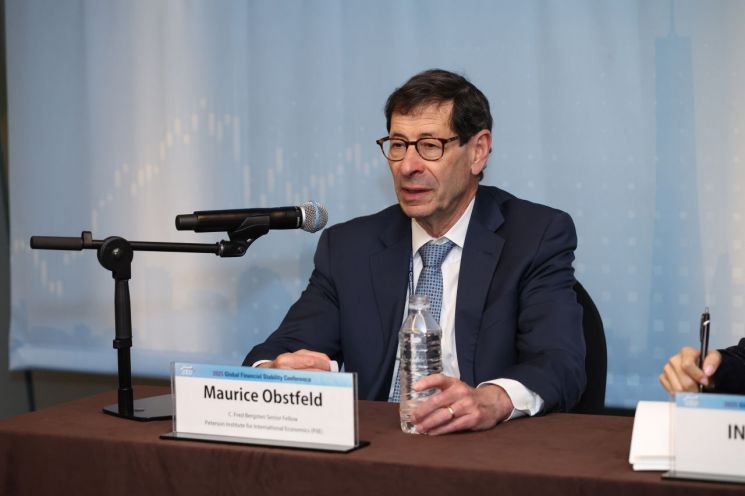 Morris Obstfeld, Senior Fellow at the Peterson Institute for International Economics and Emeritus Professor of Economics at the University of California, Berkeley, is speaking at a press conference for the "2025 G20 Global Financial Stability Conference" held on the 3rd at The Plaza Hotel in Jung-gu, Seoul. Korea Development Institute (KDI)
Obstfeld emphasized, "In fact, the more important question is whether fiscal resources are being used effectively," adding, "It is crucial to set proper goals and use resources efficiently to achieve those goals." He continued, "The government needs to use resources carefully and in line with its objectives. If all of this is managed well, risks can be avoided, but if not, risks will continue to increase."
Commenting on Korea's government debt-to-GDP ratio, which is expected to exceed 50% for the first time next year, Obstfeld assessed, "Compared to other OECD countries, Korea is at a sound level." However, he expressed concern that "due to Korea's rapid aging population, fiscal support for the elderly will continue to rise." He also cited the increase in interest burdens resulting from global rate hikes as a negative factor. He added, "Just because the situation is sound today does not mean there are no risk factors, so a cautious approach is still necessary."
Regarding projections that Korea may be entering a prolonged recession similar to Japan, he said, "(Compared to Japan's past situation) Korea is in a better position, so I do not believe deflation is inevitable." He noted, "Not long ago, President Lee Jaemyung discussed policies to ease regulations and boost potential growth," and added, "If all policies are implemented carefully, risk factors can be avoided."
On the outcome of the Korea-U.S. tariff negotiations, he pointed out, "We need to reconsider whether this is a genuine agreement," and expressed concern that "the interpretation of the agreement may differ." He predicted, "(Regarding the implementation of investment funds in the U.S.) given the lack of details and considering the American negotiation style, there is ample room for problems to arise in the future." He also said it could negatively impact bilateral relations.
Obstfeld suggested that the U.S. may make additional demands beyond this agreement, stating that "one of the objectives is the exchange rate." He explained, "If the U.S. imposes high tariffs on Korea, the value of the won will fall, but the U.S. is likely hoping for the won to appreciate." He also projected, "The value of the won has fallen by about 10% compared to January, and it is likely to continue to decline."
Regarding Korea's relationship with China, Obstfeld expressed concern about making a unilateral choice between economic and security interests. He said, "China is a major trading partner, and if trade relations with China deteriorate, the Korean economy will undoubtedly pay a heavy price." He added, "Just because there is a trade relationship does not mean relations will always be peaceful, and if there is no trade relationship at all, the likelihood of geopolitical conflict increases."
Obstfeld predicted that the U.S. would "reduce its presence in the international community" going forward. He anticipated that the U.S. would no longer play a leadership role in providing global public goods such as security, health, and climate. He added, "(For countries outside the U.S.), strengthening ties among regional members not only helps protect themselves from U.S.-origin shocks but also enables the provision of more public goods."
He explained that for Korea to enhance international cooperation, "joining ASEAN+3 is a natural next step." Obstfeld said, "It is necessary for Korea to continue expanding cooperative relationships with other countries around the world, such as Japan and China." He also stated, "Korea needs to cast a wider net, maintaining an open attitude toward establishing new trade relationships while strengthening existing ones."
Obstfeld is an Emeritus Professor of Economics at the University of California, Berkeley, and a globally renowned economist who previously served as Chief Economist at the International Monetary Fund (IMF) and as a member of the White House Council of Economic Advisers. The conference, co-hosted by the Ministry of Economy and Finance and the Korea Development Institute (KDI), featured a keynote speech by Obstfeld on "Changes in the Trade System and Financial Stability."
© The Asia Business Daily(www.asiae.co.kr). All rights reserved.

















