"Considering M&A of Companies with Sauce Distribution Networks"
The Born Korea's First Loss Since Listing...
Aims to Establish a Virtuous Cycle Domestically and Internationally
Baek Jongwon, CEO of The Born Korea, is making a comeback by leveraging Korean sauces. After announcing a halt to his broadcasting activities earlier this year due to various controversies, including the Baekham price issue and origin labeling violations, he is now seeking a breakthrough in overseas markets to offset poor domestic performance. Baek also revealed his goal to achieve 100 billion won in overseas sales by 2030.
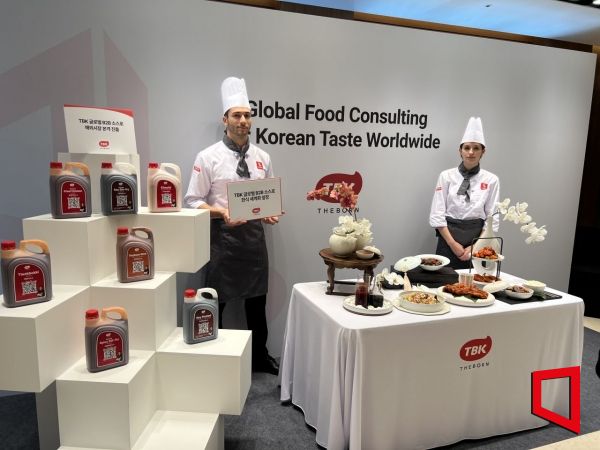
On September 3, Baek Jongwon held the "TBK (The Born Korea) Global B2B Sauce Launch Demonstration" at the Shilla Hotel in Jung-gu, Seoul, where he announced the company's global distribution business strategy. Export sauces have been identified as a growth driver for The Born Korea since its initial public offering.
At the press conference, Baek stated, "Our goal is to expand B2B sales of 'TBK Sauce,' revenue from global food consulting utilizing the sauces, and B2C sauce sales to reach 100 billion won by 2030."

"Considering M&A of Companies with Sauce Distribution Networks"
The Born Korea plans to achieve 5 billion won in sales by 2026, 50 billion won by 2028, and 100 billion won by 2030 through global sauce exports. This is 24 times higher than last year's overseas sales of 4.2 billion won. Overseas sales accounted for only 2.92% of total revenue last year. Baek expressed confidence, saying, "We may achieve the target even sooner."
Baek emphasized, "Unlike large corporations that started with B2C, we are a company that inevitably created sauces for our franchise business, so we are confident in our product quality. While we cannot afford large-scale advertising, our differentiation lies in expanding through online marketing based on video content or direct demonstrations to chefs and supermarket officials on-site."
He added, "Just as the predecessors of general trading companies, who led Korea's economic boom in the 1970s and 1980s, carried a single bundle and pioneered overseas markets by promoting products directly, I will also carry our sauce containers and promote them abroad."
However, strengthening sauce production facilities appears to be essential. The Born Korea has shut down operations at the Baekseok plant, which produced various sauces and pastes, due to allegations of violating the Farmland Act by producing and selling doenjang made from imported ingredients such as Chinese meju and soybeans from the United States, Canada, and Australia. The equipment from the Baekseok plant has been relocated to the Yesan plant, but the Yesan plant was already operating at a 90.5% utilization rate in the liquid sauce division last year, indicating an urgent need for additional investment in facilities.
For this reason, The Born Korea is also considering mergers and acquisitions of sauce-related companies. Choi Kyungseon, Vice President of The Born Korea, said, "The B2B sauces for export are produced at the Yesan plant and through some original equipment manufacturing (OEM). Rather than expanding the Yesan plant, we are reviewing various options related to mergers and acquisitions, such as acquiring a company with a sauce distribution network."
The Born Korea's First Loss Since Listing... Aims to Establish a Virtuous Cycle Domestically and Internationally
The Born Korea's recent overseas business moves are closely related to the series of controversies that began with the 'Baekham controversy' earlier this year. The company has been embroiled in various issues, including "Brazilian chicken meal kit," "tangerine beer content," "targeting and retaliatory store openings at Yesan Market," "cooking with rusty engine oil drums," "Paikdabang plastic containers," "unilateral notification of portrait rights usage at festivals," "operation of a staff blacklist," "irregular special contracts with local governments," "drinking interviews and sexual harassment," and "broadcasting power abuse allegations." In response, Baek announced a complete overhaul, suspended his TV appearances, and established a co-prosperity committee to communicate with franchise owners in an effort to restore trust.
As the brand image suffered, The Born Korea's business performance took a direct hit. In the second quarter of this year, consolidated sales dropped 34.5% year-on-year to 74.2 billion won, while operating and net losses reached 22.5 billion won and 23.8 billion won, respectively, marking a shift to losses. For the first half of the year, sales fell 16.4% year-on-year to 184.9 billion won, with an operating loss of 16.3 billion won. This is the first loss since the company's listing.
The Born Korea's business is largely divided into franchise, distribution, and hotel operations, but more than 85% of its revenue is concentrated in the franchise business, making it impossible to avoid a direct hit. In fact, 85.54% of last year's sales came from the franchise business, while distribution accounted for 12.55% and hotels just 1.89%. In the first half of this year, 159 billion won, or 85.95% of the 185 billion won in sales, came from the franchise business.
Baek is determined to overcome the risks of a franchise-focused, domestic-oriented revenue structure by utilizing funds earned overseas. He stated, "We will establish a virtuous cycle that connects domestic sales to global investment and development, and reinvest achievements from the global market into domestic research and development (R&D) to lay the foundation for stable growth."
© The Asia Business Daily(www.asiae.co.kr). All rights reserved.


















