Lee Sik, Director of KISTI: "Balanced Development of Data and Computing Is Essential"
Leading the National Bio Big Data Project
Introducing National Supercomputer No. 6 and Advancing Quantum Computing
Emphasizing the Role as a National Strategic Data Center
The Korea Institute of Science and Technology Information (KISTI) has expressed its ambition to go beyond its role as the operator of the national supercomputing infrastructure and to transform into a national data center, leading the transition into the era of artificial intelligence (AI).
In an interview with Asia Economy at the Daejeon headquarters, Director Lee Sik stated, "KISTI is transforming from a supercomputing institution focused on computational science to a national strategic data center that leads national strategic research by combining data, computing, and AI."
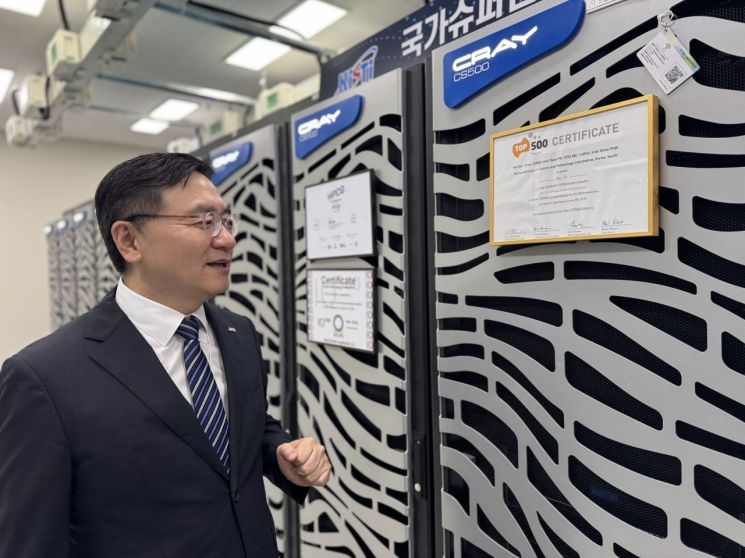 Lee Sik, director of KISTI, is explaining the National Supercomputer No. 5 Nurion to reporters. Nurion is scheduled to be replaced next year by the Supercomputer No. 6. Photo by Baek Jongmin, Tech Specialist
KISTI is the only national institution in Korea capable of not only collecting, processing, and storing data, but also providing both the platforms and supercomputing infrastructure needed to handle it. Director Lee emphasized, "Our role goes beyond simply gathering data; it is to create an environment where researchers can actually utilize data by combining analysis platforms with high-performance computing."
Director Lee is a leading researcher in the field of supercomputing, recognized both domestically and internationally.
A representative example of this transformation is the "National Bio Big Data Project." KISTI is currently working with the Ministry of Health and Welfare and the Korea Disease Control and Prevention Agency to promote the National Integrated Bio Big Data Project. This is a large-scale initiative that collects Korea's vast medical data-including clinical records, genomic data, and omics data-and uses it as foundational resources for precision medicine, new drug development, and public health research. The project analyzes large-scale medical data using artificial intelligence to extract new patterns and insights, which are then validated through supercomputer-based simulations.
Director Lee explained, "Even if you have good data, it is useless without computing power. Conversely, even the best computers are meaningless without supporting data." He added, "Korea is globally competitive in terms of the quality and scale of its medical data. By analyzing this data with supercomputers and AI, we can achieve innovative results in disease prediction, personalized treatment, and the discovery of new drug candidates."
The sixth national supercomputer, scheduled to be operational next year, marks a turning point for KISTI. Supercomputer No. 6 will be equipped with 8,496 NVIDIA graphics processing units (GPUs), aiming for computational power 23 times faster than that of its predecessor, Nurion (Supercomputer No. 5). It is expected to rank among the top 10 in the world. The new system is anticipated to significantly enhance the research capabilities of Korea's scientific community and provide robust support for AI. Director Lee expressed confidence, saying, "We will operate Supercomputer No. 6 as early as possible to secure the highest possible international ranking."
Director Lee said, "Supercomputer No. 6 is designed to handle not only computational science simulations but also AI training and bio data analysis simultaneously. Researchers in precision medicine and new drug development, especially those working with bio big data, will be the first to benefit."
Director Lee stressed, "In the future, bio, AI, and supercomputing will become inseparable. Researchers can only fully leverage these resources when data and computing power are brought together in one place. KISTI will serve as that forward base."
KISTI's ongoing efforts to introduce quantum computers also represent a significant change. KISTI is in the process of bringing in "Tempo," a quantum computer from IonQ, a leading American company in the field. As the lead institution for the Ministry of Science and ICT's "Quantum Computing Service and Utilization System Establishment Project," KISTI plans to complete a hybrid platform that combines supercomputing and quantum computing by 2028. This initiative is attracting considerable international attention and could mark a turning point for the future of quantum computing.
IonQ is also actively participating in this project to address its own shortcomings through collaboration with KISTI. Dean Kesman, Senior Vice President of IonQ, said, "Collaboration with KISTI, a leader in supercomputing, will be a significant milestone." This is because the weaknesses of quantum computers, such as error rates, can be supplemented through integration with supercomputers.
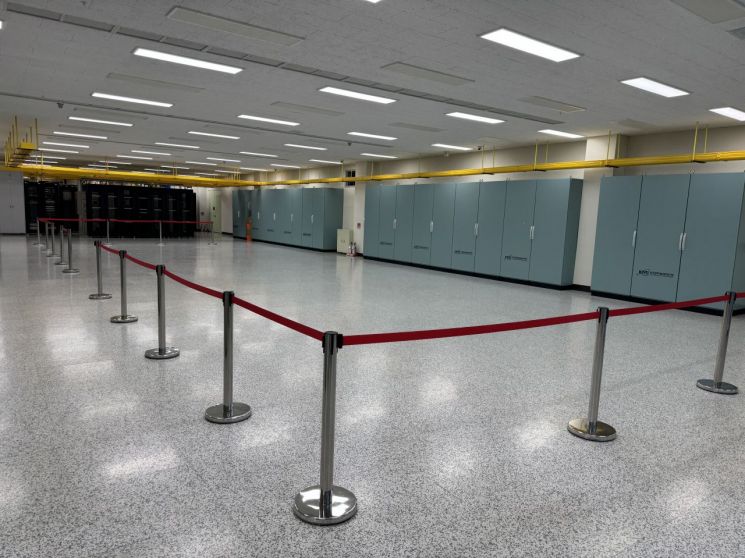 The KISI National Supercomputing Center has a designated spot for the installation of the sixth unit, which is scheduled to be operational next year. Photo by Jangmin Baek, Tech Specialist
Director Lee predicted, "Bio research will make great strides through the triangular axis connecting supercomputing, AI, and quantum computing."
As the status of Korea's supercomputing rises, more countries are seeking collaboration. KISTI is pursuing joint research with institutions in Stuttgart, Germany; CSC in Finland; and research organizations in Switzerland. It is also continuing data analysis partnerships with the University of Edinburgh in the United Kingdom and Leiden University in the Netherlands.
Director Lee explained, "We are no longer just learning from others; we are now collaborating on an equal footing based on our own data and supercomputing infrastructure."
Academic research is also a key focus. Led by KISTI, the "Korea Supercomputing Conference 2025," which will be held at COEX in Seoul on September 4 and 5, is the largest academic conference in the domestic supercomputing field. The event will explore the convergence of supercomputing with the latest technologies such as AI and quantum computing, share research achievements, and discuss optimal scientific utilization strategies for Supercomputer No. 6.
For KISTI to fulfill its role as a national data center, expanding its infrastructure is also necessary. Director Lee stated, "We are reviewing expansion plans, including securing additional sites."
© The Asia Business Daily(www.asiae.co.kr). All rights reserved.
![Clutching a Stolen Dior Bag, Saying "I Hate Being Poor but Real"... The Grotesque Con of a "Human Knockoff" [Slate]](https://cwcontent.asiae.co.kr/asiaresize/183/2026021902243444107_1771435474.jpg)

















