National Projects Like Gyeongbu Underground and Yongin-Gwacheon, Plus Six Private Investments Underway
Lee Sangil, Mayor of Yongin: "Connectivity to Key Metropolitan Hubs Will Improve"
Eight highways and four interchanges. This is the extensive road network currently being developed around Yongin City in Gyeonggi Province. The defining feature of these highway projects can be summed up in one word: semiconductors.
Once the construction of highway networks connecting the large-scale semiconductor industrial complexes in Wonseam-myeon, Idong-eup, and Namsa-eup of Cheoin-gu to major areas of the Seoul metropolitan region is completed, not only will the competitiveness of Yongin City’s ambitious semiconductor belt be significantly enhanced, but the living conditions for residents are also expected to greatly improve.
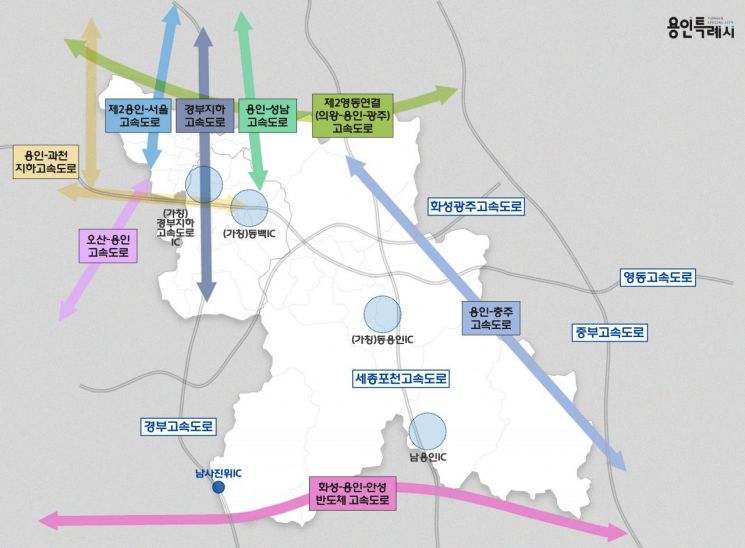 Status of Major New Highways and New Interchanges Connecting to the Yongin Area. Provided by Yongin City
According to Yongin City on September 3, there are currently eight major highway routes under construction to connect the Yongin area, with four new highway interchanges (ICs) being established.
Of these highway construction projects, two are national projects directly funded by the government, while six are private investment projects proposed by the private sector.
The two national projects underway are the Gyeongbu Underground Expressway and the Yongin-Gwacheon Underground Expressway.
The Gyeongbu Underground Expressway project involves building a four-to-six lane underground road along the 26.1-kilometer section from Giheung in Yongin to Yangjae in Seoul. After passing the preliminary feasibility study in August last year, a full feasibility assessment is currently underway.
The Yongin-Gwacheon Underground Expressway project will provide a dedicated underground road for small vehicles and a general expressway along 21.1 kilometers of the 30-kilometer section between Singal and Buk Suwon on the Yeongdong Expressway, and the Suwon-Gwacheon section. This project was included in the preliminary feasibility study targets last month.
Private investment projects are also progressing in succession. The six private investment projects currently under discussion are: the Semiconductor Expressway (45.3 km), Yongin-Seongnam Expressway (15.4 km), Yongin-Chungju Expressway (55 km), Second Yongin-Seoul Expressway (9.6 km), Second Yeongdong Connection Expressway (32 km), and Osan-Yongin Expressway (17.2 km), totaling 174.5 kilometers in length.
The Semiconductor Expressway will link major semiconductor industry hubs in the metropolitan area, including Yanggam in Hwaseong, Yongin, and Iljuk in Anseong. The private investment feasibility study for this project is scheduled for completion this month. Similar feasibility studies are underway for the Yongin-Seongnam, Yongin-Chungju, and Second Yongin-Seoul expressways.
For the new expressway along the disconnected section of the Second Yeongdong Expressway (Uiwang-Yongin-Gwangju), the Ministry of Land, Infrastructure and Transport is conducting a strategic environmental impact assessment. For the Osan-Yongin Expressway, the implementation agreement process with the private operator is in progress.
Yongin City is also working to improve highway accessibility by establishing new interchanges. The Namyongin IC on the Sejong-Pocheon Expressway is scheduled to open within this year, and the Dongyongin IC on the same road has effectively passed the feasibility study by the Korea Research Institute for Local Administration.
The number of access ramps to the Yeongdong Expressway will also increase. In February, Yongin City signed a business agreement with Korea Expressway Corporation for the construction of the new Dongbaek IC (tentative name) on this expressway, and design work has been underway since July.
The city is also planning to install an interchange connecting the Gyeongbu Underground Expressway to Platform City in Giheung-gu, with a target completion year of 2032. Additionally, to improve access to the Idong-Namsa Advanced System Semiconductor National Industrial Complex, the city is considering the installation of entrance and exit ramps in the Seoul direction at the Namsajinwi IC on the Gyeongbu Expressway.
Lee Sangil, Mayor of Yongin, stated, "Expanding the highway network is not only about improving transportation convenience for citizens, but also about enhancing the connectivity of the semiconductor cluster in the Yongin area," adding,
"Once the planned highway network is established, accessibility to major hub areas in the Seoul metropolitan region will be greatly improved."
© The Asia Business Daily(www.asiae.co.kr). All rights reserved.
![Clutching a Stolen Dior Bag, Saying "I Hate Being Poor but Real"... The Grotesque Con of a "Human Knockoff" [Slate]](https://cwcontent.asiae.co.kr/asiaresize/183/2026021902243444107_1771435474.jpg)















