Merz Delivers His Strongest Criticism Yet of Putin
Calls Putin "Perhaps the Most Serious War Criminal of Our Time"
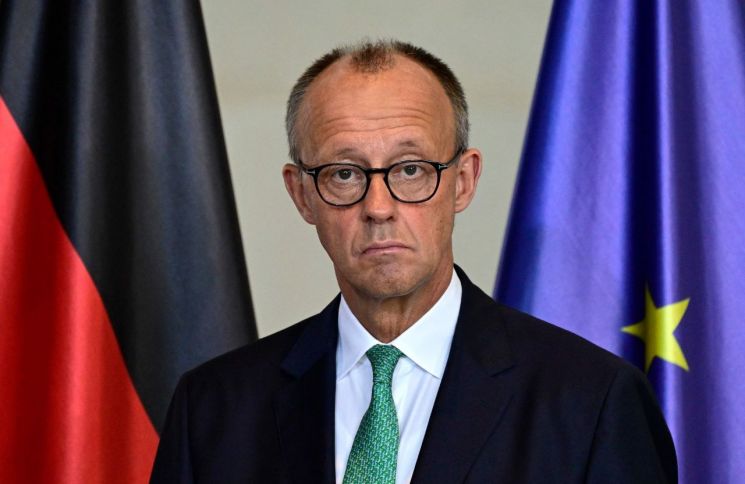
German Chancellor Friedrich Merz has, for the first time, labeled Russian President Vladimir Putin a "war criminal." This marks the strongest statement Merz has made about President Putin since taking office in May, during which he has consistently criticized Russia's military operations.
On September 2 (local time), Chancellor Merz appeared on Sat.1 and stated, "He is perhaps the most serious war criminal of our time," adding, "We must be clear about how to deal with war criminals. There is no room for leniency here."
Since his inauguration in May, Chancellor Merz has condemned Russia's military operations as "the worst war crimes" and "terror against civilians," but this is the first time he has directly referred to President Putin as a "war criminal."
From the beginning of his term, he has strengthened military support for Ukraine and expanded financial aid. Germany has provided military supplies such as air defense systems, tanks, and long-range shells. Expanding support for Ukraine was also included in his presidential campaign pledges.
Chancellor Merz reiterated his differing position from the European Union regarding the issue of sending troops to Ukraine, which was recently mentioned by European Commission President Ursula von der Leyen in an interview with the Financial Times. On August 31, he also stated that "at this point, no one is discussing the deployment of ground troops" in relation to the possible stationing of Western forces in Ukraine, emphasizing that establishing a comprehensive security framework should be the priority. While the United States has ruled out sending its own ground troops, European countries such as the United Kingdom, France, and Estonia have expressed willingness to send security forces.
When asked about the possibility of deploying security forces, Chancellor Merz responded, "At present, there are no such concrete plans," and said that security arrangements should be decided only after a ceasefire or peace agreement is reached. He also stated firmly, "The EU has no authority over this matter." This suggests that decisions on military support should be made by the coalition of willing countries discussing postwar security guarantees.
The German government also shares a negative stance on deploying its own ground troops. German Defense Minister Boris Pistorius said the previous day, "Setting aside the fact that the EU has no authority to deploy troops, we should refrain from confirming or commenting on such discussions in any way," and pointed out, "It is fundamentally wrong to bring up such topics before even sitting at the negotiating table."
Meanwhile, since the U.S.-Russia summit on August 15, peace negotiations between Russia and Ukraine have stalled. According to Russian independent media outlet Mediazona and BBC Russia, as of August 2025, the number of Russian military fatalities has surpassed 220,000. The number of Ukrainian casualties is estimated at around 400,000, with up to 100,000 deaths among them.
© The Asia Business Daily(www.asiae.co.kr). All rights reserved.
![Clutching a Stolen Dior Bag, Saying "I Hate Being Poor but Real"... The Grotesque Con of a "Human Knockoff" [Slate]](https://cwcontent.asiae.co.kr/asiaresize/183/2026021902243444107_1771435474.jpg)















