Cho Kuk Continues to Raise Concerns Over Far-Right Shift Among Men in Their 20s and 30s
"Division Is Not My Doing, but Lee Junseok's"
Lee Junseok: "Far-Right Is a Feeling, Admission Irregularities Are Facts"
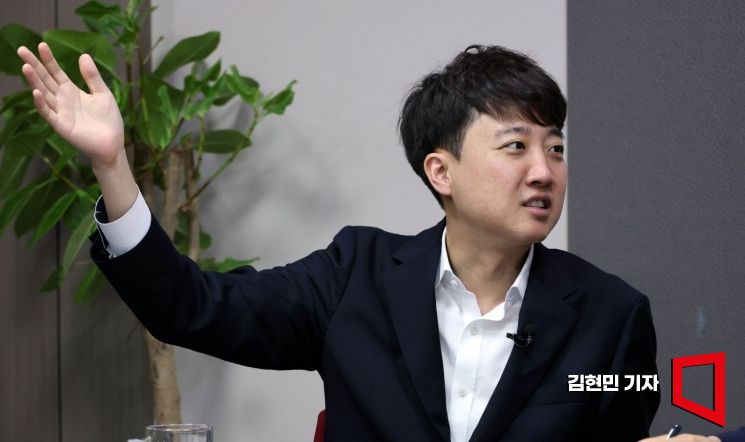 Lee Junseok, leader of the Reform New Party, appeared on the Asia Economy Current Affairs Show at the National Assembly on the 5th and is being interviewed by specialist So Jongsup. Photo by Kim Hyunmin
Lee Junseok, a member of the Reform New Party, continued his debate with Cho Kuk, head of the Innovation Policy Research Institute of the Cho Kuk Innovation Party. In an interview with Yonhap News on September 2, Cho stated, "Three out of ten men in their twenties are far-right, and the proportion is 1.5 times higher than that of women in their twenties, according to a survey," expressing his views on the far-right tendencies among men in their 20s and 30s. He has continued to voice such opinions.
On September 3, Lee Junseok commented on his social media, "I do not understand why former leader Cho Kuk is so obsessed with labeling people in their 20s and 30s as far-right. For a political methodology learned through a few months of short-term training at school, isn't it too crude and low-level?" he began.
He continued, "The definition of 'far-right' is not even clear in the dictionary, and it is just a delusion because former leader Cho himself sits so far to the left that he perceives others as sitting far to the right. Similarly, for those steeped in right-wing YouTube content, Lee Junseok is seen as a left-wing agent. No matter how much noise is made, it is merely an opinion," he pointed out.
Lee Junseok further stated, "It's like North Korea using white rice and meat soup as the standard for paradise, or the emotional outcry of the 'Jukchangga' song that gets excited at the sight of anything Japanese-just a vague feeling. However, the forgery of award certificates, proxy exams, and fabricated internship certificates are facts, and no matter how much you try to label the younger generation criticizing these facts as far-right based on vague feelings, it will not work," he criticized.
Cho Kuk Repeatedly States, "Men in Their 20s and 30s Are Far-Right"... Also Shares Related Articles on Social Media
Cho Kuk, who was granted a special pardon and reinstatement on Liberation Day, has repeatedly mentioned the far-right tendencies among men in their 20s and 30s. In an interview on MBC Radio's "Kwon Soonpyo's News High Kick" on August 22, he commented on the low approval rating of the Cho Kuk Innovation Party among the 20s and 30s demographic, saying, "Men in their 20s and 30s show tendencies similar to those in their 70s," and added, "If it were simply a conservative tendency, it would be a different issue, but they are showing so-called far-right tendencies."
 Cho Kuk, head of the Innovation Policy Research Institute of the Cho Kuk Innovation Party, is speaking at the Supreme Council meeting held at the National Assembly on the 1st. Photo by Kim Hyunmin
He stated, "It seems that a global phenomenon of young people turning far-right has emerged when their future feels uncertain and, no matter how hard they try, good jobs and positions remain insecure. With the voices of conservative parties effectively disappearing and far-right parties replacing them, the People Power Party, a far-right party, is capturing the path of those in their 20s and 30s," he pointed out.
Additionally, after paying respects at Busan Democracy Park on August 24, he said, "Some say that people in their 20s and 30s are not turning far-right, but I disagree. I believe the reason men in their 20s and 30s are turning far-right lies in their socioeconomic conditions. Solving this problem is my duty as a politician. Far-right tendencies cannot be tolerated," he added.
Since then, he has shared articles on social media reporting survey results that one out of three men in their 20s is far-right, as well as articles stating that the likelihood of being a far-right young person increases among those in higher economic classes living in Seoul.
© The Asia Business Daily(www.asiae.co.kr). All rights reserved.
![Clutching a Stolen Dior Bag, Saying "I Hate Being Poor but Real"... The Grotesque Con of a "Human Knockoff" [Slate]](https://cwcontent.asiae.co.kr/asiaresize/183/2026021902243444107_1771435474.jpg)
















